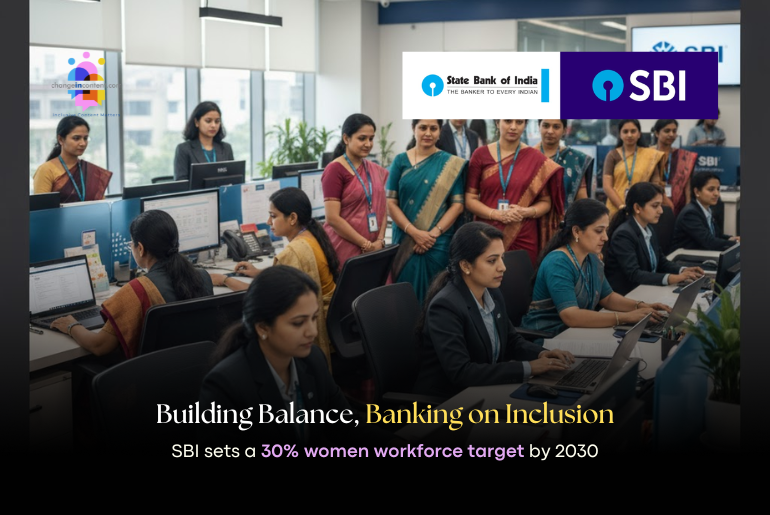
India’s largest lender, the State Bank of India (SBI), has announced a significant new milestone in its inclusion journey. It is an ambitious plan to raise the representation of women in its workforce to 30% by 2030. With this, gender diversity at SBI gets a new direction.
The initiative, revealed by Kishore Kumar Poludasu, Deputy Managing Director (HR) and Chief Development Officer (CDO) of SBI, during a PTI interview, marks a strategic and cultural shift for one of the country’s most influential employers. With a staff strength exceeding 2.4 lakh, SBI’s diversity move is expected to set a precedent across India’s financial sector and beyond.
A targeted roadmap for gender diversity at SBI
Currently, women comprise approximately 27% of SBI’s total workforce, while at the frontline level, the figure is already closer to 33%. The bank aims to bridge this gap by creating a structured framework to elevate women into mid- and senior-level positions. It aims to ensure that gender balance is maintained across all levels of hierarchy, rather than just at entry points.
Poludasu emphasised that this initiative aligns with SBI’s vision of creating a workplace where women can “thrive at all levels.” The strategy includes targeted hiring, leadership development, work-life balance initiatives, and healthcare programmes tailored to the needs of women professionals in banking.
‘Empower Her’: Grooming the next generation of women leaders.
A cornerstone of the bank’s gender inclusion plan is its “Empower Her” programme. It is an initiative designed to identify, mentor, and groom women for future leadership roles. Through leadership labs, peer networks, and professional coaching, the programme focuses on building a strong internal pipeline of female executives ready to take on strategic and decision-making positions.
This initiative is not just symbolic. It represents a data-driven recognition that diversity at the top leads to more agile, empathetic, and resilient organisations. It is particularly relevant in industries where women’s representation historically declines with hierarchy.
Creating a workplace where women can thrive
SBI’s efforts go well beyond recruitment numbers. The bank has introduced a suite of policies and programmes to ensure its women employees are supported through all stages of their careers and personal lives.
Some of the key initiatives include:
- Creche allowances for working mothers to support childcare expenses.
- Family Connect Programmes that foster better understanding and inclusion within families, easing the return-to-work transition.
- Special training modules for women returning from maternity leave, sabbaticals, or extended medical breaks.
- Focused health drives, including breast and cervical cancer screenings, nutrition allowances for pregnant employees, and a Cervical Cancer Vaccination Drive to promote preventive health awareness.
These measures reflect a more profound understanding that achieving gender equity in the workplace requires a comprehensive approach. This approach involves striking a balance between professional development and personal well-being.
Women-led branches: Inclusion on the ground
SBI’s inclusion story is visible not just in its boardrooms, but also at the grassroots level. The bank currently operates over 340 all-women branches across India, managed and staffed entirely by female employees. According to Poludasu, these branches will continue to expand in number and scale over the next few years.
Beyond symbolism, these branches demonstrate operational success. They are serving as hubs of community engagement, financial literacy, and empowerment for women customers. By positioning women employees in leadership roles at the branch level, SBI is also reshaping how financial institutions interact with local communities.
Digital and inclusive: Reimagining the future workforce
Inclusivity at SBI is also linked to the bank’s broader digital transformation. With a growing pool of women IT officers and digital specialists, the bank is reinforcing gender diversity in its technology divisions. These were traditionally seen as male-dominated spaces.
This integration of gender diversity into tech and innovation frameworks signals SBI’s intent to build an equitable, future-ready workforce. Poludasu highlighted that the bank’s evolving HR framework continues to blend technology, customer experience, and inclusion, ensuring that diversity is embedded in every layer of transformation.
Gender diversity at SBI: A model for the industry
With more than 2.4 lakh employees, SBI is not just a bank. We see it as an institution that reflects the country’s social and economic pulse. Its goal of achieving 30% gender diversity by 2030 might appear modest. However, for an organisation of its size, it represents a massive structural and cultural commitment.
As more companies in India’s banking and financial services sector move towards gender inclusivity, SBI’s data-backed approach could serve as a model for others. This model is linking measurable targets with actionable programmes that empower women beyond tokenism.
At a time when India’s female labour force participation remains below the global average, initiatives like this offer a pragmatic blueprint for improvement. It is about making inclusion measurable, making policies accessible, and making leadership visible.
Conclusion: Gender diversity at SBI and the change we need
SBI’s roadmap for gender diversity is not just about numbers, but about normalising women’s leadership in sectors long defined by imbalance. The bank’s policies recognise that gender equality must be intentional, institutional, and intersectional.
At Changeincontent.com, we see this as more than a corporate milestone. It is an invitation to reimagine what inclusion can look like in India’s workplaces. Because the real transformation begins when policies like these stop being exceptional and start becoming the norm.
Also Read: Maternity leave crisis in Indian banking: Policies vs. Reality.
Disclaimer: The views expressed in this article are based on the writer’s insights, supported by data and resources available both online and offline, as applicable. Changeincontent.com is committed to promoting inclusivity across all forms of content. We broadly define inclusivity as media, policies, law, and history. It encompasses all elements that influence the lives of women and marginalised individuals. Our goal is to promote understanding and advocate for comprehensive inclusivity.