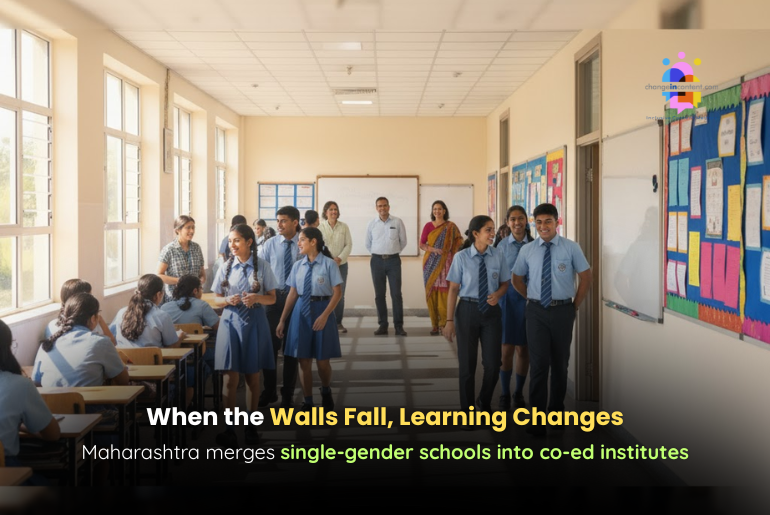
Maharashtra Ends Single-Gender Schools: That is the Headline and the Hinge.
In October 2025, the Government of Maharashtra quietly issued a notification that could change the social script of its classrooms. It announced the merger of all single-gender schools sharing the same premises (boys’ and girls’ schools) that, for decades, stood side by side, divided by walls but bound by identical timetables.
This is not only an administrative tidy-up. It follows a Bombay High Court directive and revises earlier state resolutions (2003, 2008). With the Commissioner (Education) empowered to implement mergers, the state signals that gender separation at school age belongs to a different era. It was an era that often kept girls in class, but also kept children from learning to work and live together.
At first glance, this might appear to be a simple administrative correction. But beneath the paperwork lies something more profound. It is a policy decision about social imagination. Maharashtra is posing a powerful question: If the world outside is diverse, why should the classroom remain divided?
Maharashtra ends single-gender schools: A decision rooted in law, and modern sense
In its official statement, the state’s School Education and Sports Department framed the change as one “in tune with the times.” It is designed to promote equality, mutual respect, and communication between genders from an early age.
Data from UDISE+ 2024–25 gives perspective: only about 1.54% of Maharashtra’s schools are girls-only, and 0.74% are boys-only. The rest are already co-educational. On paper, then, the reform impacts a small number. But socially, it dismantles an old boundary that shaped mindsets far beyond the schoolyard.
Co-education, the government argues, is not merely about efficiency. It is about creating shared spaces of growth, ensuring that boys and girls learn together, compete together, and coexist without fear or hierarchy.
What exactly has changed
This is the first state-level decision in India to clearly position gender inclusion as a structural aspect of education, not a moral afterthought. Here is what has changed:
- Schools for boys and girls that run within the same campus are to be merged into co-educational units.
- The order is issued in the name of the Governor and authorises the Commissioner (Education) to approve and operationalise transitions, including proposals from private institutions.
- The government’s stated intent: to prevent gender discrimination at school age, and to build balanced participation in academics, sports, leadership and everyday collaboration.
A long history of separation
To understand the significance of this move, we need to look back.
India’s schooling history was never gender-neutral. For centuries, women were excluded from formal education altogether. When reformers like Savitribai Phule opened the first girls’ school in Pune in 1848, it was an act of rebellion, not reform. Later, as more families began sending their daughters to study, girls-only schools became a bridge. It was a way to educate daughters without breaking social norms.
In the decades following Independence, when female literacy was still dismal and mobility was limited, single-gender schools provided a necessary safe space. They were often the compromise between aspiration and fear. They helped families say “yes” to education in an era when co-education would have meant saying “no.”
But as access widened and social attitudes shifted, what began as protection began to look like restriction. A new question emerged: when does separation stop helping and start hurting?
Why now: Law, policy, and the classroom reality
- The move complies with a Bombay High Court direction (Petition No. 3773/2000) that girls’ schools should not continue separately where co-education is feasible.
- It aligns with the spirit of the National Education Policy (NEP) 2020, which emphasises inclusive, equitable environments.
- It reflects a reality check: beyond school, life is a mixed bag (universities, offices, markets, hospitals, and public services). Classrooms that mirror that world help children practise respect, teamwork, and communication across gender lines.
Why Maharashtra’s move matters
The government’s decision signals that gender equality is no longer a side conversation in education. Instead, it is the foundation. By merging schools that share the same campus, Maharashtra is not just removing walls between classrooms; it is challenging the psychological wall that still separates boys from girls in many parts of India.
The argument is straightforward: children learn how to coexist with one another by being around each other. The lessons of equality cannot be confined to textbooks on “moral science”; they have to be practised in the corridors and playgrounds of everyday school life.
Co-education allows that. It gives children daily practice in collaboration, empathy, and respectful communication. These are skills that we cannot teach through exams.
The state’s decision, therefore, is both symbolic and systemic. Symbolic, because it closes a chapter on the legacy of gender-segregated learning. Systemic, because it reframes education as a rehearsal for real life, not an escape from it.
Why co-ed matters (When done well)
Maharashtra ends single-gender schools. But this decision is not just about headcounts; it is about skills:
- Communication and collaboration: daily, ordinary practice in listening to and working with the other gender.
- Stereotype softening: fewer echo chambers and less myth-making about “the other”.
- Leadership rehearsal: mixed teams in debates, labs, sports and student councils reflect future workplaces.
- Civic preparation: learning consent, boundaries, and respect in supervised environments rather than only outside school.
Global advocacy and comparative research have long cautioned that single-sex settings can become unnatural social bubbles if they are the norm, not the exception. Co-ed environments, when thoughtfully designed, can help mitigate the transition shock from segregated classrooms to mixed campuses and offices.
Legitimate concerns, and what comes next
Critics warn that we must handle the transition sensitively. Some conservative families, especially in rural and minority-dominated pockets, fear that co-education could discourage parents from sending daughters to school. Others worry about adolescent safety and discipline.
These concerns are not unfounded. However, they are not insurmountable either. What Maharashtra needs now is not just policy enforcement, but policy empathy.
A successful co-education model will require:
- Gender-sensitive teacher training to ensure that teachers can handle behavioural changes and conversations with maturity.
- Infrastructure upgrades, especially separate and hygienic toilets for girls.
- Clear anti-harassment mechanisms aligned with the POCSO Act.
- Parental engagement programmes, so that communities understand that mixed education does not mean compromised safety.
- Life skills and consent education should be introduced gradually and in an age-appropriate manner.
The state must treat this reform not as a merger of schools, but as a merger of mindsets. Change, after all, will be gradual. The classrooms can be combined in a week; cultures cannot.
A mirror to modern India
The world that awaits today’s students is no longer divided by gender. Offices, research labs, hospitals, newsrooms, and courts are co-ed by design. Mixed learning environments do more than just academically prepare students; they also socially prepare them for success.
When boys grow up learning alongside girls, they are less likely to view women as exceptions in the workplace later in life. When girls grow up debating, leading, and losing alongside boys, they carry fewer doubts about their right to a space and their voice.
That is why Maharashtra’s policy matters far beyond its 1.08 lakh schools. It represents a cultural rehearsal for gender equality. It is about an early education in coexistence, respect, and empathy.
Conclusion: Maharashtra ends single-gender schools and starts a conversation
Maharashtra Ends Single-Gender Schools; the headline itself feels like a social milestone. The state has not just changed school registration forms; it has rewritten a part of India’s educational philosophy.
For decades, the question was whether girls should be allowed to learn. Then came the question of how to keep them safe while learning. Now, Maharashtra is asking the next question: how do we teach equality itself?
At ChangeInContent, we see this not as a one-state reform, but as a test case for India’s readiness to educate without exclusion. The classrooms of tomorrow should not just produce toppers; they should produce citizens who understand that equality is not a chapter, but a practice.
Also Read: Inclusive Education Policy: Bridging the gap for a truly inclusive society.
Disclaimer: The views expressed in this article are based on the writer’s insights, supported by data and resources available both online and offline, as applicable. Changeincontent.com is committed to promoting inclusivity across all forms of content. We broadly define inclusivity as media, policies, law, and history. It encompasses all elements that influence the lives of women and marginalised individuals. Our goal is to promote understanding and advocate for comprehensive inclusivity.