
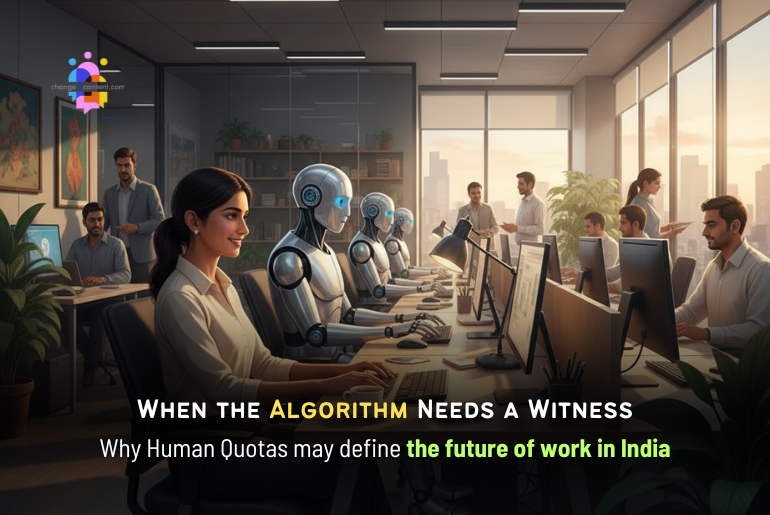
The need to discuss the relevance of human quotas in the AI age has never been as prevalent.
It begins with a quiet erasure.
An editor replaces a writer. A recruiter screens candidates with a prompt instead of a person. A designer uploads a brief into a generative model and calls it collaboration. We celebrate efficiency, but beneath the applause, something fundamental is slipping away. That is the right to remain relevant.
Across boardrooms and policy circles, the world is now debating an idea that once sounded absurd: Human Quotas. In essence, laws or guidelines that ensure a minimum level of human involvement in work that AI increasingly dominates.
It is a provocative thought that the same societies which once mandated women’s quotas in politics and diversity quotas in boardrooms may soon need to protect their own species in the workplace.
Why India cannot ignore the question
In India, the conversation around automation often swings between optimism and panic. We hear that AI will create more jobs than it destroys. It is a comforting but incomplete narrative. What it really does is shift power from labour to capital, from intuition to algorithm, from people who do to people who own.
With 65% of our population under 35, India has the world’s largest working-age demographic. But if machines begin absorbing middle-level knowledge work (analysts, designers, content specialists, support staff), what happens to this promise of demographic dividend?
A Human Quota may sound extreme, but it could soon be the only way to guarantee participation rather than spectatorship in the new economy. It is not about slowing technology. It is about ensuring technology remains answerable to people.
The ethical arithmetic of automation
At its core, AI performs pattern recognition. It learns from yesterday to predict tomorrow. But work (real human work) is not only about prediction; it is about judgment, empathy, and moral choice.
When algorithms decide loan approvals, medical diagnoses, or hiring selections, they bring mathematical precision but moral blindness. Who takes accountability when an AI-generated recruitment tool filters out women returning from maternity leave because its training data favoured uninterrupted male careers?
Keeping a human in the loop is no longer a technical safeguard; it is a democratic one. And that is where the idea of a Human Quota finds its legitimacy.
What a human quota could look like in India?
India has legislated quotas before for representation, equality, and access. Extending that logic to technology may not be as far-fetched as it sounds.
Imagine three layers of intervention:
Policy Quotas
Mandating a minimum percentage of human review or authorship in government contracts, research reports, or media outputs. If 60% of a public-funded report is machine-generated, who ensures accuracy?
Corporate Disclosure
Requiring organisations to declare the ratio of human-to-AI involvement in product design, recruitment, and content creation. Much like ESG reporting, this would become a Human Accountability Metric.
Creative Protection
In advertising, journalism, or art, a label indicating “Human-Crafted” could soon be the new mark of authenticity. We already have “organic” and “fair-trade”; why not “human-made”?
The idea is not to romanticise inefficiency but to preserve meaning. The quota does not limit technology; it limits dehumanisation.
The economic case for humanity
There is also a hard-nosed business rationale. Consumer trust is built on relatability, and relatability is built on human texture. It includes imperfections, humour, empathy, and contradiction.
Brands that replace all of this with algorithmic uniformity risk becoming sterile. The most successful Indian startups of the next decade will be those that use AI as muscle, not mind. These startups will amplify human intelligence rather than outsourcing it.
Therefore, a Human Quota doubles as an innovation strategy. It ensures that the intelligence shaping society still carries fingerprints, not just code.
The cultural dimension: Work without witness
Work has always been more than output; it is participation in a shared rhythm of life.
In Indian workplaces, that rhythm includes chai breaks, negotiation, mentorship, and the quiet dignity of teamwork. When AI performs those functions invisibly, something irreplaceable fades. That is the social glue that turns jobs into communities.
If we remove too many people from the process, we may build efficient systems but lonely societies. And loneliness is already the next global epidemic.
Towards a human framework for the AI age
The demand for human quotas is, in essence, a demand for transparency and traceability. It is a demand for knowing when we are dealing with thought and when with mimicry.
India’s lawmakers could take the lead by drafting a Human Oversight Charter within the forthcoming national AI policy. It would define:
- Sectors where full automation must remain prohibited (education, journalism, law, healthcare).
- Mandatory human review protocols for AI-driven decision systems.
- Public disclosure of AI-generated material in governance, finance, and media.
Such measures would not slow progress; they would civilise it.
Conclusion: Human quotas in the AI age
Do not confuse Human Quotas in the AI Age with a mere thought of protecting jobs. It is about protecting a purpose.
If the last century taught us to fight for representation by gender, caste, or class, this century may demand representation by existence itself. We must ensure that being human remains a professional qualification.
AI will keep evolving. It will outwrite, outcalculate, and outperform us in a thousand ways. But it cannot care, question, or carry accountability; and that, finally, is our quota to fill.
Also Read: Women in tech and AI: 58% are upskilling, but gatekeepers haven’t left the room.
Disclaimer: The views expressed in this article are based on the writer’s insights, supported by data and resources available both online and offline, as applicable. Changeincontent.com is committed to promoting inclusivity across all forms of content. We broadly define inclusivity as media, policies, law, and history. It encompasses all elements that influence the lives of women and marginalised individuals. Our goal is to promote understanding and advocate for comprehensive inclusivity.
