
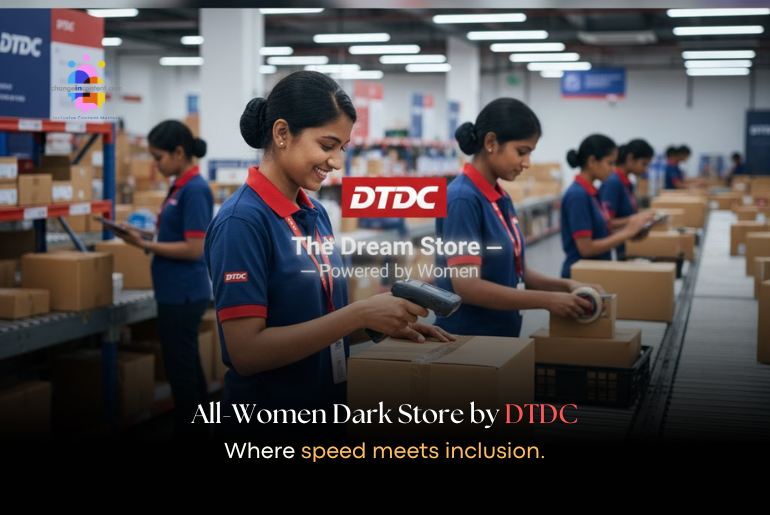
The logistics industry has always been considered a man’s world. It involves heavy lifting, long hours, and fieldwork. But DTDC Express Ltd. is rewriting that script. With an all-women dark store by DTDC in Indore, they are rewriting the rules of inclusion.
DTDC Express Ltd. has opened an all-women-operated dark store in Indore, Madhya Pradesh, as part of its rapid commerce service, DTDC Raftaar. The initiative focuses on improving operational speed and increasing women’s participation in logistics. This marks another milestone in a sector long dominated by men, showing that women can play an active, leading role at every stage of supply chain management.
Inside the Indore Dark Store
A dark store functions like a small warehouse designed specifically for online orders. Unlike a regular retail outlet, it is not open to walk-in customers. Instead, it serves as a micro-fulfilment centre, storing products, processing online requests, and dispatching deliveries to nearby locations.
DTDC already runs similar dark stores in Delhi, Bengaluru, Kolkata, Cochin, Bhopal, Kanpur, Nagpur, Udaipur, and Meerut, and the Indore outlet now joins this expanding network.
The Indore centre spans around 700 square feet and is entirely managed by women employees. Every task inside the facility, from sorting and packaging to delivery and customer handling, is carried out by women. They are also responsible for cash-on-delivery collections and client servicing.
The store fulfils orders within 2 to 6 hours, a timeline that matches the growing expectations of online shoppers in smaller cities. It acts as a pilot model for future rapid commerce facilities that DTDC plans to set up across Tier 2 and Tier 3 markets.
To prepare for this role, the team received extensive hands-on training. They learned to use DTDC’s digital tools, including its Warehouse Management System and Last-Mile Delivery App, as well as customer communication and safety procedures. This training ensures they can handle high-volume orders efficiently while maintaining quality and accuracy.
The ‘Dream Store’ vision
DTDC refers to its all-women-run dark stores as “Dream Stores.” The name reflects the company’s belief that speed and inclusion can go hand in hand.
According to Abhishek Chakraborty, CEO of DTDC Express Ltd., this initiative shows how empowering women strengthens both teams and performance.
“Women bring creativity, discipline, and commitment to logistics. The Dream Store represents what modern operations can look like — efficient, people-driven, and full of purpose,” he said.
He added that smaller cities are becoming the next big growth zones for e-commerce.
“Tier 2 and Tier 3 cities are where the future of delivery lies. Our Dream Stores will help brands reach customers faster without huge investments. With DTDC Raftaar, we offer dark store solutions that make quick delivery practical for mid-sized and direct-to-consumer brands,” he explained.
The gender gap in India’s logistics sector
The logistics sector plays a vital role in India’s economy. It is worth around USD 215 billion, contributes 13–14% to the national GDP, and continues to grow at about 10.5% every year.
Despite this growth, women remain vastly underrepresented. Across 18 NSE-listed logistics companies that share gender data, women make up only 7% of the total workforce. Jobs in logistics are increasing, but women’s participation has barely moved, rising by just one percentage point in three years.
Women in logistics still face several hurdles. Deep-rooted gender stereotypes and limited access to professional networks make it harder for them to enter or grow in the field. Many workplaces also lack safety measures and gender-sensitive facilities, discouraging women from staying long-term.
All-women dark store by DTDC: Inclusion that drives change
Ankita Tiwari, DTDC’s Chief Human Resources Officer, described the Indore store as both a business initiative and a social one.
“Every new Dream Store we open is also an opportunity centre. We want women not just to be part of logistics but to lead it. Inclusion and innovation must go together for any company to grow,” she said.
The Indore store demonstrates how companies can embed gender diversity into their operational model rather than treating it as a tokenistic effort. It also helps create a more equitable workplace by offering women training, leadership roles, and visibility in a field that rarely highlights their contributions.
The road so far, and the miles ahead
Earlier this year, DTDC launched another all-women-operated branch in Thane, Mumbai, which is its third such facility. Spanning about 7,500 square feet, that hub manages over 100 tons of parcels every month. The women-led team there handles around 30% of shipments weighing more than 3 kilograms, proving that women can manage even the more demanding parts of logistics operations.
Today, women make up around 41% of DTDC’s total workforce, reflecting the company’s long-term effort to make logistics a more inclusive industry.
Conclusion: Inclusion becomes the fastest route forward
The logistics industry, even today, remains mostly male-dominated at every level, from warehouse floors to boardrooms. However, there are now women stepping into those spaces, taking up roles across the top, middle, and ground tiers. Their presence may still be small in number, but its impact is far larger than it appears.
Logistics is one of the fastest-paced and most evolving sectors today, with ample room for growth and new opportunities. Still, it’s a field where many women hesitate to see themselves, and that’s precisely what needs to change. Each new opportunity given to women does more than change one workplace; it changes the expectations of the next generation watching from the sidelines.
Changeincontent perspective
At Changeincontent, we believe inclusion is meaningful only when it reshapes who gets to be seen, heard, and hired.
The all-women dark store by DTDC does precisely that. It challenges the old narrative that logistics is “too tough” for women, and instead shows that with the proper training, safety, and support, women can lead operations at every level.
From Abhishek Chakraborty’s vision of “Dream Stores” that blend efficiency with equality to Ankita Tiwari’s commitment to turning every new branch into an opportunity centre, this initiative reflects a more profound shift in how India’s logistics sector views talent.
When women run a warehouse, the outcome is not just faster delivery; it’s a quicker shift towards equality
Also Read: Coal India’s first all-women-operated central store unit.
Disclaimer: The views expressed in this article are based on the writer’s insights, supported by data and resources available both online and offline, as applicable. Changeincontent.com is committed to promoting inclusivity across all forms of content. We broadly define inclusivity as media, policies, law, and history. It encompasses all elements that influence the lives of women and marginalised individuals. Our goal is to promote understanding and advocate for comprehensive inclusivity.
