
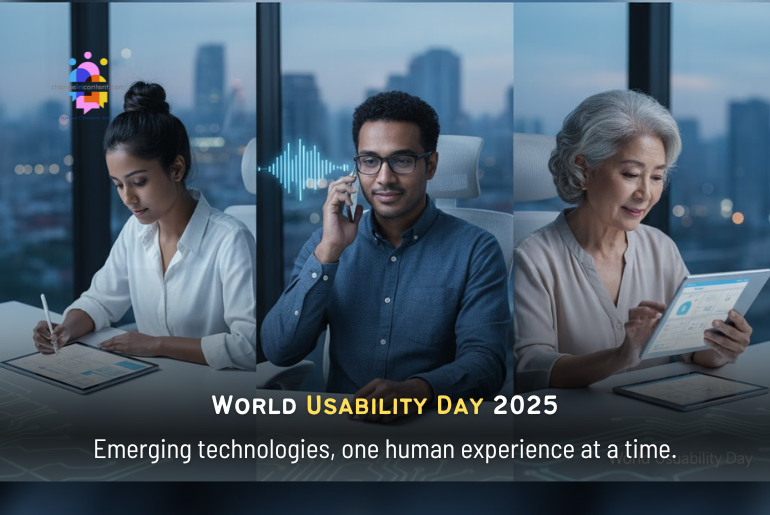
World Usability Day (WUD), also called Make Things Easier Day, is observed every year on the second Thursday of November. The date changes each year, but the purpose remains to make everyday experiences more straightforward, more accessible, and more useful for everyone.
World Usability Day promotes the values of usability, user-centred design, usability engineering, and universal accessibility. It encourages everyone to demand products, services, and systems that are inclusive to use and improve people’s lives.
At a time when technology shapes how we work, connect, and even think, this day is a global call to design with empathy, not just efficiency.
World Usability Day 2025: The introduction
Each year, WUD highlights a new global theme. In 2024, the theme was “Designing for a Better World.” For 2025, the theme is “Emerging Technologies and Human Experience.’ This year’s focus explores how new technologies can create more meaningful and inclusive experiences for people everywhere.
Since its launch, World Usability Day has become a global movement celebrated in more than 140 countries. It has reached over 250,000 participants through workshops, events, and community projects that emphasise the importance of inclusive and accessible design in improving daily life.
In 2025, World Usability Day falls on the 13th of November.
History of World Usability Day
World Usability Day (WUD) was first established in 2005 as a global initiative to promote the creation of technology that is simple, efficient, and accessible for all.
The idea was conceived in 2004 by Elizabeth Rosenzweig and Nigel Bevan, members of the Usability Professionals Association (now known as the User Experience Professionals Association, or UXPA). Their goal was to create a dedicated day to raise awareness about the importance of designing user-friendly products, services, and systems that truly serve people’s needs.
Since its launch, World Usability Day has been celebrated every year, introducing a unique theme that highlights different aspects of usability and user experience, from healthcare and education to sustainability and inclusion.
Accessibility vs. Usability
Accessibility is about creating spaces, products, and information that everyone can use with comfort and confidence. It means removing barriers that might stop someone from taking part, especially people with disabilities. Accessibility ensures that technology, buildings, and services are designed for everyone’s needs, not just for a small group of users.
Think of a public park that includes wide walkways, ramps, clear signboards, and benches with backrests. These features help people using wheelchairs, older adults, or parents with strollers. In the end, everyone benefits. This idea, often called the curb cut effect, shows that designs intended for inclusion usually make life easier for everyone. (Read more about it in our article on the curb cut effect.)
Usability focuses on how easy, efficient, and pleasant a product or system is to use. It looks at how quickly people can complete their tasks and how satisfied they feel while doing it. A usable design helps users move through a website or product without confusion or extra effort.
Accessibility and usability often work hand in hand. Accessibility focuses on inclusion, while usability focuses on creating a smooth and satisfying experience. Together, they lead to products and systems that feel intuitive and comfortable for all users. However, accessibility alone does not always guarantee usability.
World Usability Day 2025 Theme: Emerging technologies and the human experience
The theme for World Usability Day 2025 focuses on how new technologies are changing the way people live, work, and communicate. Tools such as artificial intelligence, virtual and augmented reality, and voice-based systems are becoming a part of everyday life. They affect how we get information, make choices, and connect with others.
As these technologies become more common, it is vital to keep people at the centre of their design. Every new tool should be safe to use, respect privacy, and build trust. The goal is to create technology that supports people instead of replacing them.
This theme also reminds designers and developers to think about real users. A human-centred approach means asking simple but important questions. Is the technology easy to understand? Does it protect user data? Can everyone access it equally?
When we build technology with care and responsibility, it becomes more useful and fair for all. The 2025 theme encourages everyone to create digital experiences that are innovative yet respectful of human needs and rights.
Digital age that includes everyone
Technology now influences almost every part of daily life. People use it to learn, work, shop, manage money, and stay in touch. When digital systems are easy to use, they make life simpler and open new opportunities. But when they are confusing or built for a limited group, they leave many people out of the digital world.
Around 2.6 billion people across the globe remain offline. Many of them live in low-income or rural areas where internet access is limited or too costly. Women in developing regions are also less likely than men to use mobile internet or digital tools due to safety, cost, and educational gaps.
Even among those who are online, not everyone can use digital platforms easily. Older adults often face barriers due to small text, complex interfaces, or unfamiliar layouts. People with disabilities make up about 16% of the world’s population, and many websites or apps still fail to meet basic accessibility standards.
Creating technology that is usable for everyone helps close these gaps. It means considering different needs, abilities, and backgrounds at every step of the design process. A truly usable product supports users with low digital literacy, offers clear language, works with assistive tools, and adapts to different devices or networks.
When technology learns to care, everyone wins
The theme Emerging Technologies and the Human Experience reminds us that technology should bring people together, not divide them. In celebration of this theme, ChangeinContent will launch a special series on how we can make technology more human-centred. The series will share ideas, stories, and actions that show how small steps can lead to meaningful change. Each piece will highlight what we can do, as individuals, teams, and communities, to build a digital world that works for everyone.
Usability is not only a design principle but also a commitment to equity and understanding. When products and systems are truly usable, they respect people’s time, abilities, and needs. That is the foundation of a digital future that serves everyone.
Changeincontent perspective
At Changeincontent, we see usability as more than a design discipline. It is a social responsibility.
The rise of emerging technologies has blurred the line between human experience and digital systems. But with great innovation comes an even greater question: who are we designing for, and who gets left out?
World Usability Day 2025 challenges that imbalance. It urges us to create technology that listens, adapts, and empowers. To build digital ecosystems that serve not just the connected, but the countless others still waiting to be seen.
Actual usability is not about making technology smarter. It is about making it kinder.
Disclaimer: The views expressed in this article are based on the writer’s insights, supported by data and resources available both online and offline, as applicable. Changeincontent.com is committed to promoting inclusivity across all forms of content. We broadly define inclusivity as media, policies, law, and history. It encompasses all elements that influence the lives of women and marginalised individuals. Our goal is to promote understanding and advocate for comprehensive inclusivity.
