
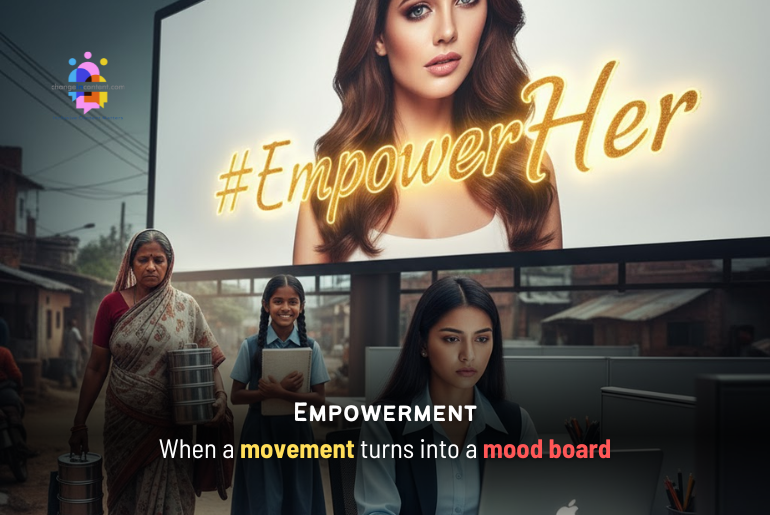
Empowerment. It is everywhere: in ad taglines, government slogans, and social-media bios. But as Neurotic Nayika asks, do we even remember what it means anymore?
When brands borrow the language of empowerment to sell lipsticks, credit cards, or “self-care,” the word loses its weight. True empowerment cannot be airbrushed or hashtagged; it must include the women left out of the frame. These women include the domestic worker, the single mother, the rural teacher, the factory worker, and the girl still fighting for her first textbook.
The definition
Empowerment, as Merriam-Webster puts it, means giving someone the power or authority to act and make decisions. The United Nations Economic and Social Commission for Western Asia explains women’s empowerment as a process by which women become aware of gender-based unequal power relationships and acquire a greater voice in which to speak out against the inequality found in the home, workplace, and community.
There are countless official definitions, but the truth is, empowerment feels different for each woman.
What feels freeing or powerful to one woman might not mean the same to another. For some, it’s financial independence. For others, it’s the freedom to choose a certain career, lifestyle, or even silence.
The problem is, society still talks about women’s empowerment as if it were a single formula. It is like a checklist to complete. It rarely considers the different realities women live through, the cultural layers, or the personal battles that decide what empowerment truly means to them.
How brands sold us “Empowerment”
It’s funny how one of the most ironic days for women’s empowerment is Women’s Day itself. Every year, we’re flooded with brand campaigns preaching empowerment, often from the same companies that profit from women’s insecurities the rest of the year.
A beauty brand that spends months telling women to hide their acne or fix their bodies suddenly turns poetic about confidence and bold lipsticks. Another might roll out an emotional ad featuring a housewife who gifts her maid a makeup palette, wrapped with a message about “lifting each other.”
Women’s empowerment has slowly turned into a marketing aesthetic. Of course, brands exist to sell, but for years, they’ve been selling products built on women’s insecurities and struggles. Somewhere along the way, empowerment became a lifestyle trend with a specific look. There is always that one type of woman at the centre of it all. The solo traveller finding herself on a mountain, or the wellness girl sipping matcha and eating organic salads to heal.
Yes, that can be empowering for some women, and that’s perfectly valid. But it isn’t everyone’s reality. When brands keep showing the same kind of woman under the label of empowerment, it starts to feel out of touch with how most women actually live.
Real empowerment includes every woman, not just a few
Empowerment can not be empowering if it only represents a small group of women. Too often, the idea of women’s empowerment centres on those who already have a certain level of privilege, women who are financially secure, educated, urban, and visible. However, the truth is, not every woman starts from the same place.
Empowerment also needs to include the women who are too often left out of the picture, such as women of colour, working-class women, single mothers, queer and disabled women, who all face different realities. The image of empowerment that brands sell us is either picture-perfect success or stories so tragic that they exist only to inspire pity and sell emotion.
When empowerment only speaks to a small, privileged group, it loses its purpose. True empowerment must create space for all women’s stories, not just the ones that look good in campaigns or fit into marketable categories. If we leave out these voices, we only repeat the same unfairness we’re trying to change.
So, what is empowerment?
What really is empowerment? The truth is, there is no single definition. It means different things to different women, depending on where they come from, what they face, and what they hope for. For some, empowerment is about fair pay and financial freedom.
Equal Pay
Across the world, women still earn around 20% less than men. In many places, they work longer hours, take on unpaid household work, and still get less recognition. For these women, empowerment means getting paid equally, being promoted for their skills, and having a voice in decisions that affect their jobs.
Right to Education
For others, empowerment starts with the right to education. Around 496 million adult women worldwide still cannot read or write. That is two-thirds of the world’s illiterate population. For them, empowerment is the chance to go to school, to hold a pen, to sign their own name, and to see education as a door, not a wall. A young girl in a rural classroom, a woman learning to read at 60, or a teacher creating space for girls who were once told to stay home. All of them are powerful acts of empowerment.
Financial Freedom
Financial independence is empowerment. In India, women own only around 39% of all bank accounts and contribute to 40% of total deposits. But millions of women still lack access to banking or financial literacy. For them, empowerment means being able to save money, open an account without a male relative’s or husband’s permission, or make choices about how to spend their earnings.
And a Lot More
For women in informal or low-paying jobs, empowerment looks different again. A domestic worker receiving fair wages and protection from exploitation, a garment factory worker getting safe working conditions, or a caregiver receiving paid leave. All of these are forms of empowerment that rarely get addressed.
For women in rural areas, it might mean access to clean water, better sanitation, or public transport that allows them to travel safely to work. For those in cities, it could mean feeling safe walking home at night or having laws that hold harassers accountable.
All of these examples show that empowerment isn’t a single idea or a single campaign. The glossy version of empowerment we see on screen or in campaigns often touches only the surface. Empowerment should never be SEO-curated, polished, or selective.
The final thoughts
Real empowerment is about fixing the systems that decide which women get to move ahead and which are left behind. That means having fair rules at work, paid family leave for both parents, and childcare that normal people can actually afford. It also means knowing that women should not have to quit their jobs to care for children or elderly parents. Pay should be open and fair, and no woman should earn less just because of her gender.
Empowerment also means access to basic things like safe transport, clean public spaces, and healthcare without judgment. When these systems work, women can make choices more freely, rather than always balancing what they want with what they can manage. Maybe empowerment isn’t about making women stronger. They already are. It’s about making things fair.
Changeincontent perspective
At Changeincontent, we believe empowerment isn’t a performance. It is not a “women’s month” campaign, a viral reel, or a curated idea of freedom.
Empowerment is uncomfortable as it questions privilege, rewrites systems, and redistributes space. It means access, opportunity, and fairness for every woman, not just those who fit a marketable mould.
When empowerment becomes an aesthetic, it ceases to be a revolution. Real empowerment does not need filters; it needs fairness.
Also Read: Women’s empowerment: The pillar of an inclusive society.
Disclaimer: The views expressed in this article are based on the writer’s insights, supported by data and resources available both online and offline, as applicable. Changeincontent.com is committed to promoting inclusivity across all forms of content. We broadly define inclusivity as media, policies, law, and history. It encompasses all elements that influence the lives of women and marginalised individuals. Our goal is to promote understanding and advocate for comprehensive inclusivity.
