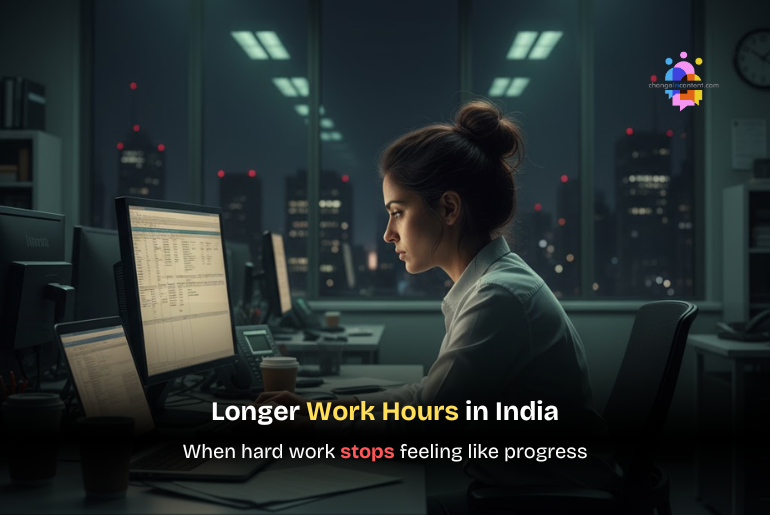
Across India, the definition of a “normal” workday is shifting. From Gujarat to Maharashtra, states are extending daily work limits to 10 or even 12 hours. They are framing it as an efficiency reform. However, in a country already ranking among the world’s most overworked, longer work hours in India may not lead to progress. They would only lead to fatigue.
While Kerala moves forward with a “Right to Disconnect Bill,” much of India is moving in the opposite direction. This widening divide raises an urgent question: are longer work hours quietly becoming the new normal?
Indian states are moving toward longer work hours.
When we think of regular office hours, most of us imagine a 9-to-5 schedule, 9-to-6, or at most a 10-to-6 day. That’s about eight to nine hours of work daily. But soon, even that could change. Despite employees already struggling with long workweeks and limited personal time, several Indian states are considering extending working hours even further.
On July 1, 2025, the Gujarat government introduced the Factories (Gujarat Amendment) Ordinance, 2025. The amendment is bringing significant changes to existing labour laws. The new rules allow factories to increase daily working hours from 9 to 12, though the total weekly limit of 48 hours remains the same. The continuous work period has also gone up, from five to six hours.
In June 2025, the Karnataka government announced plans to raise daily work hours from nine to ten, and to permit additional overtime. It will involve amendments to the Karnataka Shops and Commercial Establishments Act, 1961. Meanwhile, Andhra Pradesh and Telangana have already taken similar steps, extending workdays from eight to ten hours.
Following that, in September 2025, the Maharashtra cabinet also approved changes that would increase the maximum daily working hours for private-sector employees from 9 to 10 hours. Haryana, Himachal Pradesh, Uttarakhand, Rajasthan, Tripura, and Odisha have either introduced legislation or passed ordinances for increasing the working hours to 10-12 hours a day.
How other countries are rewriting work-life balance
India already has one of the longest average work hours in the world and some of the poorest work-life balance indicators. Despite this, many Indian states are planning to extend daily work hours. However, the rest of the world is moving in the opposite direction. They are moving toward shorter weeks, fewer hours, and more personal time. Across the globe, many countries are experimenting with reduced work hours and even four-day workweeks.
In Iceland, between 2020 and 2022, around 51% of workers took up the option of shorter working hours, including a four-day work week. Today, nearly 90% of Iceland’s workforce either works fewer hours or has the right to do so. For most Icelanders, a 36-hour workweek has led to less stress, higher job satisfaction, and more time to live life beyond work.
In Belgium, a 2022 law allows employees to choose a four-day workweek. The total working hours remain the same, but the idea is to give people flexibility and to fit their work around their lives, not the other way around.
Meanwhile, Finland’s new Prime Minister, Sanna Marin, has proposed a flexible model in which employees can work four days a week for six hours a day. It underscores the country’s seriousness about rethinking traditional schedules. In the Netherlands, workers already average just 32.1 hours per week, one of the lowest in the developed world.
The hidden cost for working women
Longer work hours in India don’t just affect work-life balance. They make existing inequalities worse, especially for women.
For many women, the workday doesn’t end when they leave the office. It simply shifts from paid work to unpaid household duties, such as cooking, cleaning, caring for children, or looking after family members. These tasks take time and energy, and longer office hours only make it harder to manage both. Because of this, many women find it difficult to continue working full-time after marriage or motherhood.
India’s female Labour Force Participation Rate (LFPR) was 41.7% in 2023–24, which remains low compared to global levels. If working hours keep increasing, fewer women may be able to remain in jobs, and the progress made so far could slow.
Longer shifts also raise concerns about travel and safety. Late working hours or night shifts are often unsafe or inconvenient, especially where public transport is limited. It means many women end up taking lower-paying or part-time jobs just to balance their responsibilities at home.
In the end, extending work hours may look like a way to raise productivity. However, it can actually push more women out of the workforce and force them into traditional gender based roles. When men spend ten or twelve hours a day at work, it automatically limits how much time they can share household responsibilities or childcare. The unspoken assumption becomes that a man’s main job is to earn, while a woman’s job is to manage the home. Over time, this normalises the very gender divide India has been trying to move past.
Longer work hours in India don’t mean better work
Supporters of longer work hours often argue that it will make India more productive and profitable. But in reality, it can easily become exploitative in the long run. Life cannot revolve solely around work, and stretching office hours to 10 or 12 hours a day leaves little space for anything else.
The constant pressure blurs the line between work and personal life. That leads to exhaustion and emotional fatigue. It is not surprising that 62% of Indian employees report feeling burnt out. That is three times the global average of 20%. The main reasons are long hours, high stress, and almost no personal time.
While longer workdays may seem like a sign of dedication, they often reduce productivity over time. Overworked employees are more likely to make mistakes, fall sick, or lose motivation. In the end, both workers and companies lose.
If India truly wants a stronger, more productive workforce, the focus shouldn’t be on working longer, but on working better.
Longer work hours in India: When productivity costs too much
Imagine spending 10 to 12 hours at work every day. By the time you return home, half the day is gone. Add household responsibilities, commuting, and the constant, quick calls or late-night emails that spill over into personal time. It leaves little room for rest or recovery.
As other countries prove, shorter working hours don’t reduce productivity. Workers perform better when they are rested, motivated, and have time for life beyond their job. The real progress lies not in how long we work, but in how well we work and how much time we leave for everything else that makes life meaningful.
Changeincontent perspective
At Changeincontent, we are not against reform or progress. But we do believe every reform must respect human limits.
India’s debate over longer work hours is not just about productivity; it is about people. It is about the parent who misses bedtime, the woman who cannot continue working full-time after motherhood, and the employee whose weekends quietly slip into burnout.
The question is simple: if work-life balance is a human right in other parts of the world, why is it treated as a luxury in India?
Progress is not about working longer; it is about working wiser. It is about working with rest, equality, and dignity intact. Because if productivity comes at the cost of people, it is not progress. It is pressure disguised as performance.
Also Read: Why DEI should continue in 2025: A call for inclusive and fair workplaces.
Disclaimer: The views expressed in this article are based on the writer’s insights, supported by data and resources available both online and offline, as applicable. Changeincontent.com is committed to promoting inclusivity across all forms of content. We broadly define inclusivity as media, policies, law, and history. It encompasses all elements that influence the lives of women and marginalised individuals. Our goal is to promote understanding and advocate for comprehensive inclusivity.