
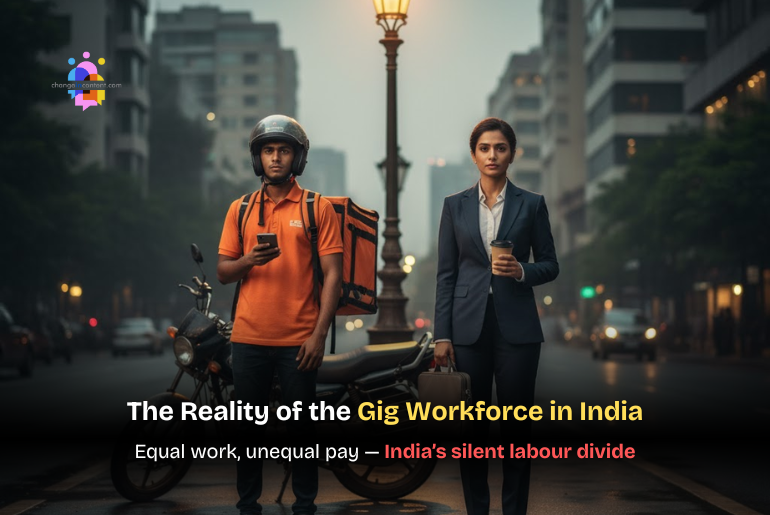
When the Union Budget 2025 expanded Ayushman Bharat coverage to include gig workers, it seemed like a turning point. Finally, the 7.7 million-strong gig workforce in India (the riders, drivers, delivery partners, tutors, and creators powering our convenience economy) would receive long-overdue recognition.
But as reports show, insurance is only one part of the equation. Fair pay is the missing piece.
Despite doing equal work, gig workers in India still earn less than their full-time counterparts. Behind every festive-season surge and every 10-minute delivery is a workforce working under unequal contracts, unstable income, and invisible labour rights.
The gig workforce in India, and the challenge
The Union Budget 2025 announced that gig workers would now be covered under the Ayushman Bharat Pradhan Mantri Jan Arogya Yojana (AB-PMJAY). It is the world’s largest health insurance scheme, marking a big step toward improving their much-needed health security. Yet, even as health coverage expands, one core problem remains unresolved: income instability.
Many gig workers still struggle to earn a minimum or fair wage. In 2024, the Fairwork India Report revealed that only two gig platforms ensure their workers earn at least the local minimum wage after accounting for costs such as fuel and vehicle maintenance. A more recent 20205 report by Genius HRTech shows that wage gaps persist across gig platforms, highlighting how far the sector has to go before ensuring equal pay for all gig workers.
47% gig workers still earn less than permanent employees
A new report by Genius HRTech (formerly Genius Consultants), a workforce staffing and HR solutions provider, highlights the growing concern over wage parity in India’s gig economy. The findings are from a Digipoll survey of 1,550 professionals across various industries conducted between September 1 and 30, 2025.
More and more companies now depend on gig workers, whether they are people who take on short-term projects or are paid per task rather than holding full-time jobs. This flexible model helps companies cut costs and adjust quickly to demand. But even as gig work becomes more common, the issue of fair pay still hasn’t been solved.
Even though companies hired more people for the festive season, gig workers still face a pay gap compared to permanent staff. Nearly 47% of respondents said gig workers earn less than their full-time counterparts. When asked to compare hourly wages for the same role, 11% of participants said gig workers make up to 10% less, 23% estimated a 10–25% lower salary, and 13% reported that the gap goes beyond 25%.
Employees support equal pay for equal work. But employers don’t
The report shows increasing agreement on the need for fair pay in the gig economy. A majority, 73%, of professionals believe that festive-season gig workers should earn the same hourly pay as permanent employees when performing the same tasks. It shows that many people in India’s workforce support the idea of “equal pay for equal work,” regardless of whether someone is on a company’s payroll or hired temporarily.
But when the question shifts to employers, the sentiment changes. Many companies continue to justify the pay gap between gig and full-time workers, mainly because of the flexible nature of gig work.
According to the report, 56% of employers said they pay gig workers less because these workers don’t receive long-term benefits such as health insurance, provident fund, or paid leave. For them, gig contracts are short and don’t need continuous financial obligations. Another 24% of employers argued that, since gig roles last only a short time, the pay doesn’t need to match that of a permanent job. Meanwhile, 10% of employers believe gig workers are often less trained or less skilled, which, according to them, justifies the lower pay.
Only 3% of employers said there is no pay difference between gig and permanent staff. That small number highlights how rare real pay equality still is, even when gig workers handle the same workload or responsibilities.
Should the gig workforce in India be guaranteed a minimum wage?
According to a NITI Aayog report, India had about 7.7 million gig workers in 2020–21, and this number is expected to jump to 23.5 million by 2029–30. By then, gig workers could make up around 4.1% of India’s total workforce, roughly 23.5 crore people.
But despite this massive rise, most gig workers still don’t have the right to a minimum wage. They are legally classified as “independent contractors,” not regular employees. It means they miss out on basic protections such as minimum pay, paid leave, and job security.
Without a guaranteed minimum wage, gig workers face constant financial uncertainty. Many depend on these jobs as their primary source of income, yet their earnings often fluctuate with demand, platform algorithms, and working hours. If they fall sick or take a day off, they lose an entire day’s income, since most gig platforms have no concept of paid leave or sick days.
Introducing a minimum wage for gig workers could change that. It would provide a safety net, protect them from underpayment, and help narrow India’s growing income gap. As gig work becomes a larger part of India’s job market, ensuring fair pay is essential to help workers build stable, secure livelihoods.
Non-monetary benefits gig workers value most
Among non-monetary benefits, gig workers value opportunities and support that improve their work-life. According to the Genius HRTech survey, 43% of respondents said that skill development programs would most improve their job satisfaction. Many gig workers see these programs as a way to build experience and move into better-paying or stable roles in the future.
After that, 31% said they would prefer flexible shifts, which would help them manage multiple jobs or personal responsibilities more easily. Another 13% felt that basic facilities such as transport and meals would make a big difference to their day-to-day comfort and safety, especially for those who travel long distances or work late hours.
Interestingly, 9% of respondents said they wanted career transition opportunities, a path that helps gig workers move into permanent, full-time roles. This shows that while gig work offers flexibility, many still seek stability and long-term growth.
“Fair compensation, skill-building, and transparency are key to creating a future-ready, motivated gig workforce that can truly power India’s seasonal demand,” Genius HRTech Chairman and Managing Director R P Yadav added.
Gig workforce in India: Flexibility without fairness is no progress
While most workers now view gig work as a regular part of the modern workforce, companies still treat it as a low-cost option. Unless pay parity becomes part of mainstream policy or workplace culture, gig workers may continue to face financial insecurity despite contributing equally during the busiest seasons. Fair pay is essential, but it’s not enough. Companies also need to invest in skills, security, and well-being if they want a satisfied and motivated gig workforce.
Changeincontent perspective
At Changeincontent, we believe India’s gig economy is a mirror reflecting how we value labour itself. We do not see it as a mere workforce.
We often praise the flexibility and opportunity gig work provides. But flexibility means little when it comes with insecurity. For many gig workers, the freedom to choose when to work is overshadowed by the anxiety of never earning enough when they do.
Nearly half of all gig workers earn less than their full-time peers, even while performing the same roles. And when employers justify lower pay by saying gig workers “don’t need benefits,” what they really mean is — we save money because we don’t have to care for them.
The gig economy is no longer the future of work. Instead, it is the present reality for millions. But if this reality continues to run on unequal pay, missing benefits, and short-term thinking, India’s workforce will remain modern in tools, yet medieval in fairness.
Also Read: Why DEI should continue in 2025: A call for inclusive and fair workplaces.
Disclaimer: The views expressed in this article are based on the writer’s insights, supported by data and resources available both online and offline, as applicable. Changeincontent.com is committed to promoting inclusivity across all forms of content. We broadly define inclusivity as media, policies, law, and history. It encompasses all elements that influence the lives of women and marginalised individuals. Our goal is to promote understanding and advocate for comprehensive inclusivity.
