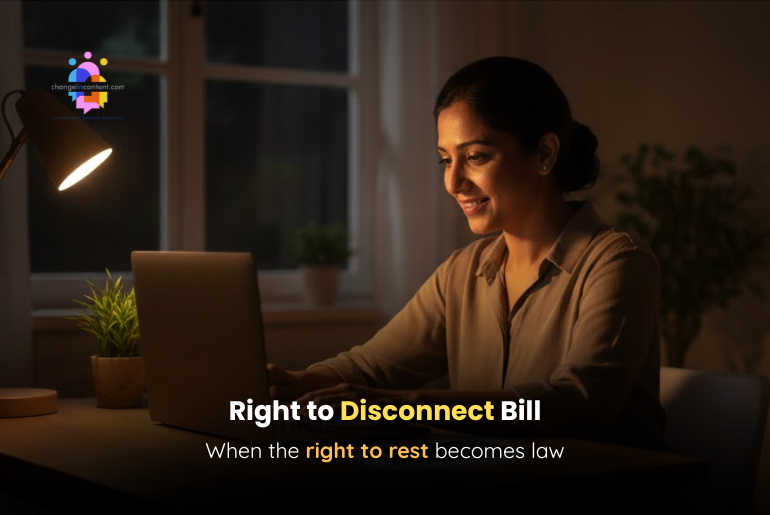
In a world where “quick calls” turn into unpaid overtime and after-hours emails have become the new normal, Kerala’s Right to Disconnect Bill, 2025, feels revolutionary.
Work-life balance and employee well-being have faced many setbacks lately, but encouraging policies are in the works. In October 2025, Kerala introduced a Right to Disconnect Bill, a small but meaningful step toward healthy work boundaries. This bill gives employees the legal right to switch off from work-related communication after office hours.
Unlike most government initiatives that apply mainly to public sector workers, this bill gives private sector employees the right to disconnect, allowing them to refuse any after-dinner Zoom calls, late-night emails, or “just a quick chat” messages. The bill follows the principles of Article 24 of the Universal Declaration of Human Rights, which recognises the right to rest and leisure, including reasonable limits on working hours and paid holidays.
‘Right to Disconnect’ Bill puts boundaries back in private sector work culture
Work-life boundaries have blurred so much that logging off on time feels like a luxury. Employees, especially in the private sector, are expected to stay connected well beyond their official work hours, often leading to burnout and declining mental well-being. Recognising this growing issue, Kerala has proposed a progressive step forward through the Right to Disconnect Bill, 2025.
The current state
The bill, introduced by Kanjirappally MLA Dr N. Jayaraj as a Private Member’s Bill on September 23, 2025, seeks to regulate after-hours work communication. It grants private sector employees the right to disconnect from non-emergency emails, phone calls, and online meetings outside designated working hours. The proposal was formally introduced in the Kerala Legislative Assembly on October 3, 2025, for legislative consideration.
At present, the bill remains under examination in the Assembly and is subject to committee review, amendments, and voting. It has drawn strong support from labour organisations that view it as a long-overdue reform, while employers have expressed mixed reactions, citing operational and coordination concerns. Despite differing opinions, the proposal highlights a growing awareness that unregulated connectivity directly affects employee health and productivity.
If enacted, the bill could take effect in 2026 through specific rules notified by the Labour Department. Beyond its immediate impact in Kerala, this initiative has the potential to set an important precedent for other Indian states.
Core provisions of the Kerala Right to Disconnect Bill, 2025
The Kerala Right to Disconnect Bill, 2025, introduces legal safeguards for private sector workers, ensuring that work-life boundaries are respected and mental well-being is prioritised. Here are the key provisions:
Recognition of the right to disconnect
The bill formally defines the Right to Disconnect as an employee’s ability to refuse work-related communications outside designated working hours. This includes phone calls, emails, messages, or connecting through any digital platforms, unless there is an explicit agreement between the employer and employee. The bill acknowledges that employees should not be expected to remain available around the clock.
Prohibition of punitive measures
In general, most employees often end up working late in the evenings or on Sundays because they fear being demoted, passed over for promotions, or penalised in some way. The Right to Disconnect Bill strictly forbids employers from taking any disciplinary or punitive action against employees who exercise this right. This means no demotions, dismissals, benefit cuts, or denial of training opportunities should occur simply because an employee does not respond to work communications after hours.
Grievance redressal mechanism
To enforce compliance, the bill mandates the creation of Private Sector Workplace Grievance Redressal Committees (PSCWGRC) at the district level. With the regional joint labour commissioner as its chairman, the district labour officer as secretary, and the deputy labour commissioner as a member, these committees will investigate complaints, monitor compliance with working-hour regulations, and issue directives to maintain work-life balance.
Employers must draft clear internal policies in consultation with employees, explicitly define working hours, and outline exceptions for emergencies. The bill also requires annual reporting on after-hours communication and employee well-being metrics, promoting accountability and transparency.
Powers of enforcement
The Labour Commissioner has the authority to conduct inquiries in cases of non-compliance and recommend disciplinary action against private establishments that violate the law. This ensures that the bill is not just a guideline but a legally enforceable instrument with administrative oversight.
Why India needs a Right to Disconnect Bill
Many employees are expected to remain available beyond office hours, responding to emails, calls, and messages late into the evening or even on weekends. This constant connectivity often leads to stress, burnout, and declining mental and physical well-being. India even ranks among the world’s most overworked countries, as the average Indian worker spends 46.7 hours per week on the job.
According to the Organisation for Economic Co-operation and Development (OECD), Indian workers typically put in 48–52 hours per week, well above the international standard of 40 hours. This is also significantly higher than the global average of 34–36 hours per week.
Extended working hours contribute to widespread stress and burnout. Nearly 40% of employees in India report frequent experiences of burnout. Among private sector workers, around 43% show signs of anxiety, depression, or other mental health challenges, highlighting the urgent need for policies that protect employees’ well-being.
With extended hours becoming the norm rather than the exception, stress, burnout, and mental health challenges are increasingly common, especially in the private sector. Addressing these issues is essential not only for individual well-being but also for creating a more productive and sustainable workforce.
Read our take on the Right to Disconnect Policy and why it matters for inclusivity and employee well-being here.
Right to Disconnect Bill: Redrawing the line
By giving employees the legal right to disconnect and protecting them from disciplinary action, the bill not only safeguards mental and physical well-being but also sets a clear standard for workplace culture.
While the Kerala Right to Disconnect Bill is still under review, other states in India should take note. They must also consider similar measures to create healthier, more inclusive workplaces. If these policies reach all levels of work in India, they could support employees’ well-being. Moreover, they can improve job satisfaction and even increase women’s workforce participation.
Changeincontent perspective
At Changeincontent, we see Kerala’s Right to Disconnect Bill as a cultural shift in the making.
India’s work culture normalises exhaustion. It celebrates “grind” and glorifies burnout as a form of loyalty. But when being available 24×7 becomes a measure of dedication, rest turns into rebellion.
This bill challenges that mindset. By protecting workers from punitive action for switching off, it reframes productivity through the lens of mental health, respect, and time autonomy.
But the deeper question is: will corporate India listen?
For this policy to mean something beyond Kerala, India’s private sector must see boundaries not as resistance. Instead, they must see it as respect — respect for health, for time, and for life beyond the laptop.
Because the truth is simple: no economy thrives when its people are exhausted.
Disclaimer: The views expressed in this article are based on the writer’s insights, supported by data and resources available both online and offline, as applicable. Changeincontent.com is committed to promoting inclusivity across all forms of content. We broadly define inclusivity as media, policies, law, and history. It encompasses all elements that influence the lives of women and marginalised individuals. Our goal is to promote understanding and advocate for comprehensive inclusivity.