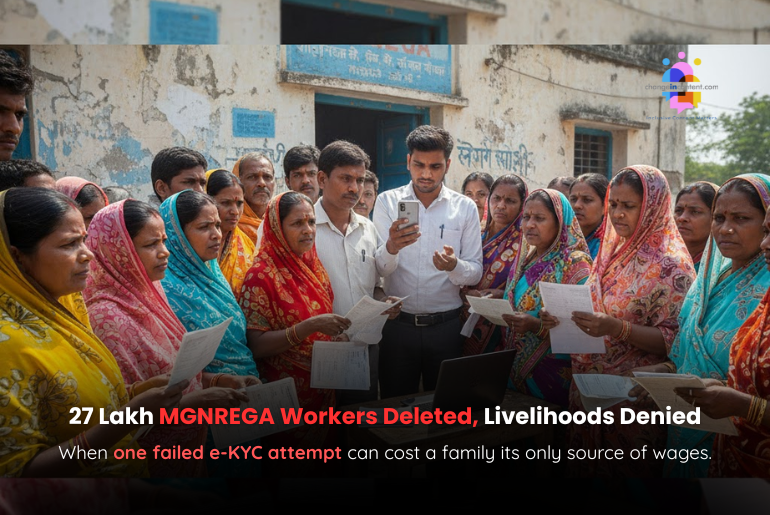
The news about ’27 Lakh MGNREGA Workers Deleted’ should worry all of us. In just a few weeks, lakhs of rural workers (many of them women and older labourers) were pushed out of India’s largest employment guarantee scheme. That is not because the work disappeared, but because the system decided they no longer “qualified” on digital terms.
27 Lakh MGNREGA workers deleted: A case of digital exclusion
In one of our previous features, we examined how e-KYC and the digital divide blocked women from accessing the Mukhyamantri Majhi Ladki Bahin Yojana, which offers ₹1,500 a month through direct benefit transfer. Out of 100 women trying to complete e-KYC, barely 5 to 10 succeed. In villages like the Bhamane group gram panchayat and Kharde Khurd, nearly 500 women depend on a single point of internet access. Their chances of clearing the process stay below 5%.
That story did not end there. When the government made e-KYC compulsory for all active workers under the Mahatma Gandhi National Rural Employment Guarantee Scheme (MGNREGA), about 27 lakh workers were removed from the database simply because they could not clear a digital hurdle in time. The policy was meant to clean up records. Instead, it deleted people.
MGNREGA workers deleted: A sudden drop after e-KYC rollout
From October 10 to November 14, officials removed almost 27 lakh worker names from the MGNREGA database (The Hindu). At the same time, they added only 10.5 lakh new names. The mass deletions came soon after the start of the electronic Know Your Customer process. The government introduced e-KYC to verify who still qualified for the scheme. Still, many people could not complete the process due to weak networks, slow websites, and limited digital access.
Over six months, the system removed around 15 lakh names. Then, in just one month, that number reached 27 lakh. This also affected the overall numbers for the financial year. In the first half of 2025–26, officials added 98.8 lakh workers and removed 15.2 lakh workers, which gave a net gain of 83.6 lakh. By mid-November, the net gain came down to 66.5 lakh. So nearly 17 lakh workers lost their eligibility in only a few weeks.
A large part of this group included active workers. They had worked at least once in the last three years and depended on MGNREGA for regular income. Their removal shows how poor digital access can block people who rely the most on government incentives.
When we look at data from state to state:
- Andhra Pradesh: 15.92 lakh deletions with a 78.4% e-KYC completion rate.
- Tamil Nadu: 30,529 deletions with a 67.6% e-KYC completion rate.
- Chhattisgarh: 1.04 lakh deletions with a 66.6% e-KYC completion rate.
Why e-KYC is pushing many MGNREGA workers out
The e-KYC step now plays a central role in MGNREGA, placing a heavy burden on both workers and supervisors. Supervisors must take a fresh photograph of each worker and upload it to the National Mobile Monitoring System. The app checks the photo with the worker’s Aadhaar details. It sounds simple, but in many villages, the internet is slow, the app glitches often, and workers wait for long hours for a single photo upload. Many women and older workers travel far to reach the worksite, yet there is no guarantee they will complete the process.
The government introduced e-KYC following allegations of misuse of the NMMS platform by supervisors. Some uploaded unrelated photos, while others entered the wrong details. Instead of fixing these gaps with better training and stronger checks, the system pushed the burden onto the scheme beneficiaries. Now every mismatch, blurry photo, or slow upload leaves workers without wages. Many of them depend on MGNREGA for their daily income, so even a single failed attempt creates stress and uncertainty.
From 2023, every worker must use the Aadhaar-based Payment System. But what happens when their Aadhaar number does not link properly with the bank or with the MGNREGA records? Poor connectivity, spelling errors, and name mismatches quickly turn into payment failures.
Digital checks without digital access: Who loses out?
The Ministry says e-KYC protects the system from ghost workers and keeps the scheme transparent. Digital systems offer many benefits and already influence most government procedures. The question now is not whether we should use technology. The real question is: why are we not looking at how these systems affect workers before we roll them out everywhere? When lakhs of people lose access in one month, we need to pause and understand what the technology is doing on the ground.
The most affected workers include women, older people, and those living in areas with patchy internet. Many rural and semi-urban areas still struggle with unstable 3G or 4G networks. When supervisors try to capture face, fingerprint, or iris data, the app times out repeatedly because the connection drops. The UIDAI servers take too long to respond, and workers return home without completing their verification.
Offline-first verification can reduce failed attempts and give workers a fair chance to complete their checks. Field agents can support workers directly, rather than forcing everyone to rely solely on an app. We can also talk to the people who face the digital divide every day. Their experiences can show us what kind of support they need, which tools work better in their villages, and how we can design systems that include them rather than push them out.
27 Lakh MGNREGA workers deleted: A red flag for Digital India
India will continue moving toward digital governance, but we need to do so in a way that aligns with people’s realities. This means we cannot assume that everyone has the same kind of internet access, devices, or digital skills. Cities may adapt quickly, but many rural and low-income communities still struggle with weak networks, shared phones, and limited digital literacy.
When the government brings in new digital rules without looking at these gaps, people who already stand on the margins fall even further behind. 27 lakh MGNREGA Workers Deleted is not just a data point; it is a warning. Actual digital progress happens only when every person, no matter where they live, can keep up with the system rather than being pushed out by it.
Changeincontent perspective
Digital reform is sold as efficiency, but for many workers, it has become erasure. When 27 lakh MGNREGA workers are deleted in a month, the problem is not “non-compliance”—it is design. Systems built far away from the lives they govern will always miss the people at the edges.
If the cost of cleaning databases is that real workers vanish from public records and lose wages, then the system is working against the very people it claims to protect. We cannot measure digital governance in dashboards and completion rates. Instead, we must judge it by a simpler question: who is being left out?
Disclaimer: The views expressed in this article are based on the writer’s insights, supported by data and resources available both online and offline, as applicable. Changeincontent.com is committed to promoting inclusivity across all forms of content. We broadly define inclusivity as media, policies, law, and history. It encompasses all elements that influence the lives of women and marginalised individuals. Our goal is to promote understanding and advocate for comprehensive inclusivity.