
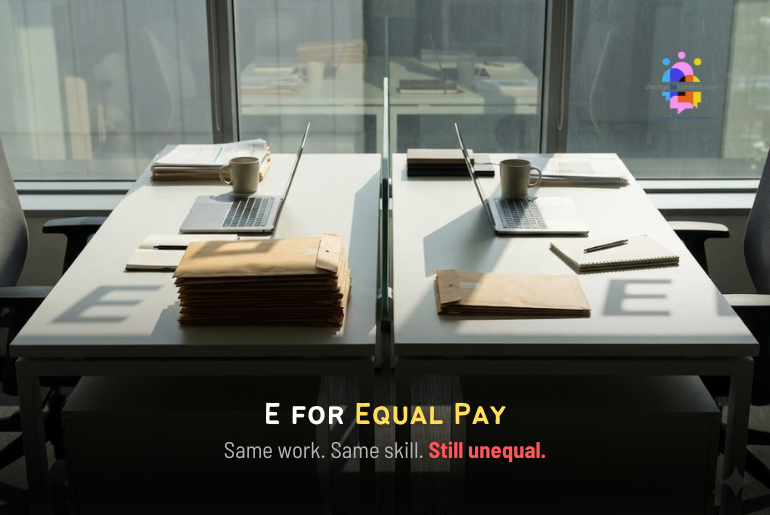
In this chapter of our A–Z Year-End Glossary, we confront a reality that should have been history by now: Equal Pay. The idea is simple: equal pay for work of equal value. The lived experience is not. Women show up, deliver results, lead teams, carry emotional labour, and handle responsibility with the same depth and intensity as men, yet they walk away with less. Less income, less security, less long-term stability.
Suppose earlier chapters were about ambition, barriers, conditioning, and the invisible double shift. In that case, this one tackles the part that stings the most: even when women do everything “right,” the system still pays them less for it.
Equal pay for work of equal value
Equal pay means that women and men have the right to receive the same pay for work of equal value. In practice, this means that when a woman and a man perform identical or similar roles, both should receive equal compensation. This principle supports fairness, workplace trust, and encourages a work culture that prioritises performance, not gender.
How far behind are we on equal pay?
Despite growing awareness about gender equality, women continue to earn significantly less than men worldwide. On average, women earn only 77 cents for every dollar men earn. This persistent gap creates a lifetime of income inequality and pushes more women toward retirement in poverty. At the current pace, women will not achieve equal pay until 2069.
According to the World Inequality Report 2022, men in India earn 82% of total labour income, while women account for just 18%. Between July 2022 and June 2023, the average monthly salary for male employees in India was ₹20,666, compared with ₹15,722 for female employees. It means women earned roughly 76% of what men earned.
A 2023 report by the International Labour Organisation (ILO) confirms the gap persists even for the same work. Indian women earn, on average, 73% of what men earn for identical jobs, showing a 27% gender pay gap.
The undervaluation of women-dominated sectors
The gender pay gap is higher in sectors that women dominate. Many women work in industries that pay less, such as caregiving, domestic work, textiles, and service roles. Companies often see these jobs as low-skill, even though they require strength, patience, emotional labour, and other abilities. Because of this mindset, employers offer lower wages in these sectors and limit growth opportunities.
At the same time, women rarely reach leadership roles in high-paying fields such as technology, finance, and engineering. Bias and discrimination keep many of them out of decision-making positions. As a result, men fill most of the roles that offer higher salaries and faster promotions.
Caregiving and domestic work also sit outside many equal pay protections. Since the law does not fully cover these jobs, employers can set lower pay without any legal penalty. This exclusion hurts women the most because they make up the majority of workers in these fields.
When a job becomes women-dominated, pay declines
Women also remain underrepresented in high-earning, male-dominated trades. In five of the largest occupations for men, including carpenters, electricians, and auto mechanics, the number of women is so low that reports do not even show their earnings. In fields that include both men and women, such as retail, women often work in lower-paying segments. They rarely receive access to roles that offer higher commissions, bonuses, or leadership chances.
Research from the Institute for Women’s Policy Research shows that women earn less than men in almost every occupation. It includes all twenty of the most common jobs for both genders. Women earn about 33 cents less per dollar in roles like financial managers and about 10 cents less as cashiers.
A long-term study examining Census data from 1950 to 2000 tested two theories. The first theory suggested that higher pay attracts more men and fewer women. The second theory argued that when women enter an occupation in large numbers, employers lower wages because society undervalues the work women do. The evidence supported the second theory.
Occupations paid less mainly because women dominated them. Designers experienced a 34% wage drop when more women entered the field, and biologists saw an 18-point drop. In contrast, when computer programming shifted from a women-heavy field to a male-dominated one, pay increased rather than decreased.
Why do we need equal remuneration for work of equal value
Equal remuneration for work of equal value helps more than simply equal pay for equal work because it addresses a much broader range of pay inequalities. Equal pay for equal work only applies when a woman and a man perform the same or very similar jobs. It does not account for cases where men and women work in different roles that require comparable levels of skill, responsibility, effort, and working conditions.
Many women-dominated occupations, such as caregiving, teaching, nursing, administrative support, and domestic work, have historically been undervalued. Employers often pay less for these roles, not because the work is easier or less important, but because society associates these jobs with women. As a result, women in these roles earn less than men in different roles that require similar levels of expertise and responsibility.
The principle of equal remuneration for work of equal value uses objective, gender neutral, transparent criteria to evaluate the actual value of a job. These criteria include the skills required, the qualifications needed, the level of responsibility, the effort involved, and the working conditions. By applying these standards, organisations can ensure that pay reflects the real worth of the work, rather than outdated assumptions about gender.
The final thoughts
Women continue to face a persistent pay gap, undervaluation of women-dominated work, and limited access to high-paying roles. That makes the principle of equal remuneration for work of equal value more important than ever. Equal pay is both a goal and a standard we must insist on.
Keep reading, our next glossary entry will dive into another vital topic affecting women in the workplace.
Changeincontent perspective
Equal Pay should have been the bare minimum. Instead, it has become a fight women inherit the moment they enter the workforce. Pay is not just a number on a slip; it signals worth, dignity, and how seriously a system values someone’s contribution. At Changeincontent, we believe the wage gap is not a gap at all. It is a message. And until organisations confront the habits that keep underpaying women, “equal opportunity” will remain a comforting slogan rather than a lived experience. Equality begins where fairness is measurable — in the money.
Disclaimer: The views expressed in this article are based on the writer’s insights, supported by data and resources available both online and offline, as applicable. Changeincontent.com is committed to promoting inclusivity across all forms of content. We broadly define inclusivity as media, policies, law, and history. It encompasses all elements that influence the lives of women and marginalised individuals. Our goal is to promote understanding and advocate for comprehensive inclusivity.
