
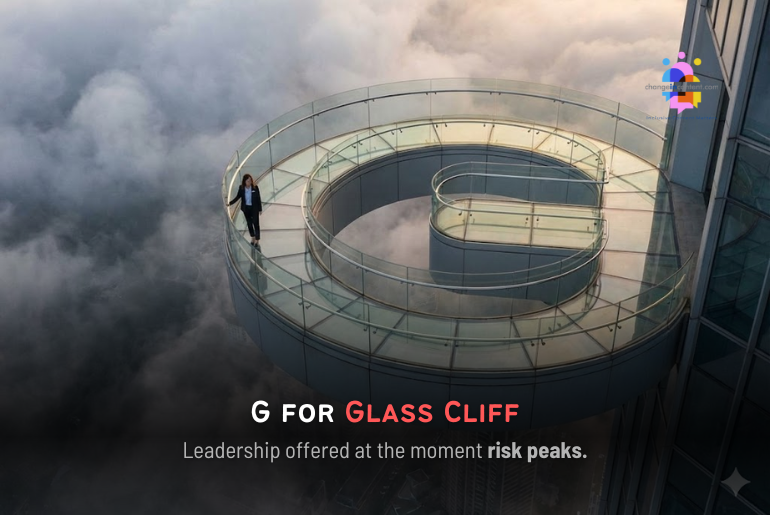
If you have been following our year-end glossary, you already know that each letter highlights an essential aspect of women and the workplace. Now we have reached the letter G. The first word that many working women think of is ‘Glass Ceiling’. It is a prevalent barrier and gendered issue we’ve explored from many angles. You can check that out quickly here. But today, we want to focus on something different yet also related to the glass ceiling. The next word in our series is G for Glass Cliff.
Glass Cliff is a problem that affects women when a company faces a crisis or enters a risky phase. Instead of blocking a woman’s rise, the glass cliff pushes her into unstable leadership roles where the chances of failure run high.
So, what exactly is the Glass Cliff?
We already know that women and minorities still don’t appear in leadership roles as often as they should. However, companies tend to give women leadership positions during crises, financial trouble, or major organisational instability. This is the glass cliff, a pattern where women and minorities step into leadership roles only when a company is already struggling.
Women remain underrepresented in stable, long-term leadership positions, yet organisations often turn to them during crises. They enter when the situation is unstable, the pressure is high, and the chances of failure rise sharply. When things don’t improve fast enough, people blame them, and the company comfortably returns to the familiar choice of appointing a man.
The glass cliff creates a surface-level impression of diversity without changing anything in the long run. It only looks empowering on the outside.
Glass Ceiling vs. Glass Cliff: 2 barriers, 2 very different realities
The glass cliff is different from the glass ceiling, but both create unfair hurdles for women.
The glass ceiling blocks women from reaching leadership positions in the first place. It keeps them out, no matter how skilled, capable, or deserving they are. The glass cliff does the opposite. It allows women in, but only when the risk is highest and the likelihood of success is lowest. In simple terms, the glass ceiling stops women from rising, while the glass cliff invites them to rise only when the fall is almost guaranteed.
Think about large companies that appoint a woman as CEO right after a major scandal or a big financial loss. Marissa Mayer became CEO of Yahoo in 2012, just as the company was in decline. Linda Yaccarino became CEO of X Corp (formerly Twitter) during one of the company’s most chaotic periods. Six months before her appointment as CEO, Elon Musk had taken over, and the platform was losing both users and advertisers. She also became the first and only woman to lead X Corp.
Another very common area where the glass cliff appears is politics. Parties often choose women leaders when their approval ratings drop or after they lose public trust. These women lead during the toughest moments, face harsher judgment, and usually shoulder the blame if the situation doesn’t improve. Did you know that when President Joe Biden endorsed Kamala Harris as the Democratic nominee for president, Google searches for the term “glass cliff” suddenly tripled?
How companies can prevent the Glass Cliff
If companies want real diversity and inclusion, they need to rethink how they choose leaders during tough moments. Senior teams must ask themselves whether they expect women to step in only when the situation already looks risky. When a woman takes charge during a crisis, leadership must support her with resources, authority, and a team that helps her succeed, not place her in the role as a last resort.
Women and people of colour should not stand out as rare or unusual choices for leadership. Offer them opportunities at all times, not only during chaos or crisis. In other words, diversity should be a natural part of how an organisation grows, succeeds, and makes decisions, rather than something it turns to only when the situation becomes difficult.
Women and leadership in crisis moments
A study covering all IMF programmes from 1980 to 2018 found that countries appoint more women to cabinet positions immediately after entering an IMF programme. This usually happens when the economy is unstable, and the government needs to make tough decisions fast. Women are also appointed in countries with serious gender bias, high levels of corruption, or a deepening economic crisis. Leaders turn to women at the exact moment when pressure, scrutiny, and risk are at their highest.
At the same time, other reports reveal something equally important. Women frequently perform better during crises. They make decisions with a long-term view, communicate more clearly, and build trust in moments of uncertainty. So while many women rise in the moment, they also rise to the moment with strong, steady leadership.
The final thoughts
The glass cliff shows us that opportunity means little if it comes without stability, support, or fairness. Women deserve leadership roles in moments of growth, not only in moments of crisis. They deserve chances that recognise their skill, not their ability to absorb risk.
We at ChangeInContent will be back with the next word in our glossary.
Changeincontent perspective
The glass cliff reveals a truth we do not discuss enough: leadership without support is not opportunity. It is a setup. At Changeincontent, we believe women deserve more than symbolic appointments during chaos. Practically, they deserve the chance to lead in seasons of stability, growth, and vision. A fair workplace does not call women only when things are breaking. It calls them when things are building.
Disclaimer: The views expressed in this article are based on the writer’s insights, supported by data and resources available both online and offline, as applicable. Changeincontent.com is committed to promoting inclusivity across all forms of content. We broadly define inclusivity as media, policies, law, and history. It encompasses all elements that influence the lives of women and marginalised individuals. Our goal is to promote understanding and advocate for comprehensive inclusivity.
