
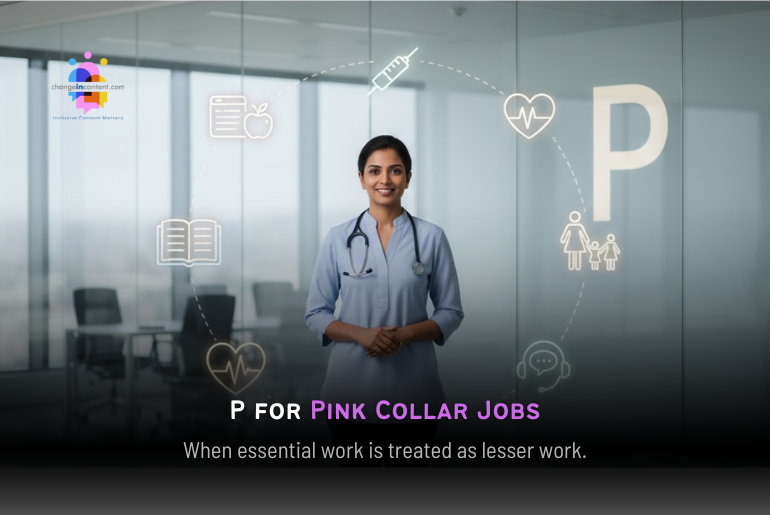
We often speak about blue-collar and white-collar jobs as if they neatly explain how work is organised. Yet another category quietly shapes women’s careers and economic outcomes. Pink Collar Jobs describe roles that are seen as women’s work, roles rooted in care, support, and service, and systematically undervalued because of who performs them.
As part of The A–Z of Women and Work, P for Pink Collar Jobs examines how gendered job labelling creates segregation, suppresses wages, and limits growth, even in professions that keep societies functioning every day.
What are Pink Collar Jobs?
Pink-collar jobs are occupations predominantly held by women, particularly in sectors such as healthcare, education, and customer service. Nursing, teaching, secretarial work, social work, and childcare are some common examples. Most of these roles focus on care, support, and service, which is why they are grouped under the pink-collar label.
Although these jobs are essential to society’s functioning, they often entail lower pay, limited growth, and less recognition. Many pink-collar roles sit at the lower end of the status ladder, despite requiring skill, emotional labour, and long working hours. Career advancement in these fields is also slower, making it harder for women to attain leadership positions.
Challenges in the Pink Collar Jobs
The challenges and biases do not come from the work itself, but from how society and workplaces treat these jobs and the people who do them.
Pay and wage gaps
Many pink-collar roles continue to pay less, even though the work requires skill, responsibility, and emotional effort. Women in these jobs often earn less than men doing similar work, which affects long-term financial security and keeps inequality in place. A survey on Satisfaction with the Salary from Pink Collar Jobs found that 54.74% of the respondents were not satisfied with their salary.
Limited career growth
Moving up the ladder is not easy in many pink-collar fields. Leadership roles are fewer, and gender stereotypes still influence who gets promoted. This slows professional growth and limits access to decision-making roles.
Job segregation
When women are clustered into certain types of work, it reinforces the idea that these roles are “meant” for them. This limits career mobility and discourages people from exploring opportunities outside these traditional paths.
A study on gender-based job segregation shows a clear divide in the workforce. Women primarily hold pink-collar roles. About 35.85% of women work in clerical and administrative positions, such as office support and coordination. In contrast, 98% of blue-collar workers are men, mainly employed as technicians, trades workers, machinery operators, drivers, labourers, and in technical management roles.
Lack of recognition
Despite being essential, pink-collar jobs often receive less respect and visibility. This lack of recognition can affect confidence, job satisfaction, and the degree to which the work is valued by society.
Work-life balance pressures
Many assume these jobs offer flexibility, but roles in healthcare, education, and care services often involve long hours and emotional stress. Over time, this can lead to exhaustion and burnout.
Growing and succeeding in pink collar jobs and careers
Pink-collar jobs matter, but success in these roles often takes extra effort. Limited pay growth, slow promotions, and stereotypes can hold people back. With the right choices and mindset, workers can still build strong and rewarding careers in these fields.
Keep learning and upgrading skills
Learning new skills helps you move ahead. Short courses, certifications, or basic tech skills can improve your chances of better roles and pay. For example, a teacher learning digital tools or an office worker mastering new AI software becomes more valuable to their organisation.
Build connections and seek mentors
Strong networks open doors. Talking to peers, joining professional groups, or learning from seniors in your field can make a big difference. A mentor can guide you, share advice, and help you plan your next steps.
Stand up for fair pay and respect
Understanding your rights and speaking up during reviews or appraisals matters. Supporting fair pay and equal treatment benefits not only you but also others in similar roles.
Challenge stereotypes with confidence
Show your skills and take pride in your work. When people see your results, it helps break old ideas about women’s jobs and creates space for growth and leadership.
Real change begins when this work is valued for its skill, impact, and importance, not for outdated ideas about gender. Supporting pink-collar workers means creating fair systems where effort and ability truly matter.
The closing thoughts
Understanding pink-collar jobs helps us see how deeply gender bias is built into the world of work. It also pushes us to question why jobs dominated by women are still treated as less worthy, even when they form the backbone of our economy and daily lives. Pink-collar careers deserve respect, visibility, and equal opportunity.
The A–Z of Women and Work continues. ChangeinContent will return with the next letter with a new perspective.
Changeincontent perspective
The pink-collar jobs reveal one of the most uncomfortable truths about work: value is not decided by skill, effort, or impact alone. It is shaped by gender. Until care-based and service-driven roles are rewarded fairly, workplace equality will remain incomplete. Respecting pink-collar work means dismantling the idea that women’s labour is naturally worth less.
Also Read: Pink collar jobs: Navigating gender dynamics in the post-COVID era.
Disclaimer: The views expressed in this article are based on the writer’s insights, supported by data and resources available both online and offline, as applicable. Changeincontent.com is committed to promoting inclusivity across all forms of content. We broadly define inclusivity as media, policies, law, and history. It encompasses all elements that influence the lives of women and marginalised individuals. Our goal is to promote understanding and advocate for comprehensive inclusivity.
