
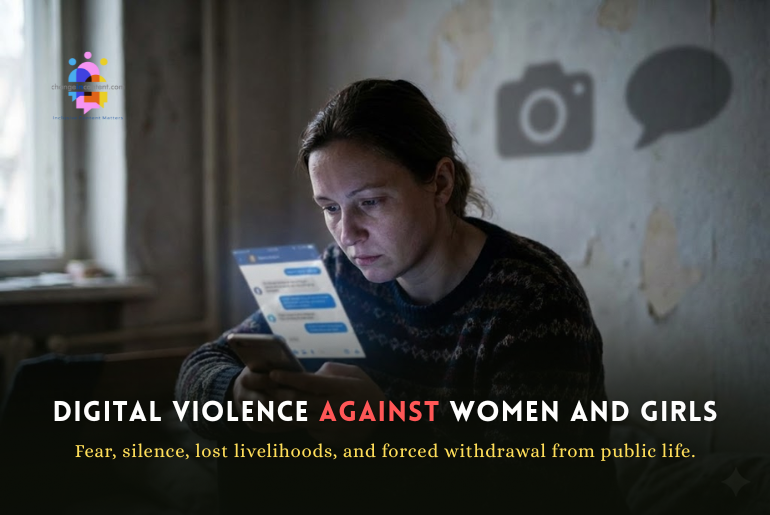
For years, violence against women was framed as something that happened behind closed doors or on unsafe streets. Today, it happens on screens; quietly, persistently, and often invisibly. Digital violence against women and girls is not a new problem born from technology; it is an old problem that has found faster tools, wider reach, and more profound psychological impact.
As 2025 comes to a close, it is impossible to ignore how deeply digital spaces have become woven into everyday life. Social media, messaging platforms, work apps, and online forums are no longer optional extensions of reality. They are reality. And for millions of women and girls, that reality comes with threats, surveillance, humiliation, and fear. These are all delivered through notifications, images, fake profiles, and anonymous messages.
This violence does not stay online. It follows women into their homes, workplaces, classrooms, and relationships. It alters behaviour, silences voices, and reshapes ambition. To understand Digital Violence Against Women and Girls, we must stop treating it as an internet problem and recognise it as a human rights issue unfolding in real time.
What digital violence against women and girls looks like
Digital violence rarely arrives as a single dramatic act. It builds slowly, often disguised as “attention,” “jokes,” or “free speech.” Unwanted messages escalate into threats. Shared photos turn into tools of control. Location data becomes a weapon. Accounts are hacked, impersonated, or flooded with abuse until silence feels safer than resistance.
Women experience this violence in many forms: cyberstalking, image-based abuse, sextortion, doxxing, deepfake pornography, coordinated harassment, and relentless monitoring by known or unknown perpetrators. What makes digital violence particularly insidious is its persistence. Blocking one account often leads to three more appearing. Reporting abuse rarely guarantees resolution. The violence becomes ambient, which is always possible, always looming.
Young women face the greatest risk. Globally, women between 18 and 24 are far more likely to encounter digital abuse than older women. It is often from the same individuals who harass or harm them offline. A UN Women report shows that more than 50% of women over 18 across Europe and Central Asia have experienced at least one form of digital violence.
For many, the first experience of digital violence coincides with their first experience of independence. It can be owning a phone, opening a social media account, or stepping into public life.
The emotional and material cost of being targeted
Digital violence is often dismissed because it does not leave visible scars. But its impact is deeply physical and economic. Anxiety, depression, sleep disruption, panic attacks, and loss of concentration are common. Many women stop posting online, withdraw from professional opportunities, or abandon public-facing careers altogether.
Some lose income. Freelancers and creators leave platforms when harassment becomes unmanageable. Journalists and activists self-censor. Students drop out of online communities, which are essential for learning. Others move cities, change phone numbers, or limit mobility after being tracked digitally.
This is not resilience. It is a forced adaptation.
And for women from marginalised communities (such as Dalit women, Muslim women, LGBTQIA+ individuals, women with disabilities), the abuse is often more targeted, more sexualised, and more violent. Digital spaces replicate offline hierarchies, then amplify them through scale and anonymity.
Technology is not neutral
One of the most dangerous myths surrounding digital violence against women and girls is the idea that technology is neutral. It is not. Platforms are shaped by who builds them, who funds them, and what they choose to prioritise.
The overwhelming majority of deepfake content online is sexualised imagery of women. Algorithms that reward engagement often amplify outrage, misogyny, and harassment because they keep users scrolling. Reporting systems are frequently slow, opaque, and emotionally exhausting for survivors to navigate.
Digital violence thrives not because technology is broken. Instead, it thrives because it is functioning exactly as designed. That is: without women’s safety at the centre.
When violence becomes a tool of silencing
Digital violence is especially effective at pushing women out of public life. Women journalists, politicians, academics, and human rights defenders are routinely targeted with threats of sexual violence and death. The message is clear: speak up, and pay the price.
This has consequences beyond individual harm. When women withdraw from public discourse, democracy itself is weakened. Representation shrinks. Perspectives narrow. Truth becomes easier to distort.
Silencing women does not require imprisonment or censorship anymore. A sustained campaign of online abuse often does the job faster and more quietly.
India’s legal and institutional response
India has not been silent on violence against women. Over the years, legal frameworks, helplines, commissions, and schemes have expanded to address safety and redressal. Institutions such as the National Commission for Women allow women to file complaints online, recognising that harm now often begins in digital spaces.
Yet the gap between law and lived experience remains wide. Many women do not report digital abuse due to fear of escalation, victim-blaming, or lack of trust in outcomes. Police capacity to handle technology-facilitated abuse varies widely. Platform accountability is inconsistent.
Laws matter. But without social change, survivor-centric systems, and platform responsibility, they remain reactive rather than preventive.
A Changeincontent reflection
Digital violence against women is not about the internet becoming dangerous. It is about society carrying its worst instincts into new spaces and refusing to take responsibility for the damage it causes.
The solution does not lie in telling women to log off, hide, or grow thicker skin. It lies in redesigning systems (legal, technological, and cultural) that currently reward harm and ignore survivors. Furthermore, it lies in educating boys as much as protecting girls. It lies in holding platforms accountable not just for content, but for impact.
Most importantly, it lies in believing women when they say the violence is real, even if it happens through a screen.
Closing thoughts on digital violence against women and girls
Digital violence is not virtual. Its consequences are lived, felt, and carried long after screens are turned off. As we approach the end of 2025, the question is no longer whether digital violence against women exists. The question is whether we are willing to confront the uncomfortable truth that technology has become one of its most efficient enablers.
The internet can still be a space of connection, creativity, and freedom. But only if women’s safety is treated not as an afterthought, but as a foundational design principle. Silence, dismissal, and inaction are no longer neutral positions. They are forms of complicity.
Also Read: UN Women’s UNiTE Campaign: Tackling digital violence against women and girls.
Disclaimer: The views expressed in this article are based on the writer’s insights, supported by data and resources available both online and offline, as applicable. Changeincontent.com is committed to promoting inclusivity across all forms of content. We broadly define inclusivity as media, policies, law, and history. It encompasses all elements that influence the lives of women and marginalised individuals. Our goal is to promote understanding and advocate for comprehensive inclusivity.
