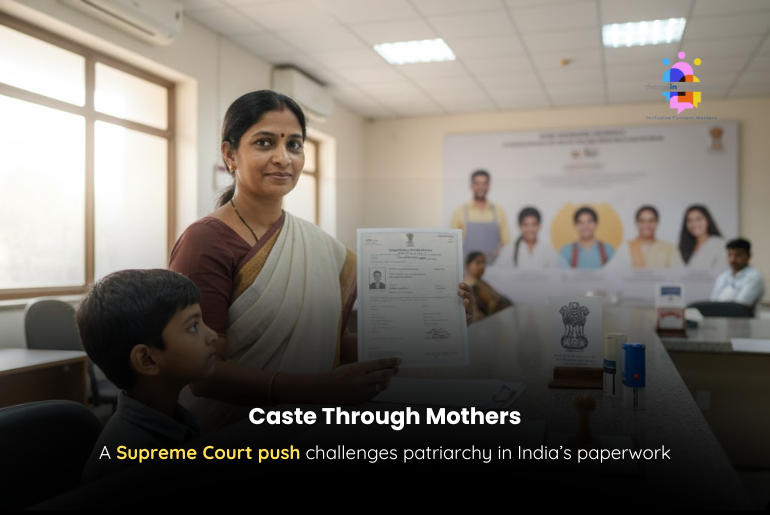
The most stubborn forms of patriarchy in India rarely announce themselves as patriarchy. They hide in “standard procedure”. Sometimes, they sit inside application forms. They travel through office files, stamped and signed, until inequality begins to look like an administrative routine. That is why the idea of a Caste Certificate Based on Mother’s Caste feels bigger than a technical correction.
The idea is a reminder that women do not only give birth to citizens; they also carry social identity, lived community, and structural disadvantage. And the State has no moral right to treat that as optional.
In December 2025, a Supreme Court bench led by Justice Surya Kant challenged the assumption that caste identity must flow only from a father. It opens the door for caste certification to reflect a mother’s caste and the child’s upbringing.
What the court’s push really means
At its simplest, the intervention challenges a default Indian habit: “father’s caste becomes the child’s caste” as a near-automatic rule. But social identity is not biology. It is also a social location: who raised the child, where the child lived, what community shaped daily life, what discrimination followed them into school corridors and public spaces.
It is not the first time Indian courts have recognised that upbringing and lived reality matter in caste determination. In Rameshbhai Dabhai Naika (2012), the Supreme Court held that these questions are fact-sensitive. We cannot reduce them to a single parental label, especially where the child is raised within the mother’s community and experiences that social world.
What is new here is the broader implication: the State’s paperwork should not be allowed to erase mothers.
Caste Certificate Based on Mother’s Caste: Why this is a ‘Patriarchy’ question
Patriarchy survives by declaring men the “default” carriers of identity.
- Father’s surname becomes the norm.
- Father’s lineage becomes the record.
- Father’s caste becomes the certification logic.
Women are positioned as “attached” to a household, rather than as independent social beings whose identities can shape a child’s future.
When we say Caste Certificate Based on Mother’s Caste, we are also referring to parity: equal institutional recognition of women as full citizens whose identities are valid, documentable, and legally meaningful.
What “Matrilineal Recognition” actually means
Matrilineal recognition is not the claim that India must become matriarchal or that fathers do not matter. It is simpler and sharper:
It means the State formally accepts that a mother’s identity can be the child’s recognised identity. Moreover, it holds true when the child’s social reality, upbringing, and community belonging reflect that.
In practical terms, matrilineal recognition is a tool to correct a deeply patriarchal default. It tells institutions: stop treating mothers as background characters in a child’s legal identity.
Why it matters in real life, not just in courtrooms
This is not an academic argument. It shows up in the lives of women and children in specific, painful ways:
1. When women raise children alone, the system should not punish the child
Single mothers, separated mothers, widowed mothers, survivors of abandonment, and mothers raising children without the father’s documentation often face a bureaucratic wall. If caste certification rigidly demands a father’s caste, the child’s rights can become hostage to a man’s presence, consent, or paperwork.
2. When the mother’s community is the child’s lived community
If a child is raised in the mother’s community, shares its social networks, and faces its discrimination, a father-centric rule can become an institutional lie. Courts have repeatedly recognised the relevance of upbringing and environment in such cases.
3. When women’s rights are reduced to a “secondary identity”
The damage is not only to the child. It is for women. Because every time the State refuses to recognise a mother’s caste as a valid basis, it signals that a woman’s social identity is incomplete unless attached to a man.
That is patriarchy. In file format.
The changeincontent perspective
India keeps asking women to fight patriarchy in speeches, in slogans, and in self-help language. But the hardest patriarchy to fight is the one embedded in systems that pretend to be neutral. A Caste Certificate based on mother’s caste is not a “women’s issue” in the narrow sense. It is a constitutional fairness issue. It is parity in documentation.
The State acknowledges that women are not just caregivers; they are legitimate holders of identity and rights. Once that door opens, it does not remain limited to caste certification. It sets a precedent: mothers count.
What could change next?
This moment aligns with a broader direction Indian law has been inching toward: dismantling male-first assumptions in rights and recognition. From how laws interpret guardianship, to how laws have strengthened daughters’ inheritance rights, the long arc is clear: the law is slowly learning to stop treating women as exceptions.
The real test now is not just a matter of legal principle. It is implementation: how states interpret it, how local offices apply it, how officials handle edge cases without reverting to patriarchal convenience.
The final thoughts
A Caste Certificate based on mother’s caste is not a niche reform. It is a public confrontation with a quiet truth: patriarchy is not only cultural. It is administrative. If India wants parity, it cannot continue building identity systems that treat mothers as supporting documents rather than primary citizens. Matrilineal recognition is not about replacing fathers. It is about ending a default that never deserved to exist.
Also Read: Understanding Patriarchy and Feminism in India.
Disclaimer: The views expressed in this article are based on the writer’s insights, supported by data and resources available both online and offline, as applicable. Changeincontent.com is committed to promoting inclusivity across all forms of content. We broadly define inclusivity as media, policies, law, and history. It encompasses all elements that influence the lives of women and marginalised individuals. Our goal is to promote understanding and advocate for comprehensive inclusivity.