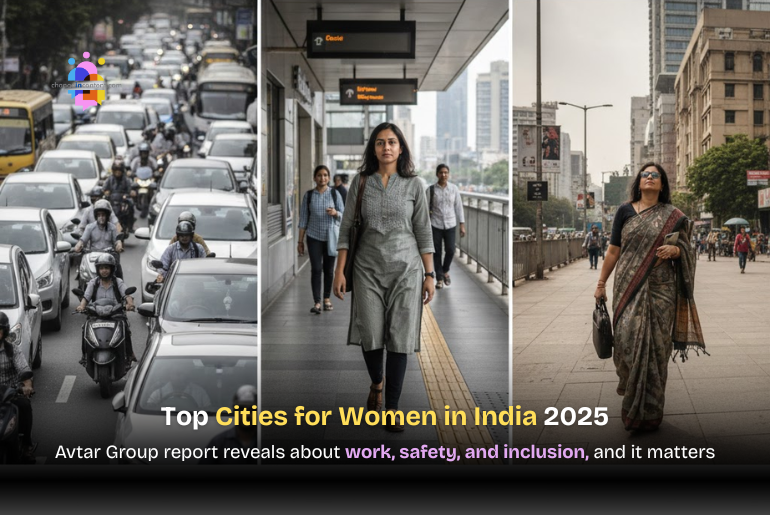
The conversation on the Top Cities for Women in India has matured. It is no longer only about jobs or salaries. It concerns whether women can build careers, move freely, feel safe, and remain visible across different stages of life. The Top Cities for Women in India 2025 report, released by Avtar Group, clearly reflects this shift.
Now in its fourth edition, the report evaluates 125 Indian cities. It uses a structured framework that measures not only employability but also social infrastructure, safety, inclusion, and sustainability. As organisations, professionals, and policymakers increasingly ask what makes a city truly work for women, this year’s findings offer important answers. At the same time, it raises some uncomfortable questions.
What is the Top Cities for Women in India Report?
The Top Cities for Women in India report is one of the most comprehensive assessments of women’s workforce participation and urban inclusion in the country. Unlike popularity-based rankings, this report uses quantitative indicators across multiple dimensions to evaluate how cities perform for women.
The 2025 edition assesses cities on five broad pillars. These pillars are career opportunities and workforce participation; safety and security; healthcare and access to education; quality of life and social infrastructure; and inclusion and policy support. The report assesses the performance of each city using public data, industry indicators, and structured analysis. That makes this a benchmark rather than a perception survey.
What makes the report relevant is its interconnected lens. A city cannot rank high simply because it has jobs. It must also show how women can sustain careers without being pushed out by safety concerns, caregiving responsibilities, or a lack of institutional support.
Top Cities for Women in India 2025: Who leads and why
The 2025 rankings of the Top Cities for Women in India place Bengaluru at the top, followed closely by Chennai. These cities have consistently performed well across multiple editions of the report, and 2025 reinforces why.
Bengaluru’s strength lies in its deep employment ecosystem, particularly in technology, research, and professional services. The city benefits from a large base of women professionals, relatively progressive workplace policies, and better-than-average access to healthcare and education. While safety remains uneven across neighbourhoods, institutional mechanisms and corporate participation continue to push the city forward.
Chennai’s performance is anchored in different strengths. It includes manufacturing, education, and steady workforce participation by women across sectors. The city scores well on healthcare access and social infrastructure and has historically seen stronger participation by women in both formal and informal employment.
Other high-performing cities in the 2025 rankings include Hyderabad and Pune, which have benefited from expanding corporate presence, better public infrastructure, and growing emphasis on diversity hiring. Notably, Delhi and Mumbai do not rank among the top cities, despite their economic dominance. Congestion, safety concerns, and uneven access to care infrastructure continue to weigh heavily on their scores.
What the rankings reveal beyond the headlines
The 2025 report makes one thing clear: economic opportunity alone does not make a city inclusive for women.
Cities that rank higher show better alignment between work and life. These are the cities where women can access jobs without compromising safety, health, or dignity. Cities that fall behind often struggle not because women lack ambition, but because systems fail to support them.
A recurring insight across the data is that women’s participation drops sharply when care infrastructure, safe mobility, and affordable housing are weak. Even cities with strong corporate presence see women exiting the workforce when public systems do not keep pace.
Another important finding is the widening gap between Tier-1 and emerging cities. While large metros continue to dominate, several mid-sized cities are showing promise. This promise is particularly evident at the intersection of local governance, access to education, and employer practices.
Why this report matters now
The timing of the Top Cities for Women in India 2025 report matters. India’s female labour force participation has improved on paper, but retention and progression remain fragile. Women are entering the workforce, but too many are quietly pushed out. The reasons are unsafe commutes, inflexible work models, lack of childcare, and cultural expectations that cities have not adapted to.
This report highlights an uncomfortable truth: cities inherit patriarchy unless they actively dismantle it. Infrastructure, transport, zoning, and public safety are not gender-neutral. Cities that fail to recognise this continue to rank lower. And it is not because women are absent, but because they lack support.
The ChangeInContent perspective
At ChangeInContent, we read the Top Cities for Women report not as a celebration list, but as a diagnostic tool.
The rankings tell us where women can survive. At the same time, it also shows where they can thrive without shrinking themselves. They show which cities understand that inclusion is not a benefit, but a structural responsibility.
For organisations, this report is a reminder that location choices matter. For policymakers, it reinforces the need for gender-responsive urban planning. For women professionals, it offers clarity about where systems may work with them and where they will have to advocate more vigorously.
Cities do not become inclusive by accident. They become inclusive when care, safety, work, and dignity are treated as interconnected rather than optional.
Summing up
The Top Cities for Women in India 2025 report does more than rank cities. It reflects on India’s urban priorities.
Bengaluru and Chennai lead not because they are perfect, but because they have built ecosystems in which women can enter, remain, and grow. Other cities have work to do, not only in attracting women but also in retaining them with respect.
As India’s economy grows, the question is no longer whether women will work. Instead, it is about building cities where they can do so without compromise. This report helps answer that question. What we do with that answer will define the next decade.
Also Read: Top cities for women in India 2024.
Disclaimer: The views expressed in this article are based on the writer’s insights, supported by data and resources available both online and offline, as applicable. Changeincontent.com is committed to promoting inclusivity across all forms of content. We broadly define inclusivity as media, policies, law, and history. It encompasses all elements that influence the lives of women and marginalised individuals. Our goal is to promote understanding and advocate for comprehensive inclusivity.