
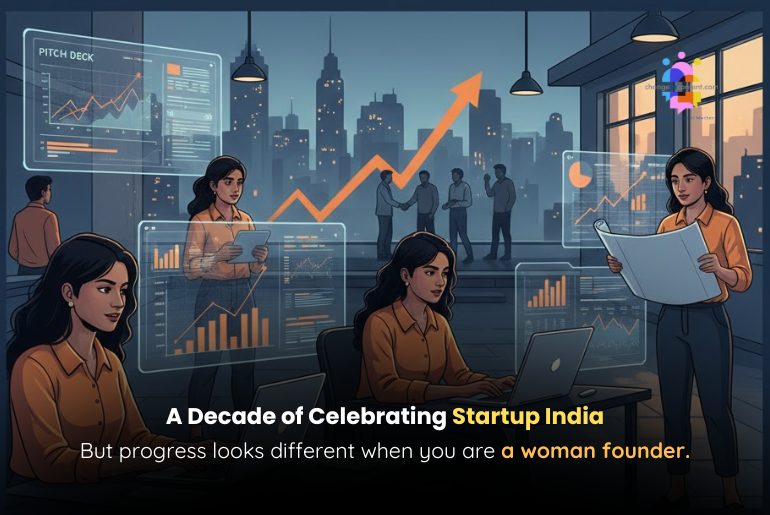
India marks National Startup Day 2026 on 16 January, commemorating ten years of the Startup India Initiative. Launched in 2016 by the Department for Promotion of Industry and Internal Trade (DPIIT), the programme aimed to create a supportive and inclusive startup ecosystem across the country.
Over the past decade, India has grown into one of the world’s largest startup hubs, with more than two lakh registered startups as of December 2025. Women founders have also made visible progress. Nearly 45% of recognised startups now have at least one woman Director or Partner.
Yet as National Startup Day returns in its tenth year, the question is no longer whether women are building companies. It is whether the ecosystem is built to support them.
The rise of women-led startups
From around 500 startups in 2016, the country now has two lakh registered startups, making India the world’s third-largest startup ecosystem. Among the startups operating today, women lead 76,000 ventures. Together, these businesses have created more than 1.7 million jobs.
Data from the Department for Promotion of Industry and Internal Trade (DPIIT) reports the strong presence of women founders in the top three D2C sectors. These include Personal and Home Care, Food and Beverages, and Fashion. In these segments, 3644 startups are women-led, accounting for nearly 52% of all startups in these sectors. The number rose from just 130 in 2017 to 3644 in May 2023, an increase of more than 2700%.
About 33% of these startups, which are more than 1200 women-led businesses, started during 2020 and 2021. As people spent more time shopping online during the pandemic, demand for customised products and smaller, homegrown brands grew, opening new doors for women founders.
State-wise, Maharashtra, Karnataka, Delhi, Uttar Pradesh, and Gujarat lead in the number of women-led startups in these D2C sectors. At the same time, over 1700 startups, or 47% of all women-led startups in these sectors, come from Tier-2 and Tier-3 cities.
National Startup Day reality check: Why funding still skips women
Since April 2021, the Startup India Seed Fund Scheme (SISFS) has backed 1,278 women-led startups with funding worth ₹227.12 crore. Alternative Investment Funds (AIFs) have also stepped in, investing ₹3,107.11 crore across 149 women-led startups. However, women founders still face a significant funding gap.
When Indian startups raised more than $3.2bn, none of the top 15 companies that received this funding had a woman founder. A report by the non-profit WinPE (Women in PE) found that the share of total funding going to women founders dropped to under 10% in 2023. In 2021, women-led startups received just 0.3% of India’s total venture capital funding.
Access to credit remains a challenge
Access to credit remains another major hurdle. According to the International Finance Corporation (IFC), the private sector arm of the World Bank, women-led businesses face an unmet credit gap of more than $11.4 billion. Women entrepreneurs also received only 5.2% of the outstanding credit extended by Indian public sector banks to enterprises. At the seed stage, women-led startups secure only 15% of available funds, while men-led startups take the remaining 85%.
Women founders in deep tech startups face the highest underrepresentation and funding gaps. Read more here.
Credit, bias, and the cost of being a woman founder
Women founders in India face far higher loan rejection rates than men. Around 19% of loan applications from women entrepreneurs are rejected, compared to just 8% for men. [Money Control]. It means women face rejection nearly 2.5 times more often, even when they apply with the same business proposals.
A recent study by the Goa Institute of Management (GIM) explains why access to formal loans remains harder for women entrepreneurs. It shows that women founders face more doubts from lenders and investors at every stage of the funding process. Many investors approach women-led businesses with extra caution and often question their ability to manage risk.
How investor questioning differs by gender
Research also shows a difference in the way investors speak to women and men. A 2018 study published in the Academy of Management Journal observed that women founders are more often asked questions focused on avoiding losses and reducing risk. Men usually receive questions centred on growth plans, expansion, and profits.
Women founders also face personal questions that male founders rarely encounter. Investors often raise concerns about family responsibilities, long-term commitment, and technical skills, adding pressure that goes beyond business performance.
The early-stage support
Early-stage financing brings another set of challenges. Many small enterprises in India rely on personal savings or family support, options that are harder for women to access. In a Bain & Company and Google survey, 43% of women said their families or spouses did not support their business efforts.
On average, women also have smaller professional networks than men, which limits their ability to seek external financing and scale their businesses.
What still holds back women-led startups
Despite their growing presence in India’s startup ecosystem, women founders continue to face barriers rooted in social norms and everyday bias. Many investors and lenders still view entrepreneurship as a male space, which impacts how they judge women-led businesses. Women founders often have to prove their credibility repeatedly, answer personal questions about family responsibilities, and justify their commitment in ways men rarely experience.
Networking itself can be a challenge. Men often tap into long-standing professional networks, mentors, and peer groups. Women, especially first-time founders, usually have smaller networks and fewer role models in their sectors. That makes it harder to find guidance, partnerships, or investors who “get” their business.
These challenges aren’t always visible in statistics. However, they play a significant role in who gets funded, who gets noticed, and ultimately, who can grow their startup.
Read our latest article exploring why women startup founders, and those aspiring to launch, still hesitate to participate in conferences and public networking events. It is mainly due to systemic bias and persistent gender gaps in the industry.
The changeincontent perspective
At Changeincontent, we do not see the National Startup Day as a mere celebration. We would rather see it as a checkpoint.
Women founders have proven they can build at scale, across sectors, and beyond metros. What they lack is not ambition, but an ecosystem that funds them without suspicion and evaluates them without bias.
If India wants its startup ecosystem to mature, it must shift focus from counting unicorns to correcting inequalities. Inclusion cannot be a side programme. It must be embedded in credit systems, investor behaviour, mentorship pipelines, and policy design.
The closing thoughts on National Startup Day
National Startup Day 2026 is not only a moment to celebrate how far India’s startup ecosystem has come, but also a chance to address what still holds women founders back. Women entrepreneurs are building businesses across sectors, cities, and communities, yet they continue to face barriers in funding, credit access, and investor trust.
Closing these gaps will require more targeted public funding, gender-aware lending practices, stronger mentorship networks, and greater representation of women in investment decision-making.
The next phase of India’s startup journey must focus not just on scale, but on fairness so that women founders can grow their businesses on equal terms.
Disclaimer: The views expressed in this article are based on the writer’s insights, supported by data and resources available both online and offline, as applicable. Changeincontent.com is committed to promoting inclusivity across all forms of content. We broadly define inclusivity as media, policies, law, and history. It encompasses all elements that influence the lives of women and marginalised individuals. Our goal is to promote understanding and advocate for comprehensive inclusivity.
