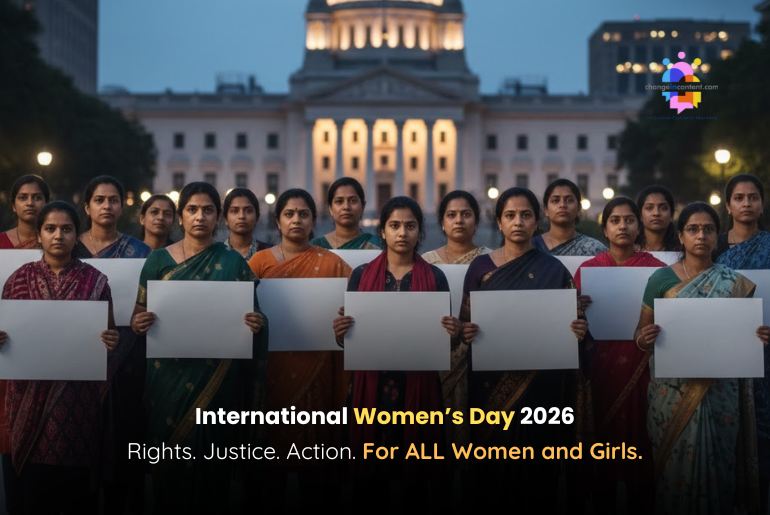
International Women’s Day 2026 arrives with an uncomfortable truth: women’s rights are often written into laws, but rarely protected with the urgency those laws promise. UN Women’s theme for the year is blunt by design: “Rights. Justice. Action. For ALL Women and Girls.” It is not calling for performative allyship. Instead, it calls for systems that consistently enforce rights across workplaces, homes, courts, streets, and clinics.
The tone is urgent because no country has fully closed the legal gaps between women and men. UN Women flags that women globally hold only 64% of the legal rights men do. That, at the current pace, legal protection gaps could take 286 years to close. We do not see it as a timeline. It is institutional indifference.
What does the International Women’s Day 2026 theme mean?
This year’s theme has three words that move in sequence:
- Rights mean the law must recognise women as full citizens at work, in mobility, in property, in money, in safety, in family and caregiving, in healthcare, and in retirement.
- Justice means those rights must be enforceable. Neither expensive nor humiliating. Not “only if your family supports you.” Justice includes accessible legal aid, survivor-centred processes for addressing violence, and institutions trained to recognise bias rather than reproduce it.
- Action means governments, employers, media, and communities stop outsourcing safety and fairness to women’s “resilience”. It is about removing the structural barriers that make rights fragile. These include discriminatory laws, weak protections, stigma, delays, and impunity.
UN Women also anchors this year’s observance alongside the 70th session of the Commission on the Status of Women (CSW70). It focuses on strengthening access to justice for women and girls. That is because the world cannot keep discussing equality while legal systems remain inaccessible to those who need them most.
International Women’s Day 2026 and the uncomfortable gap between “law” and “life”
In many countries, rights fail women in predictable places:
- At work: Hiring and pay decisions still penalise motherhood, caregiving, and “career breaks” more than they penalise incompetence. Even where policies exist, enforcement is weak, and retaliation is common.
- At home: Laws may exist on paper, but family pressure and social stigma decide whether a woman can file a complaint, seek divorce, claim maintenance, or simply live without violence.
- On the street: Safety is treated like a “women’s issue,” not a governance issue. Public infrastructure, policing, and response systems often lag behind the reality women navigate daily.
- In courts: Justice delayed becomes justice denied. It is especially relevant for women who cannot afford time, travel, lawyers, or social backlash.
This is why UN Women is insisting on justice systems that work for women. UN Women believes that without enforcement, rights become promises that never arrive.
What equal justice looks like (and why it changes everything)
UN Women’s framing of equal justice is intentionally practical. It looks like:
- A girl’s right to education protected in law and practice.
- An end to harmful practices like child marriage.
- Women’s freedom to work, participate, and lead without gatekeeping dressed up as “culture.”
- Strong prevention and protection systems to end gender-based violence.
- Family, labour, and healthcare laws that do not discriminate.
- Justice systems free of bias, centred on survivors, and backed by zero tolerance for abuse and impunity.
- Affordable, accessible legal aid.
Let us not mistake it for idealism. It is the difference between equality as branding and equality as lived reality.
Where changeincontent stands: Continuing #NoWomensDay in 2026
Last year, #NoWomensDay at Changeincontent was our way of saying that celebration feels hollow when the baseline remains unsafe, unfair, and unpaid. It was not anti-women. Instead, it was anti-tokenism. We asked a simple question: What exactly are we celebrating when women still have to negotiate dignity every day?
In 2026, we carry the same spirit forward. We will mark International Women’s Day 2026 by focusing on the systems that decide women’s outcomes: policies, courtrooms, workplaces, public infrastructure, media narratives, and budgets. Because “empowerment” without enforcement is just content.
What employers and leaders should take from International Women’s Day 2026
If you are a business leader reading this, the theme is not asking you to post a graphic. It is asking you to build a workplace where rights are not optional.
That means:
- A culture where reporting harassment does not risk careers.
- Pay structures that stand up to audits, not just opinions.
- Parental and caregiver policies that do not quietly punish ambition.
- Support systems for frontline women workers—not only corporate campuses.
- Accountability that is measurable, not motivational.
International Women’s Day 2026 is about much more than women’s lives outside organisations. It is about what happens inside them every day: performance reviews, project allocations, travel policies, grievance redressal, and promotions.
Summing up
International Women’s Day 2026 is asking the world to grow up. Rights are not a “women’s issue.” They are a governance issue, a workplace issue, a justice issue, and a nation-building issue.
UN Women’s theme of Rights. Justice. Action. For ALL Women and Girls is beyond just a feel-good line. It is a reminder that we cannot achieve equality when it is announced. We will only do so when it is enforced.
At Changeincontent, we will continue to push for the difficult conversation. It is not whether women deserve rights (they do), but why the world still treats enforcement like an optional extra.
Disclaimer: The views expressed in this article are based on the writer’s insights, supported by data and resources available both online and offline, as applicable. Changeincontent.com is committed to promoting inclusivity across all forms of content. We broadly define inclusivity as media, policies, law, and history. It encompasses all elements that influence the lives of women and marginalised individuals. Our goal is to promote understanding and advocate for comprehensive inclusivity.