
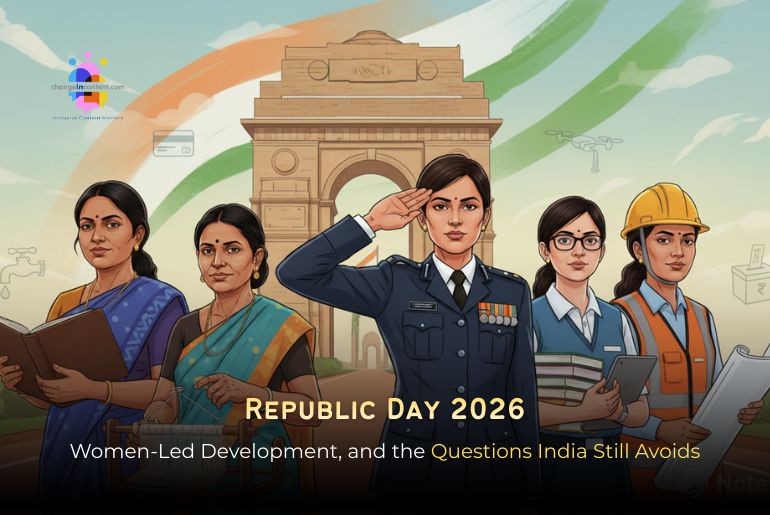
Republic Day 2026 is being framed as a milestone year for “women-led development” in India. Not just empowerment as charity, but women as decision-makers. They are earning, leading, owning, building, and representing the country at scale. That shift in vocabulary matters. It changes how we design policies, defend budgets, and measure outcomes.
But let me share the uncomfortable truth. A Republic that still needs to campaign for a girl child’s right to study, or a working woman’s right to a toilet, cannot afford self-congratulation. It can only afford honesty.
This article breaks down what India has built for women through schemes, laws, infrastructure and institutional reforms. We also highlight what these moves actually mean for women’s lives, and what a “women-led Republic” will require next, beyond slogans.
Republic Day 2026 and the new politics of visibility
Every year, Republic Day tells a story about who the nation wants to be. In 2026, the story is clearly revolving around women’s work, rural livelihoods, and grassroots contributions.
That is not symbolic fluff. The Government’s choice of who sits in the stands is also a policy statement. This year, for instance, artisans from traditional industries were invited to witness the parade on Kartavya Path. These artisans include 199 KVIC artisans and 50 best-performing women artisans under the Mahila Coir Yojana.
It is a crucial messaging shift that says “nation-building” is not only about uniforms and boardrooms. It is also about women who work with coir, khadi, craft, and community enterprises, often without social status attached to their labour.
Yet visibility is only the first layer. The harder layer is value.
- Are these women being paid fairly?
- Are they protected?
- Are they able to scale?
- Are they building assets in their own names?
That is where “women-led development” either becomes structural or collapses into tokenism.
Republic Day 2026 and the economics of Women’s Independence
If there is one arena where India has moved decisively over the past decade, it is financial access and livelihood scaffolding. The Republic has recognised a fundamental truth. The fact is that a woman’s income is harder to control.
The Self-Help Group engine and the “Lakhpati Didi” ambition
The SHG model has become the backbone of rural women’s livelihoods. Under DAY-NRLM and related rural livelihood frameworks, women are organised, trained, linked to credit, and nudged towards entrepreneurship. At the same time, they are increasingly pulled into non-farm income opportunities. The Government’s stated ambition of creating “Lakhpati Didis” is rooted in this logic that women in SHGs are earning at least ₹1 lakh annually.
The SHG ecosystem is also where policy can travel faster than formal labour markets. It can reach women who lack degrees, networks, English proficiency, or a resume tailored for corporate recruitment. That can convert an informal hustle into a documented enterprise.
But let us not romanticise it. The SHG economy is also where the state often quietly shifts responsibility onto women without fixing the deeper conditions. The conditions are low local demand, limited market linkages, caste barriers, unpaid care work, and weak enforcement against exploitation by middlemen.
Jan Dhan and the power of having your own bank account
Financial inclusion has been one of the Republic’s most measurable interventions. A Ministry of Finance update reported 53.13 crore Jan Dhan accounts. Interestingly, women hold 55.6% of these (as per that report).
A bank account is not liberation by itself. But it is a doorway. It is where subsidies land, where savings become possible, where formal credit history begins, where the household starts seeing a woman as an economic unit, not just a dependent.
The next challenge is not account-opening. It is about usage, digital safety, grievance redressal, and preventing women from becoming “account holders” whose accounts are controlled by others.
Mudra, Stand-Up India, and women’s entrepreneurship
Support for women’s entrepreneurship has expanded through credit-linked schemes. An official DD India explainer on Mudra notes that a large share of beneficiaries are women.
But credit is only one piece. Many women-run microenterprises struggle with procurement, branding, supply chain, digital payments, and scaling beyond local markets. In other words, the Republic is handing women a bicycle and calling it mobility, without building the roads.
A women-led economy cannot run only on loans. It needs training, market access, procurement reforms, buyer guarantees, and corporate linkages that treat SHG women as real vendors, not just CSR stories.
Republic Day 2026 and women in tech-led livelihoods
One of the more interesting shifts in women-focused policy has been the attempt to place rural women closer to technology-enabled livelihoods. Not in a “coding bootcamp for everyone” fantasy, but in work that fits local economies.
Drone Didi and what it signals
The “Namo Drone Didi” scheme is a serious policy experiment. A PIB release describes it as a central sector scheme to provide 15,000 drones to women SHGs. It has an outlay of ₹1,261 crore and structured training for drone pilots and assistants.
The idea is straightforward: women SHGs become drone service providers for agriculture. It adds income while normalising women’s presence in tech-adjacent roles.
The promise is enormous. So are the operational risks. These risks include access to transport, maintenance, security at work sites, male gatekeeping in local agri-ecosystems, and the very real possibility that women are trained, but the “service business” is captured by others.
If implemented well, Drone Didi is beyond just a scheme. It is a cultural provocation. It says that women are operating machines in public spaces, charging for services, negotiating with farmers, handling equipment, and building a reputation.
Republic Day 2026 and the constitutional question of political representation
The Republic’s biggest statement on women’s political power is the Nari Shakti Vandan Adhiniyam (Women’s Reservation Act), 2023. That provides for reservations for women in the Lok Sabha and State Assemblies. The structuring happens through changes linked to delimitation and a future census exercise.
It matters because political power changes everything else. That includes budgets, enforcement, priorities, policing, and even what gets debated. But it also comes with a timing anxiety. Women do not only need a law. They need the law to arrive within their working lifetime.
Meanwhile, women’s participation in local governance through Panchayati Raj has remained a strong lever in many states. That is where women learn governance in the real sense. That means roads, water, schooling, ration access, local violence, and local budgets.
The Republic Day question is not “Do we have women leaders?” We do. The more complicated question is:
- Are women leaders protected from violence, intimidation, and proxy control?
- Are they given administrative support?
- Or do we celebrate representation while leaving women to fight alone once the cameras leave?
Republic Day 2026 and the infrastructure that quietly changed women’s lives
Some of the Republic’s most significant changes for women did not make it into feminist headlines. They arrived as pipes and toilets.
Swachh Bharat and the dignity question
PIB has repeatedly cited the scale of toilet construction under Swachh Bharat as over 12 crore toilets.
We must not see it as a minor achievement. For women, sanitation is not only a “facility”. It affects safety, health, school attendance, and menstruation management. Furthermore, it affects the basic confidence needed to step out.
But workplace sanitation remains a fight of its own. Many women in India still work in environments where toilets are unsafe, inaccessible, or simply absent. That is why our earlier reporting on the struggle for basic sanitation is not a “side issue”. It is central to women’s equality.
A Republic that celebrates toilets built must also confront toilets missing in factories, markets, warehouses, construction sites, and informal workplaces.
Jal Jeevan Mission and the time poverty of women
Water access is one of the most underrated women’s policies because it affects time, not only health. A DD News report notes that 15.72 crore rural households had tap water connections under the Jal Jeevan Mission at that point.
When water comes home, women gain hours. And hours are the invisible currency behind education, work, rest, and ambition.
That is what women-led development looks like when it is serious: not motivational speeches, but removing the unpaid labour that quietly consumes women’s lives.
Republic Day 2026 and the laws that still need to touch reality
India has not lacked laws for women. What it has lacked is consistent enforcement, survivor-sensitive systems, and social change that does not punish women for using their rights.
Mission Shakti’s support infrastructure, such as One Stop Centres, is one of the most critical interventions because it addresses violence as an urgent state responsibility rather than a private family matter. A PIB release on One Stop Centres describes the scheme’s purpose and implementation framework.
But the Republic Day truth remains: systems for women often work best for women who can access them. That means language, location, transport, legal literacy, police sensitivity, and the absence of stigma.
A justice system that intimidates women into silence is still a patriarchal system, even if it has women-focused schemes on paper.
Republic Day 2026 and women in uniform: A cultural shift that is not cosmetic
Women’s inclusion in defence and security has become one of the most visible “new India” signals. We are having debates over permanent commission, entry into academies, and public leadership moments.
But visibility is not the endpoint. The question is whether women are being placed in roles with authority, operational value, and real pathways to leadership.
Our Republic Day coverage across DEI Insights has been tracking exactly this. We are not talking about women “participating”, but women commanding, leading, and being trusted with responsibility.
It matters because the armed forces are not just institutions. They are cultural factories. When women lead in uniforms, it spills into society’s imagination of what women can do.
Republic Day 2026: The progress worth applauding, and the progress we must stop performing
Here is what I can say plainly, as a citizen and as someone building Changeincontent:
Yes, there is progress worth recognising. The Republic has invested in women’s financial inclusion, grassroots livelihoods, and dignity infrastructure at scale. That is not small.
But if Republic Day 2026 becomes a victory lap, we will lose the plot.
I write this because the Republic still forces women to prove they deserve the rights men receive by default.
Because patriarchy is beyond just a mindset. It is a system that exists inside homes, workplaces, police stations, courtrooms, hiring panels, health systems, media narratives, and the everyday language that turns women’s ambition into “attitude”.
Because as long as women must fight for toilets at work, safe night shifts, equal pay, and respect in public spaces, “women-led development” is still a promise under negotiation.
That is precisely why our earlier work exists, and why we must bring it back into Republic Day conversations:
- Why is India still talking about Beti Bachao, Beti Padhao?
- Women Working Night Shifts: Empowerment on paper, exposure on the ground?
- Majhi Ladki Bahin Yojana: When digital India leaves rural women behind
- Women in the Central Government: Why India’s public institutions still lag in gender parity
- From parliament chambers to construction sites: Women still struggle for basic sanitation.
We do not publish these to sound angry. We publish them because hope without honesty becomes propaganda.
The closing thoughts
Republic Day 2026 is a moment when India is spotlighting women’s role in the Republic’s growth story. The schemes, the infrastructure, the representation moves, and the livelihood engines are real.
Now the Republic has to do the harder thing. We have to build the conditions where women do not need special schemes to access fundamental rights. Where dignity is not conditional, work is safe, and where equality is not a campaign theme but a daily reality.
At Changeincontent, we will continue to track what improves women’s lives. At the same time, we will continue to name what the Republic still refuses to fix.
That is our version of patriotism: not blind celebration, but relentless insistence on fairness.
Disclaimer: The views expressed in this article are based on the writer’s insights, supported by data and resources available both online and offline, as applicable. Changeincontent.com is committed to promoting inclusivity across all forms of content. We broadly define inclusivity as media, policies, law, and history. It encompasses all elements that influence the lives of women and marginalised individuals. Our goal is to promote understanding and advocate for comprehensive inclusivity.
