
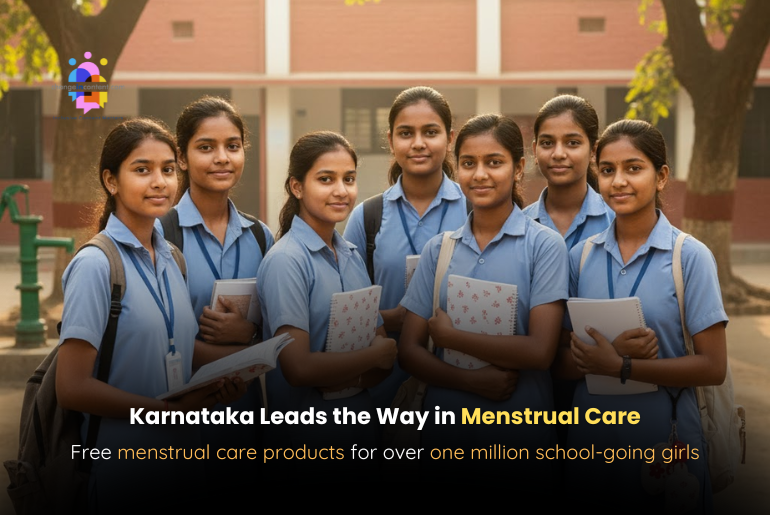
Karnataka has continued to push the conversation on women’s health and dignity by expanding access to free menstrual care products for school-going girls. After becoming the first Indian state to introduce paid menstrual leave for women in both government and private workplaces, the state has now announced a large-scale programme to provide sustainable menstrual care options to over one million students.
In October 2025, the Karnataka State Cabinet approved the “Menstrual Leave Policy, 2025.“ The policy enables women to take one paid day off each month during their menstrual cycle. Ultimately, the policy aims to make workplaces more supportive of women’s health.
In January 2026, the Karnataka government confirmed that it would distribute free menstrual cups, in addition to sanitary pads, to girls studying in government schools and colleges. The move positions Karnataka as a national frontrunner in linking menstrual health, education, and sustainability. At the same time, the government is addressing affordability, access, and long-standing stigma around periods.
Karnataka introduces free menstrual cups alongside sanitary pads.
On January 7, the Karnataka government announced a major scheme to provide free menstrual cups to more than 1 million girl students. Since menstrual cups are reusable, unlike disposable sanitary pads, the plan will help the state save more than Rs 16 crore and reduce the significant waste generated by pads. Currently, the government spends Rs 71 crores annually to procure 2,35,74,084 sanitary napkins for women covered under the Shuchi scheme.
The government will provide free menstrual cups and sanitary pads to students in classes 9 to 12 starting next academic year. With this step, Karnataka has become the first Indian state to endorse sustainable menstrual practices through a state-wide programme.
The state previously tested menstrual cups in Chamarajanagar and Dakshina Kannada by distributing approximately 15,000 cups under a pilot program. Depending on the success of the pilot project, the government will expand the scheme across the state.
Under the Swachh Bharat Abhiyan, Karnataka will supply more than 10.38 lakh menstrual cups at a total cost of Rs 61 crore. This step will also reduce sanitary napkin spending by Rs 10 crore. For the next three months, students will continue to receive pads before switching to menstrual cups in the next academic year.
How Karnataka’s free menstrual care products scheme will work
The scheme will provide each beneficiary with one menstrual cup, which she can use for up to a year with proper care. The state will conduct training sessions to teach students how to use, clean, and store the cup safely. Officials also noted that the cup does not replace sanitary napkins and is only one additional option for menstrual care.
Through this step, the government hopes to lower long-term spending and cut down on the large amount of waste from disposable pads. The plan also focuses on helping girls understand their bodies better and learn more about menstrual and reproductive health.
At the same time, students in classes 6 to 8 will continue to receive sanitary napkins. The government will provide sanitary napkins at a rate of one unit per month (each unit comprising 10 pads), covering more than 19.64 lakh students in classes 6 to 12.
Training & awareness: Teaching girls safe use of menstrual cups
Very few women and girls in India use menstrual cups today. Only 35% of women even know about menstrual cups, and just 5% actually use them. Across India, 64.4% of women aged 15-24 use sanitary napkins, 49.6% use cloth, and 15% rely on locally made napkins. At the same time, only 0.3% use menstrual cups. Many girls still turn to cloth even when better options exist, often because they lack access, money, or clear information.
According to the data, 336 million girls and women of reproductive age in India use approximately 1 billion sanitary napkins per month, totalling 12.3 billion annually.
Why menstrual cups?
Menstrual cups, made from medical-grade silicone, rubber, or latex, are a sustainable, environmentally friendly alternative to disposable pads and tampons. Unlike traditional single-use products, these reusable devices can last for several years. That significantly reduces the staggering volume of menstrual waste (including plastic wrappers and used materials) that ends up in landfills or incinerators. This transition is particularly vital for a highly populated nation such as India, where managing municipal waste is a critical challenge.
Menstrual cups also last longer throughout the day, resulting in fewer changes and a lower risk of leaks. It helps girls stay in class, participate in activities, and move around freely without discomfort. With proper guidance and support, menstrual cups offer a safe and sustainable way to manage periods.
Karnataka to offer free menstrual care products: Conclusion
Karnataka has taken a much-needed step by integrating women’s health, education, and sustainability in a single, comprehensive initiative. Free menstrual cups, monthly sanitary pad support, and paid menstrual leave together create a system that supports women at work and girls in school. If more parts of India follow this path, period care could become more affordable, more open, less stigmatising, and far better for both people and the planet.
Low awareness, high impact: The case for menstrual cups in India
A quick scan of shops shows that retailers, at least in Mumbai and Delhi, are not really stocking them. Therefore, consumer demand and education must be the invisible pull that ultimately changes buyer behaviour, at least among the privileged category or those who can afford to buy sanitary napkins. Only then will there be a measurable environmental impact.
The changeincontent perspective
By making the switch, women not only save money over the but also reduce their ecological footprint by adopting a more waste-conscious approach to hygiene. Ultimately, switching to menstrual cups is an excellent choice for Indian women.
More conversations and investments by majors in the healthcare sector can make this possible. We also hope that all state governments will adopt such measures to support the transition away from cloth among the less financially privileged.
Check out this space for “Healthcare, Menstruation and Women” – A changeincontent initiative.
Disclaimer: The views expressed in this article are based on the writer’s insights, supported by data and resources available both online and offline, as applicable. Changeincontent.com is committed to promoting inclusivity across all forms of content. We broadly define inclusivity as media, policies, law, and history. It encompasses all elements that influence the lives of women and marginalised individuals. Our goal is to promote understanding and advocate for comprehensive inclusivity.
