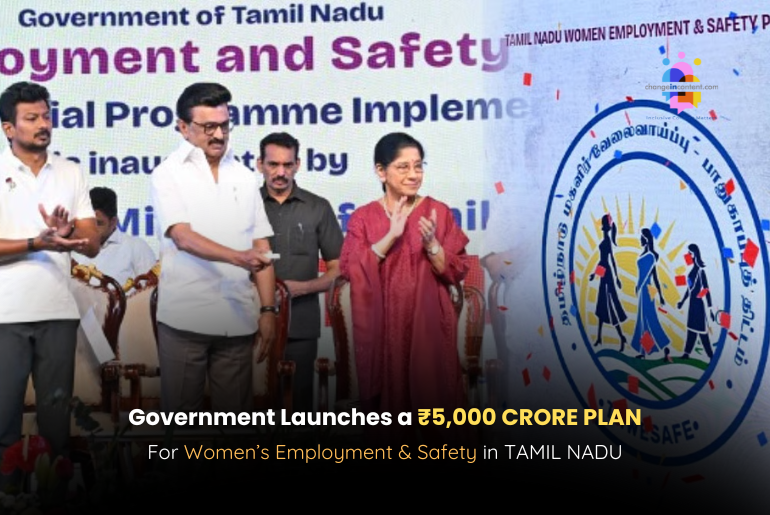
The launch of the Tamil Nadu Women Employment and Safety Project marks one of the most comprehensive state-led attempts in recent years to address women’s employment, safety, and economic participation as a single policy continuum rather than isolated interventions.
Announced at the Tamil Nadu Global Women Summit 2026 in Chennai, the project integrates employment generation, workplace safety, care infrastructure, and health support within a single five-year framework, supported by substantial public funding and a World Bank loan.
What the Tamil Nadu Women Employment and Safety Project is about
Unveiled by Chief Minister M. K. Stalin, the Tamil Nadu Women Employment and Safety Project (TNWESafe) is a ₹5,000-crore initiative. It aims at promoting sustainable and inclusive economic development for women across the state. Of this, ₹1,185 crore is financed through a loan from the World Bank. That underscores the scale and international confidence in the programme’s design.
Structured as a five-year intervention, the project focuses on three interlinked priorities. The priorities are improving women’s access to quality employment, strengthening safety mechanisms in public and workspaces, and enabling participation through supportive services such as care infrastructure and housing.
The state government has positioned the project as a systemic response to the structural barriers that keep women out of the workforce or push them into informal, unsafe, or unstable work.
Why are employment and safety being addressed together?
One of the defining features of the Tamil Nadu Women Employment and Safety Project is its refusal to treat employment and safety as separate policy silos. State officials and development partners have repeatedly pointed out that women’s workforce participation drops not only because of a lack of jobs, but also because of unsafe travel, the absence of childcare, housing insecurity near workplaces, and weak institutional support.
By integrating safety, care services, and employment pathways, the project acknowledges what women across sectors have long articulated. Access to jobs means little if the journey to work is unsafe, if care responsibilities are unsupported, or if workplaces remain exclusionary. This integrated framing moves the conversation away from symbolic empowerment towards practical conditions that enable sustained participation.
World Bank’s role and the emphasis on enabling services
Speaking at the summit, World Bank Regional Director Cem Mete highlighted that the project’s emphasis on enabling services was critical. Services such as safety measures, care facilities, and housing can help remove long-standing barriers to women’s access to quality jobs. According to the World Bank, employment outcomes improve significantly when governments address the social and infrastructural constraints that disproportionately affect women.
The TNWESafe model, Mete noted, has the potential to be adapted by other Indian states and even globally. However, it can only occur when implementation aligns with intent. This endorsement places Tamil Nadu’s approach within a broader international discourse on gender-responsive labour policy.
Health as economic infrastructure: HPV vaccination and cancer care
Alongside the Tamil Nadu Women Employment and Safety Project, the state government also launched a human papillomavirus (HPV) vaccination programme. It aims at adolescent girls above the age of 14. The programme will benefit 3,38,649 girls, with the first phase covering Ariyalur, Dharmapuri, Perambalur, and Tiruvannamalai districts. In the initial rollout, over 30,000 girls will receive the vaccine.
The health interventions do not stand apart from the employment agenda. The Chief Minister also referenced the state’s earlier rollout of ‘Wellness on Wheels’ vehicles. It offers free breast cancer screening across all 38 districts. Together, these initiatives signal a policy understanding that women’s health is not a welfare add-on. Instead, it is foundational to workforce participation, productivity, and long-term economic security.
Economic empowerment beyond income
Industry leaders at the summit reinforced the idea that employment is not merely about wages. Mallika Srinivasan, speaking at the event, noted that employment and entrepreneurship provide women with agency, voice, and dignity. These outcomes extend far beyond household income. She also flagged persistent gaps in vocational training and the need for industry-aligned education and infrastructure if employment initiatives are to translate into real opportunities.
This acknowledgement is significant because it situates the Tamil Nadu Women Employment and Safety Project within a broader ecosystem. This ecosystem encompasses skills development, education reform, transport, and workplace culture.
The changeincontent perspective
At Changeincontent, we see the Tamil Nadu Women Employment and Safety Project as an important case study. It reflects how governments can rethink women’s workforce participation beyond token measures. Employment, safety, health, and care are deeply interconnected realities in women’s lives. Addressing them together is not merely progressive; it is necessary.
As more states explore similar frameworks, the conversation must move from “intent” to “impact”. Policies do not succeed with their launch. Instead, they succeed when women can travel to work safely, earn with dignity, and access healthcare without barriers. At the same time, policies succeed when women can remain in the workforce without being forced to choose between survival and participation.
Tamil Nadu Women Employment and Safety Project: What this signals for policy going forward
Tamil Nadu has consistently ranked higher than many states on women-centric social indicators, but officials themselves have acknowledged that progress remains uneven and fragile. The Tamil Nadu Women Employment and Safety Project represents an attempt to move from fragmented schemes to a coordinated policy architecture that recognises women as economic actors rather than beneficiaries.
Whether this ambition translates into durable change will depend on execution, monitoring, and the extent to which women across caste, class, geography, and occupation experience tangible improvements. The design, however, suggests a shift towards evidence-led, infrastructure-backed gender policy rather than headline-driven announcements.
Also Read: Karnataka endorses the provision of sustainable, free menstrual care products for one million girls.
Disclaimer: The views expressed in this article are based on the writer’s insights, supported by data and resources available both online and offline, as applicable. Changeincontent.com is committed to promoting inclusivity across all forms of content. We broadly define inclusivity as media, policies, law, and history. It encompasses all elements that influence the lives of women and marginalised individuals. Our goal is to promote understanding and advocate for comprehensive inclusivity.