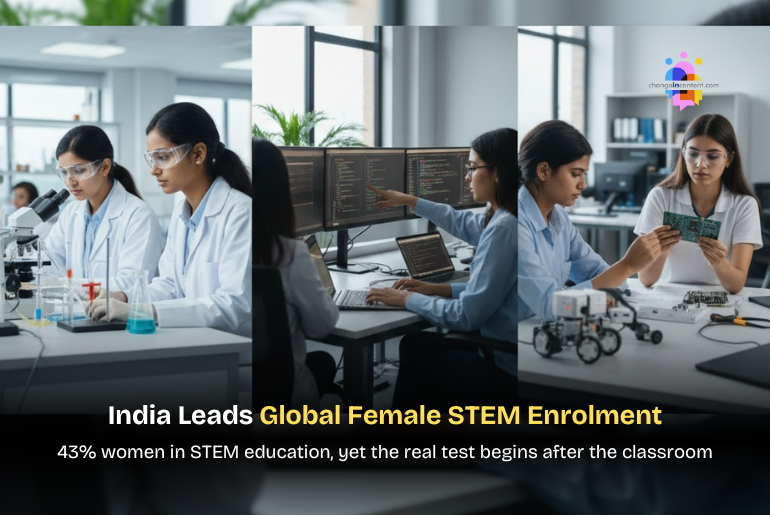
India has topped the global female STEM enrolment, with women accounting for 43% of all STEM students. As per UNESCO, this number is well above the global average of 35%. The milestone places India ahead of all other countries in women’s participation in science, technology, engineering, and mathematics education.
Data from the All-India Survey on Higher Education (AISHE) also points out that women’s postgraduate enrolment rose from 19,86,296 in 2014-15 to 32,02,950 in 2022-23. It is an increase of 12,16,654 students, or a growth rate of 61.3%.
Yet, this progress on paper masks deeper structural gaps. While more women are entering STEM classrooms, far fewer are transitioning into long-term careers, leadership roles, or research positions. The numbers indicate improving access, but opportunity still lags.
Global female STEM enrolment is rising, but workforce parity remains distant
A 2020 World Bank report on women’s participation in STEM found that, although women graduate at higher rates than men, they are less likely to pursue careers in engineering, Information and Communication Technology (ICT), and physics.
India produces the largest number of STEM graduates in the world, and more women are choosing STEM courses every year. Yet, female participation in the STEM workforce remains low. According to World Bank data, women constitute only 27% of India’s STEM workforce, despite their strong presence in higher education.
Gender bias, pay gaps, and slower growth in STEM careers
In India, about 81% of women in STEM report encountering gender bias during performance evaluations. Such bias often affects promotions, leaving women less likely to reach senior or leadership positions even when they perform at the same level as their male colleagues.
Women in STEM earn 15–30% less than men, and the pay gap appears right at the start of their careers. Studies, including research from Stanford University, suggest that this difference is not due to a lack of skill or ability. Instead, it is due to bargaining dynamics, where men are often more likely to negotiate higher starting salaries or better benefits.
For women in STEM, career progression often clashes with household responsibilities, creating what experts call a dual burden. STEM jobs usually require long hours, laboratory work, research deadlines, and field assignments. At the same time, women are often expected to manage domestic duties like cooking, childcare, and household management. Balancing both responsibilities can limit their ability to take on challenging projects, leadership roles, or extended work hours, slowing career growth.
Research, publishing, and the invisible barriers for women in STEM
Higher enrollment of women in STEM has not closed gaps in several key areas. A recent study found that papers written by women remain under review 7.4-14.6% longer than those written by male authors. This means that for every 50 papers a woman publishes, she spends an additional 350–750 days waiting for reviews, editorial decisions, or revisions compared with her male peers. The same pattern appears in papers with women as corresponding authors, women as first and corresponding authors, and teams composed entirely of women.
A separate analysis examined 2404 articles and 4583 authors across 10 selected Indian LIS journals from 2014 to 2023. Male authors made up 71.81% of all contributions and held 69.3% of first author positions. Team-based research also showed a similar pattern, with male-only and male-majority groups appearing far more often.
If women make up a high share of STEM enrolment, why do gaps persist in authorship, leadership, research output, and where that work is published?
Global female STEM enrolment: The closing thoughts
India’s high female enrolment in STEM is an achievement worth noting, but women remain underrepresented in research, leadership, and workforce participation. Career barriers, pay disparities, and household burdens continue to hinder them.
Converting enrollment into meaningful impact will require targeted policies, inclusive workplaces, and systemic changes that allow women to succeed in STEM careers beyond the classroom.
The changeincontent perspective
At Changeincontent, we see India’s leadership in global female STEM enrolment as a starting point, not a finish line. Education has opened the door, but systems within workplaces, research institutions, and funding networks continue to quietly push women out. STEM careers still reward uninterrupted availability, penalise caregiving, and treat bias as an individual problem rather than a structural one.
If India wants absolute gender parity in STEM, it needs to move beyond celebrating enrolment statistics. That means fixing hiring pipelines, rethinking evaluation metrics, and addressing unpaid care burdens. At the same time, we must make leadership and research spaces accountable for who advances and who disappears. Women in STEM do not need more motivation. They need fair systems that prevent talent leakage.
Disclaimer: The views expressed in this article are based on the writer’s insights, supported by data and resources available both online and offline, as applicable. Changeincontent.com is committed to promoting inclusivity across all forms of content. We broadly define inclusivity as media, policies, law, and history. It encompasses all elements that influence the lives of women and marginalised individuals. Our goal is to promote understanding and advocate for comprehensive inclusivity.