
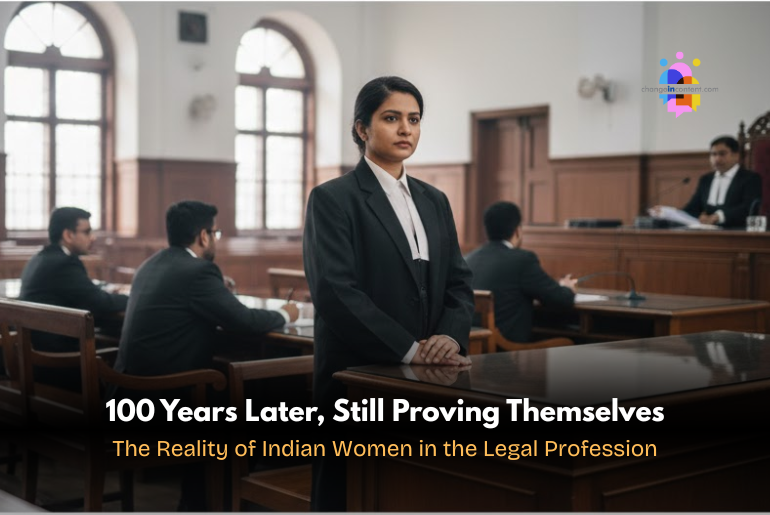
A hundred years ago, Indian women were legally barred from practising law. It was only after the Legal Practitioners (Women) Act, 1923, that they were formally allowed to argue in court. A century later, Indian women in the legal profession continue to face a system that remains structurally male-dominated.
Women enter law schools. They enrol as advocates. They argue cases. But when it comes to leadership, representation, referrals, and long-term career sustainability, the profession still closes ranks. The fight today is not for entry. It is for space, authority, and permanence.
Indian women in the legal profession: Only 15% practising lawyers are women
Women may be entering the legal profession in India, but very few attain positions of authority. Data from 15 states, shared by the Bar Council of India (BCI), show that only 2,84,507 women lawyers are enrolled, out of a total of 15,42,855 advocates. It means women form just 15.31% of India’s legal workforce.
Since its establishment in 1961, the Bar Council of India has never had a woman president. Out of 426 elected seats across 18 State Bar Councils, only 9 were held by women. In 11 of the 18 state bars, there are no women representatives. While women make up around 15% of practising lawyers, which is already a worrying number, they hold only 2.1% of elected positions.
A petition before the Supreme Court has asked the judiciary to intervene and ensure better representation of women in the Bar. It highlights that, apart from Bihar, where women hold approximately 8% of bar council seats, nearly every state exhibits a substantial gender gap in the legal profession.
Why women lawyers exit the Indian legal profession mid-career
Among women who join the legal profession, many do not remain long enough to build full careers. While India lacks precise data on the number of women who remain actively engaged in legal practice, many leave midway. It is primarily due to the pressure of balancing work and personal life.
A 2022 Reuters survey found that nearly 60% of women lawyers leave the profession between the ages of 35 and 55, a crucial phase of their careers. Approximately 82% of respondents cited poor work-life balance as the primary reason for quitting. For many, long working hours, unpredictable schedules, and a lack of institutional support make the profession difficult to sustain.
Gender bias in Indian courts and bar councils
A survey by the Supreme Court Bar Association (SCBA), conducted among 301 women advocates across Delhi-NCR, reports that one-third of respondents experienced gender bias or discrimination at work. More than half reported struggling to manage professional responsibilities alongside marriage and motherhood. About 31% of women reported difficulties in getting cases referred to them during pregnancy, a period when visibility and court exposure already decline.
The findings were presented under the SCBA initiative ‘We – Women Empowerment in Law: Struggle and Success’, with participants drawn from the Supreme Court, High Courts, district courts, tribunals, and other judicial bodies.
In Maharashtra, fewer women have started enrolling in law courses. Data from the State Common Entrance Test (CET) Cell shows that the share of women in the three-year LLB programme fell from 36.59% in 2023–24 to 35.21% in 2025–26, as male admissions grew at a faster pace.
What Indian women in the legal profession actually need to stay and lead
If the legal profession wants more women to remain and advance, it needs more than entry-level inclusion. Women lawyers need support systems that recognise flexible working hours, transparent promotion policies, access to mentorship, and leadership pathways that do not penalise them for life stages like marriage, pregnancy, or caregiving.
Most importantly, firms need to move beyond token diversity and adopt frameworks that embed gender equality into everyday practice. One such global framework is the United Nations’ Women’s Empowerment Principles (WEPs), which focus on leadership commitment, equal opportunity, fair workplace policies, and accountability. What women lawyers need is an industry-wide shift where such principles become the norm rather than the exception.
Indian firms stepping up.
A handful of Indian law firms have begun to show what this could look like in practice.
Ahlawat & Associates
In 2025, Ahlawat & Associates formally joined the UN Women’s Empowerment Principles, building on a legacy shaped by its founder, Avnish Ahlawat, one of India’s earliest women litigators. Today, women constitute nearly 80% of the firm’s partners, supported by mentoring and leadership initiatives that help ensure women do not stagnate in mid-level roles. [Lawsikho]
Trilegal
Similarly, Trilegal signed the UN Women’s Empowerment Principles in 2022 and has since taken steps towards gender-balanced leadership. The firm promoted 11 counsels to partnership in 2024, 7 of whom were women. Moreover, the firm has committed to raising women’s representation at the partner level to 40% in the next few years.
Aarna Law
Aarna Law, co-founded by Managing Partner Kamlla, has focused on developing flexible, technology-enabled work systems that enable more women to remain in the profession without sacrificing career growth. The firm places strong emphasis on mentorship and inclusive leadership, particularly for young women in the early stages of their careers.
These firms remain a small number of examples for now, but they point to what the Indian legal sector can become: one in which women are not merely recruited but supported to build long-term careers and attain leadership roles. What the legal sector needs now is not a few standout examples, but many more firms willing to treat gender equality as a core workplace practice, not just a line in policy documents.
The changeincontent perspective
The legal profession shapes justice, rights, and the interpretation of equality itself. When Indian women in the legal profession remain underrepresented in bar councils, senior advocacy, and decision-making roles, it is not merely a workplace gap; it is a democratic one.
Entry-level diversity is not progress if leadership remains closed. Representation cannot stop at enrolment statistics; it must extend to power structures. Courts interpret equality under the Constitution, yet the profession struggles to model it internally.
Real reform will require transparent election systems within bar councils. Furthermore, it requires institutional maternity support, equitable referrals, and measurable accountability within law firms. Symbolism will not fix a century-old imbalance. Structure will.
The final thoughts
A hundred years after women gained the right to practise law in India, the profession still struggles to offer them equal space, voice, and power. Women continue to enter law schools and courtrooms. Yet the system fails to retain them and rarely allows them to attain leadership positions.
From low representation in bar councils to high dropout rates in mid-career, real change will come only when the legal profession shifts from symbolic inclusion to structural reform.
Disclaimer: The views expressed in this article are based on the writer’s insights, supported by data and resources available both online and offline, as applicable. Changeincontent.com is committed to promoting inclusivity across all forms of content. We broadly define inclusivity as media, policies, law, and history. It encompasses all elements that influence the lives of women and marginalised individuals. Our goal is to promote understanding and advocate for comprehensive inclusivity.
