
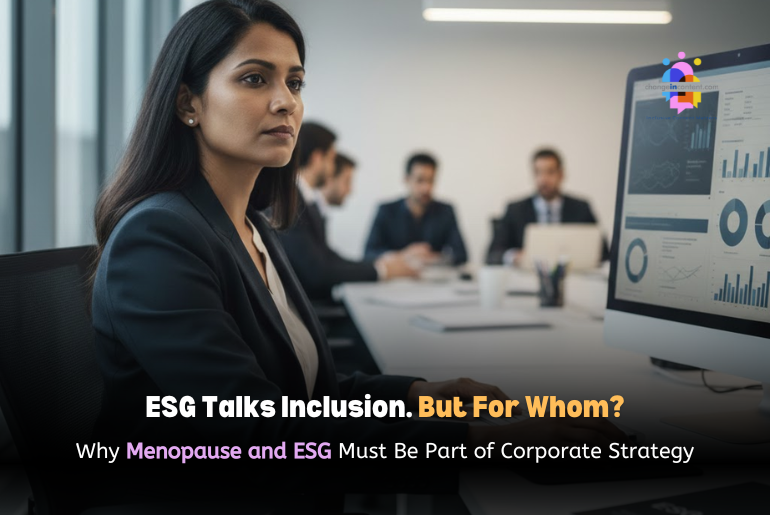
Almost every major corporation today claims to follow an ESG framework. ESG stands for Environmental, Social, and Governance. These are the three pillars that measure how responsible a business is. Menopause and ESG, however, rarely appear in the same sentence.
While Environmental, Social, and Governance metrics increasingly shape investor decisions and corporate reputation, one of the most significant workforce realities remains absent from boardroom conversations.
ESG measures how responsibly companies operate. Environmental responsibility, social impact, and governance standards. The checklists grow longer every year. Climate targets. Pay equity audits. DEI disclosures. Mental health benefits. Flexible work. Yet when it comes to a life stage that affects half the workforce, menopause remains largely invisible.
Why Menopause and ESG must be linked in corporate strategy
Women typically experience menopause between their late 40s and mid-50s, the same years when many attain senior roles. These are also the years when companies expect peak performance, long hours, and constant availability. At the same time, many women deal with menopause-related fatigue, anxiety, brain fog, sleep problems, joint pain, and hot flashes while managing demanding jobs.
Unlike women in Europe and North America, the average age of menopause in India is 46.6 years. This means most Indian women experience menopause while still actively employed, often in mid-career roles with high responsibility.
Every year, about 47 million women enter menopause, often during their peak working years. Yet studies show that in some countries, nearly 8 out of 10 women receive no menopause-related support at work. Given that this affects half the workforce, the lack of attention is very concerning.
The environmental impact of menopause in the workplace
Menopause is also directly linked to the environmental side of ESG. The “E” does not only refer to emissions and energy use. It also looks at how physical environments affect human health.
Poor ventilation, extreme heat, air pollution, and long commutes increase fatigue, hot flashes, headaches, and sleep problems. In India, rising temperatures and longer heatwaves make menopause even harder to manage. It is especially the case for women who work in non-air-conditioned offices or who travel daily by crowded public transport.
Climate change affects the planet, but it also worsens everyday health conditions, and menopause is one of them.
The social cost of ignoring menopause in ESG policies: Losing women at their peak
Within the social dimension of ESG, companies claim to prioritise inclusion and employee well-being. However, most workplace policies focus on younger employees. Maternity leave, childcare benefits, fertility support, and menstrual health receive attention. Support drops when women age.
Many women reduce their working hours, forgo promotions, or step back from leadership roles because they cannot manage symptoms in rigid work environments. It creates a silent talent drain.
The silent talent drain during mid-career
A 2023 Mayo Clinic study found that menopause symptoms lead to an estimated $1.8 billion in lost work time every year for women aged 45 to 60 in the United States alone. It includes missed workdays, reduced productivity, and women stepping back from roles.
At the same time, one in six women says they have considered leaving their job because of menopause symptoms. Many do not leave because they want to, but because workplaces do not offer flexibility, understanding, or medical support.
In sectors such as education, healthcare, law, media, and corporate services, this results in a quiet exit of experienced women. Companies lose senior talent, and younger women lose mentors and role models.
Companies spend years investing in gender diversity, only to lose women at the point when they should be entering senior leadership. This gap explains why women remain underrepresented in boardrooms and executive roles despite strong entry-level hiring.
The governance gap: Policies that do not exist
In many companies, HR policies cover maternity, childcare, mental health, disability, and even menstrual leave. However, these policies rarely mention menopause.
Manager training and policy accountability
Managers also receive little to no training on the topic. Many do not understand menopause symptoms or feel uncomfortable discussing them. As a result, women hesitate to speak openly, and supervisors often misinterpret symptoms as poor performance, lack of commitment, or burnout.
Because no formal policies exist, women handle menopause through personal negotiations. They request flexible hours, work-from-home days, or medical leave on a case-by-case basis. Their access to support depends on how understanding their manager is, not on company rules.
Menopause is not just a woman’s issue.
From an ESG lens, menopause exposes inefficiencies in how companies manage human capital. Organisations spend heavily on hiring, training, and branding themselves as inclusive. However, they lose women precisely when their experience peaks. That is a waste of accumulated skill, leadership capacity, and social capital.
Menopause is no longer a niche or rare workplace issue because the structure of the global workforce has changed. The global workforce is ageing, and women now remain in the workforce well into their 50s and 60s, especially in professional and leadership roles.
Most ESG frameworks focus on bringing women in. Menopause shifts the question to a more important one: why do companies fail to retain them?
Changeincontent perspective on Menopause and ESG
If ESG frameworks claim to measure social responsibility, then menopause cannot remain a footnote. Menopause and ESG intersect at the core of workforce sustainability. Companies cannot celebrate hiring women at entry levels while quietly losing them at leadership stages. The solution is neither complicated nor radical.
Organisations can implement menopause-inclusive HR policies, flexible work options during symptom-intense phases, temperature-controlled office environments, trained managers, and confidential medical support.
ESG reporting should require disclosure of retention rates for women aged 45–60 and the tracking of support mechanisms. Inclusion must account for ageing, not just entry. A truly inclusive workplace prepares for every life stage, not only the convenient ones.
Menopause and ESG: The closing thoughts
Companies often treat ESG as a branding exercise. They highlight what feels easy to measure and easy to showcase. Carbon targets, hiring ratios, and glossy sustainability reports dominate the narrative. However, ESG cannot claim social responsibility while ignoring the realities that affect millions of working women. When leadership ignores menopause, it signals that ageing women do not factor into workplace planning.
Disclaimer: The views expressed in this article are based on the writer’s insights, supported by data and resources available both online and offline, as applicable. Changeincontent.com is committed to promoting inclusivity across all forms of content. We broadly define inclusivity as media, policies, law, and history. It encompasses all elements that influence the lives of women and marginalised individuals. Our goal is to promote understanding and advocate for comprehensive inclusivity.
