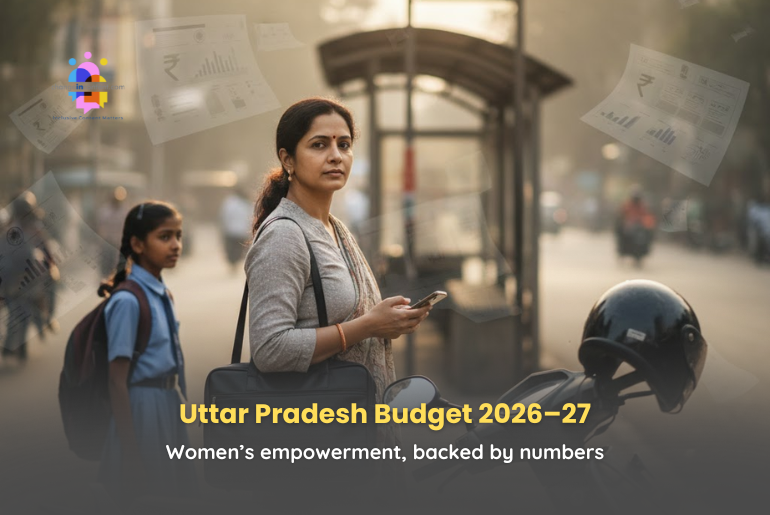
The Uttar Pradesh Budget for 2026–27 has placed women at the centre of multiple policy announcements, and not just in the symbolic sense. The Uttar Pradesh Budget conveys a clear message that the state seeks to make women’s safety, mobility, and economic participation measurable outcomes, supported by allocations and schemes.
In a country where women’s work is often unpaid, unseen, or informal, that shift matters. The central question is whether the design enables funds to reach the women who need them most, and whether the delivery systems can keep pace.
This article breaks down the women-focused numbers, what each proposal is trying to solve, and where the gaps could still show up on the ground.
The Uttar Pradesh Budget story in one snapshot
The headline figure is hard to ignore: the UP government presented a budget outlay of ₹9.12 lakh crore, around 12.2% higher than the previous year’s budget estimate.
Within that, the women-focused announcements are spread across safety, welfare, education-linked incentives, mobility support, and entrepreneurship.
It matters because women’s empowerment budgets often become a single departmental line item. Here, the approach is broader: it treats women’s participation as a cross-sector priority rather than a standalone programme.
Uttar Pradesh Budget: Women and child development gets a big allocation
One of the most direct signals is the allocation for the Women and Child Development department. Reports indicate the allocation of ₹18,620 crore, underscoring that the state prioritises women’s welfare and child development.
The number is important for two reasons. First, it strengthens the pipeline of schemes, which are typically the first point of contact for women in low-income households. Second, it determines whether services such as nutrition support, maternal care, and child-linked transfers remain reliable or become patchy.
Uttar Pradesh Budget: Kanya Sumangala, marriage grant, and the politics of “Support”
The budget continues to lean on family-centric welfare schemes that use girls’ education and life-stage support as the framing. Under the Kanya Sumangala Yojana, the budget notes benefits reaching over 26.81 lakh girls. It also reports that the grant for a daughter’s marriage has been increased from ₹50,000 to ₹1 lakh.
That is where policy intent needs careful reading. Higher grants can ease household pressure and reduce debt-driven decisions. But if the ecosystem still nudges girls towards early marriage, the “support” can quietly become a reinforcement of the same life script. The outcome will depend on how strongly education continuation, skill pathways, and safety infrastructure are funded alongside these incentives.
Uttar Pradesh Budget: Mobility is a policy tool now
A detail that deserves far more attention is the mobility push. The budget includes ₹400 crore for a dedicated scooter scheme for school and working women, intended to improve mobility and participation.
Mobility is not a lifestyle perk. In India, mobility is the difference between applying for a job and dropping out of the workforce. It shapes whether women can travel safely, reach training centres, access healthcare, and stay employed after marriage or childbirth. If implemented well, a mobility scheme can create ripple effects across education, employment, and autonomy.
Uttar Pradesh Budget: Safety, surveillance, and the everyday reality of women
The budget mentions expansion of Safe City projects, including CCTV networks and anti-Romeo squads.
The intent is clear: visible safety infrastructure.
But women’s safety is not only about surveillance. It concerns response time, complaint credibility, and whether women trust the system sufficiently to report harassment. CCTV helps after an incident. What women need is fewer incidents. The most meaningful safety investments are the ones that strengthen prevention, enforcement, and survivor support without turning public spaces into controlled zones that still blame women for being outside.
Uttar Pradesh Budget: Skill centres and the missing link between training and pay
The budget also proposes establishing special skill development centres to improve women’s economic status.
It is promising, but only if “skill” does not become code for low-wage, low-mobility work. Women in India are often trained into roles that do not enhance their bargaining power, such as beauty services, basic tailoring, and informal micro-selling. A women-focused skill budget becomes transformative only when it pushes women into higher-value roles, supports market access, and funds the bridge between training and actual income.
What the numbers suggest about the state’s strategy
Taken together, the measures reflect a recognisable model:
Support girls early, enable women’s mobility, invest in safety optics, and expand women-linked welfare delivery.
The upside is scale. The risk is fragmentation. When schemes spread across departments, women experience them as a maze. The real success of the Uttar Pradesh Budget will not be measured by announcements alone, but by whether women can access multiple supports without paperwork fatigue, corruption, or social backlash.
Changeincontent perspective
At changeincontent, we observe a recurring pattern in Indian budgets: women appear as beneficiaries but rarely as full economic actors. Mobility, safety, and skill-building are steps in the right direction. Still, they need to link to outcomes that women actually feel. It includes income security, workplace dignity, and freedom of movement without fear.
That is also why we continue to link state budgets to national signals. If you are tracking how public finance is shaping women’s lives across India, read our Union Budget deep dive as well.
We will continue to follow the implementation, the delays, and quiet disillusionment after the headlines move on.
The final thoughts
The Uttar Pradesh Budget 2026–27 places women’s empowerment within the budget’s language of scale: large outlay, multiple schemes, and a visible intent.
But announcements cannot prove empowerment. You can only prove it when a working woman can commute safely, keep her job after motherhood, access skills that raise her pay, and feel that the state sees her as more than a dependent.
The numbers are finally speaking. Now the delivery has to.
Disclaimer: The views expressed in this article are based on the writer’s insights, supported by data and resources available both online and offline, as applicable. Changeincontent.com is committed to promoting inclusivity across all forms of content. We broadly define inclusivity as media, policies, law, and history. It encompasses all elements that influence the lives of women and marginalised individuals. Our goal is to promote understanding and advocate for comprehensive inclusivity.