
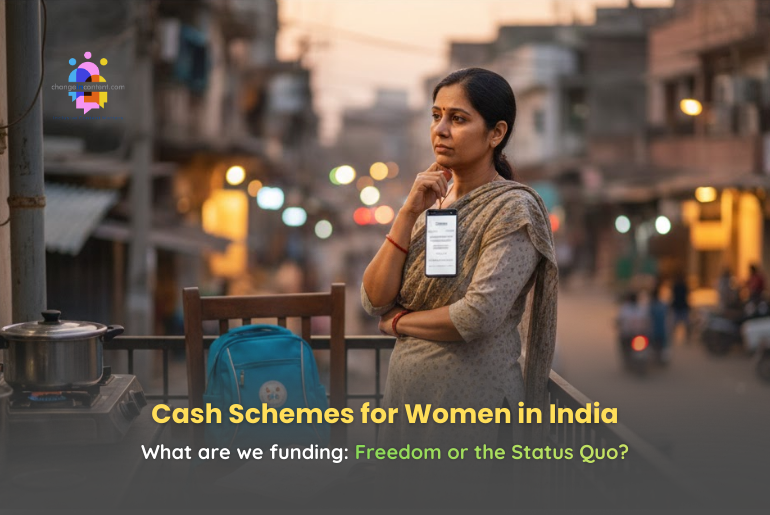
Cash schemes for women have become one of the most repeated political slogans in India over the last few years. They arrive wrapped in the language of dignity, welfare, and empowerment, and they often do offer relief. A thousand rupees can pay for a refill, a medicine strip, a child’s exam fee, or two days of groceries when the month is collapsing. For many households, this is not symbolic money. It is survival money.
But here is the question India has not asked loudly enough: when the State transfers cash specifically to women, what is the State recognising and what is it avoiding? Is it paying women because it finally sees their labour, their unpaid work, and their financial vulnerability? Or is it paying women to keep the system stable while the deeper work of jobs, care infrastructure, safety, mobility, and equal wages remains unfinished?
Let us not see this as a cynical question. It is a necessary one, because the answer changes how we judge these schemes: as empowerment, as compensation, as political insurance, or as a mix of all three.
Cash schemes for women: A new default in Indian governance
Across states, the architecture is familiar. A monthly transfer, usually routed via direct benefit transfer, with eligibility defined through age, residence, income category, family status, or exclusion criteria.
The government markets the scheme as an agency. The messaging is often maternal. It talks about well-being, household stability, children’s future, and family dignity.
For example, Madhya Pradesh’s Ladli Behna Yojana appears to be a monthly assistance program for eligible women. The scheme’s FAQs state that beneficiaries receive a monthly benefit of ₹1,250.
Tamil Nadu’s Kalaignar Magalir Urimai Thittam offers a monthly entitlement of ₹1,000 per beneficiary. The reporting around the programme repeatedly highlights the scale in crores of women covered.
West Bengal’s Lakshmir Bhandar model publicly lists monthly assistance of ₹1,000 for general categories and ₹1,200 for Scheduled Castes and Scheduled Tribes, as displayed on a district administration website.
These are not fringe pilots anymore. They are now part of the mainstream grammar of Indian welfare. And that is precisely why we need to interrogate the idea behind them, not only the intent.
What these schemes get right (and why women trust them)
Let us begin with what is working, because dismissing these transfers as “freebies” is lazy analysis. Women often trust these schemes for four grounded reasons.
First, the transfer is predictable.
Predictability is power in a life shaped by price shocks, medical surprises, school demands, and informal work that does not guarantee a steady wage. A regular transfer can be the difference between borrowing at exploitative interest and staying afloat.
Second, the money routes to women.
Even when the household treats women’s labour as the default, cash routed directly to women can shift bargaining power within the home, though that shift is often small and sometimes contested.
Third, cash is flexible.
Unlike narrowly designed subsidies, cash lets a woman decide what is urgent that month. That choice itself matters.
Fourth, cash creates visibility.
It is one of the few moments when the State appears to recognise women not as an attachment to a family card, but as citizens with a direct relationship to the system.
That is why many women defend these schemes. Because the defence is not ideological, it is a lived reality.
The uncomfortable truth: Cash often becomes a substitute for care
Here is where the question sharpens.
Many women in India are not “economically inactive” because they lack ambition. They face the constraints of an economy that leans heavily on their unpaid labour. In most households, care work is not shared work. It is women’s default work.
So a monthly transfer can serve as a quiet substitute.
- Instead of childcare infrastructure, the State pays a stipend.
- Instead of safe transport, it pays a stipend.
- Instead of maternity support that punishes employment, it pays a stipend.
- Instead of enforcing equal and dignified work, it pays a stipend.
It is not always intentional. But it is the effect when cash becomes the easiest instrument of governance.
When that happens, the scheme risks becoming a “care economy tax refund” paid to women for doing what the system refuses to redistribute.
What does it mean when the State pays women to be ‘Women’?
Let us phrase the core concern in a way that is harder to ignore.
Many of these schemes, in practice, do not pay women because of work, skill, training, or employment. They pay women because they are women in a certain life bracket. That has two competing interpretations.
- One interpretation is progressive: The State is acknowledging structural discrimination and transferring resources to correct it.
- The other interpretation is more troubling: The State is paying women for the social role it expects them to perform. Keep the household stable. Absorb inflation shocks. Manage care. Ease the distress. Raise children. Remain the shock absorber of the economy.
In that second interpretation, the transfer becomes less about women’s autonomy and more about preserving the social order with women as its unpaid infrastructure. That is why these schemes deserve a stronger vocabulary than “welfare”. They sit at the intersection of gender, labour, political strategy, and the care economy.
A reality check: Cash does not automatically create work
The most common public argument for these transfers is that they “empower” women. Empowerment is not a word we should throw around without asking: “Empower to do what?”
If empowerment means the ability to exit violence, to choose employment, to access education, to start a micro-enterprise without predatory debt, to move freely, to say no, and to delay motherhood without punishment, then cash alone is insufficient.
Cash helps, but it rarely fixes the constraints that block women’s workforce participation. Those constraints are structural. They are availability of local jobs, safety at work, childcare, social norms, skilling aligned to real demand, transport, and the absence of workplace protections in informal labour.
If the State wants these schemes to be a bridge to agency, cash must sit alongside a credible ecosystem that expands choices. Otherwise, the scheme becomes a monthly coping tool rather than a pathway.
The political economy nobody admits: These schemes are also votes
It would be dishonest to pretend that the rise of women-targeted cash schemes is only about gender justice. In many states, these programmes have become politically valuable because they are legible, visible, and emotionally resonant. Money arrives. Gratitude forms. Trust consolidates. The scheme becomes proof of governance.
But here is the risk: when political competition moves into a bidding war of monthly transfers, the public conversation narrows. Instead of asking how to build childcare systems, dignified jobs, safe cities, and accountable workplaces, we argue over whether the transfer should be ₹1,000 or ₹1,500.
That is a dangerous trade. It turns women’s empowerment into a number and women’s citizenship into a monthly receipt.
Also Read: 14,000 Men, Rs 21 Crore Lost: The blunder that haunts Ladki Bahin Yojana.
So, what should better cash schemes for women look like?
If India is going to run cash schemes for women, the question should not be whether to have them. The question should be how to design them so they expand freedom rather than create dependency.
A well-designed scheme should do five things.
It should be honest about what it is compensating for.
- If it is a care-economy support, say it.
- If it is a nutrition support, say it.
- If it is an autonomy grant, define what autonomy means in outcomes.
It should not punish employment.
The government should not design transfers in ways that disincentivise women from entering work or declaring work.
Integrate transfers with real services.
A cash transfer, paired with access to childcare, skilling pathways, safe transport, and health services, can be transformative. Cash alone is rarely transformative.
Transparent evaluation
The real question is not popularity. It is the impact on women’s decision-making power, participation in the workforce, health outcomes, and safety.
Citizenship, not charity
The government should frame these transfers as citizenship, not charity. Women do not need “help” as a favour. They need entitlement as a right.
Changeincontent perspective
At Changeincontent, we do not treat women-centric policy as either propaganda or betrayal. We treat it as evidence of what the State chooses to do easily, and what it refuses to do deeply.
Cash schemes for women can be relief, and relief matters. But relief cannot be the ceiling. Our editorial work will keep pushing the harder questions:
- Are we building public childcare at scale?
- Are we improving women’s mobility and safety?
- Are we formalising women’s work with protections?
- Are we reducing women’s unpaid labour, or are we simply paying women to carry it more quietly?
If India is serious about women-led development, then the most feminist budget line is not always the transfer. Sometimes it is the boring, stubborn infrastructure that makes women freer: childcare, toilets, safe buses, legal enforcement, workplace accountability, and local jobs.
We will keep writing where the policy language ends, and women’s lived reality begins.
The final thoughts
Cash schemes for women are neither inherently good nor inherently bad. They are powerful. And power must be questioned.
If the State is transferring money to women, we should celebrate the relief, protect the entitlement, and still ask the hardest question: is this building women’s freedom, or purchasing women’s silence in a system that refuses to change?
India does not need women to be the economy’s shock absorber forever. It needs women to be full citizens with choices. Cash can help. But only if it is the first step, not the final headline.
Disclaimer: The views expressed in this article are based on the writer’s insights, supported by data and resources available both online and offline, as applicable. Changeincontent.com is committed to promoting inclusivity across all forms of content. We broadly define inclusivity as media, policies, law, and history. It encompasses all elements that influence the lives of women and marginalised individuals. Our goal is to promote understanding and advocate for comprehensive inclusivity.
