
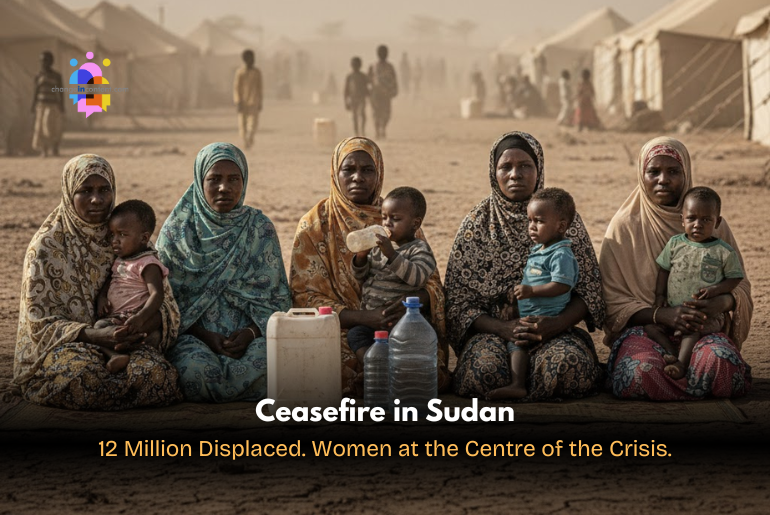
The demand for a Ceasefire in Sudan has intensified after UN Women publicly appealed for an immediate halt to hostilities during the recent African Union Summit in Addis Ababa. Speaking at the high-level gathering, Deputy Executive Director Dr Nyaradzayi Gumbonzvanda underscored the disproportionate toll the conflict is taking on women and girls.
According to UN Women, the ongoing war in Sudan has displaced more than 12 million people. Over half of them are women and children. The agency has also documented widespread cases of sexual violence, including rape, systematically used as a weapon of war.
It is no longer only a geopolitical conflict. It is a gendered emergency.
Why UN Women is calling for a ceasefire in Sudan
The conflict in Sudan, which erupted in April 2023 between rival military factions, has evolved into one of the world’s largest displacement crises. International agencies, including the United Nations, have described it as one of the most severe humanitarian disasters in recent years.
UN Women’s appeal for a ceasefire is grounded in both numbers and patterns. When more than 12 million people are displaced, housing collapses. Healthcare systems fail. Food insecurity surges. Women and girls often lose access to reproductive healthcare, maternal care, and protection services first.
Dr Gumbonzvanda’s remarks at the African Union Summit made clear that peace negotiations cannot remain detached from gender realities. She emphasised that violence against women in conflict zones is not incidental. It is structural and frequently strategic. Sexual violence is deployed to destabilise communities, instil fear, and fracture social cohesion.
A ceasefire, from UN Women’s perspective, is not only about stopping gunfire. It is about halting the machinery that enables systemic gender-based violence.
The gendered impact of war: Beyond displacement numbers
Statistics alone rarely capture what displacement means in practice. When families flee, women often become primary caregivers in unfamiliar territories. Many end up in overcrowded camps with limited sanitation and little security.
Reports from humanitarian organisations indicate rising incidents of rape, forced marriages, and exploitation in displacement camps and conflict-affected regions. In prolonged periods of instability, girls are pulled out of school. Women lose livelihoods. Informal economies expand, often exposing them to unsafe labour conditions.
Human rights groups have widely reported the use of sexual violence as a weapon of war in Sudan. Survivors face not only trauma but stigma. In conservative societies, this stigma can mean social isolation, forced marriage, or abandonment.
The call for a Ceasefire in Sudan, therefore, intersects with the demand for survivor-centred justice and long-term reconstruction that recognises women as agents, not victims.
International diplomacy and the African Union’s role
The African Union Summit provided a crucial platform for this appeal. Regional diplomacy carries weight in African conflicts, particularly when continental institutions push for coordinated responses.
The African Union has repeatedly urged de-escalation in Sudan. However, implementation remains fragile. Ceasefire agreements in the past have collapsed quickly. Humanitarian access has been obstructed. Aid delivery remains inconsistent.
UN Women’s intervention at the summit signals an attempt to ensure that women’s voices are not sidelined in diplomatic negotiations. Historically, peace talks that exclude women produce less durable outcomes. Data from global peace processes show that agreements are more sustainable when women participate meaningfully.
The ceasefire debate, therefore, is also about representation. Who negotiates peace, and whose safety is prioritised?
Economic shockwaves and regional context
While Sudan struggles under conflict, neighbouring countries face ripple effects. Displacement increases pressure on border regions. Economies strain under refugee inflows. The BBC report that accompanied the coverage of UN Women’s appeal also referenced Zambia’s declining inflation, illustrating how economic stability elsewhere in Africa contrasts sharply with Sudan’s humanitarian breakdown.
The juxtaposition is telling. In regions where governance stabilises economies, cost-of-living indicators improve. In war zones, inflation, scarcity, and insecurity compound each other. Women often absorb this shock first by reducing food intake, withdrawing from paid work, or engaging in precarious survival strategies.
Conflict is never gender neutral. Economic instability is never gender neutral, either.
Ceasefire in Sudan: What happens after silence
A ceasefire is the beginning, not the solution. If hostilities pause tomorrow, the scale of reconstruction required in Sudan will be immense. We must rebuild health systems. Trauma services expanded. Schools reopened. Women must regain land rights, employment opportunities, and access to justice.
Post-conflict recovery frameworks often underfund gender-responsive initiatives. That cannot be repeated here. The longer the conflict continues, the deeper the structural damage becomes. UN Women’s message is therefore layered. Stop the violence. Protect women and girls. Ensure accountability. Include women in rebuilding Sudan’s institutions.
Changeincontent perspective
At Changeincontent, we have consistently argued that wars do not simply redraw borders. They redraw gender hierarchies. Women’s bodies become battlegrounds. Care work intensifies. Economic independence collapses.
We have previously examined how armed conflicts disproportionately impact women’s safety, mobility, and economic autonomy in our coverage on the gendered impact of war. The Sudan crisis reinforces that analysis. When over half of the 12 million displaced people are women and children, the phrase “humanitarian crisis” must be understood as a gender crisis.
Also Read: Wars on women escalate: When global conflicts turn personal.
The demand for a ceasefire in Sudan is therefore not a diplomatic slogan. It is a human rights imperative grounded in data, lived experience, and the recognition that sustainable peace requires women at the negotiating table.
UN Women demands a ceasefire in Sudan: Closing thoughts
The call for a ceasefire in Sudan is urgent. The numbers are stark. Twelve million displaced. More than half of them are women and children. Documented systemic sexual violence.
But beyond statistics lies a deeper truth. Conflicts reveal whose lives are considered expendable. UN Women’s appeal at the African Union Summit reframes the conversation. Peace must be gender responsive. Safety must be structural.
Silence the guns. Protect women and girls. Build a future where a ceasefire does not mean temporary relief, but the foundation of lasting justice.
Disclaimer: The views expressed in this article are based on the writer’s insights, supported by data and resources available both online and offline, as applicable. Changeincontent.com is committed to promoting inclusivity across all forms of content. We broadly define inclusivity as media, policies, law, and history. It encompasses all elements that influence the lives of women and marginalised individuals. Our goal is to promote understanding and advocate for comprehensive inclusivity.
