
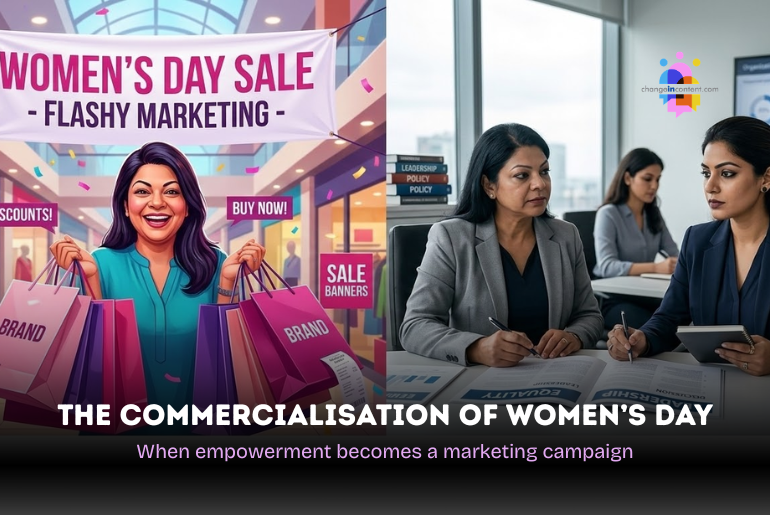
Every year, in the week leading up to March 8, the colour pink begins to dominate timelines, storefronts, and advertisements. Brands launch “Women’s Day Specials.” Restaurants offer complimentary desserts. Shopping apps promote limited-time deals. You may have already seen something like “Use code WOMEN20 for 20% off.” The commercialisation of Women’s Day is evident and concerning.
At first glance, it appears celebratory. Businesses seem eager to honour women. Social media campaigns speak about empowerment and appreciation. But look a little closer, and a different question begins to emerge.
When did a day rooted in protest and political struggle become another marketing event on the calendar?
The missing theme in celebrating International Women’s Day
International Women’s Day was born from labour movements and activism demanding fair wages, safe working conditions, and voting rights. Yet today, the conversation often drifts away from those origins toward shopping carts, lifestyle campaigns, and promotional codes.
The commercialisation of Women’s Day has transformed a historic movement into a seasonal marketing opportunity. And in doing so, it risks diluting the very issues the day was meant to spotlight.
The commercialisation of Women’s Day and the rise of ‘Empowerment Marketing.’
Over the past decade, brands have recognised the visibility and emotional resonance surrounding International Women’s Day. It offers an opportunity to connect with audiences through powerful messaging.
Campaigns feature inspirational quotes, stories of resilience, and hashtags celebrating women’s strength. Advertisements highlight independence and ambition. But almost inevitably, these messages are tied to products.
Empowerment becomes something you can purchase.
- A dress that celebrates confidence.
- A travel package that represents freedom.
- A beauty product marketed as self-expression.
Empowerment can not always be consumption.
While there is nothing inherently wrong with celebrating women through storytelling, a subtle shift is evident. The language of empowerment often leads back to consumption.
Instead of encouraging deeper engagement with issues such as wage inequality, leadership representation, or workplace discrimination, many campaigns frame empowerment as something that can be expressed through shopping.
This narrative reduces empowerment to a lifestyle choice rather than a structural challenge. And it quietly reinforces another stereotype that women are primarily consumers. Yet women’s contributions extend far beyond consumer identities. They are scientists, entrepreneurs, policymakers, artists, engineers, and leaders shaping economies and societies.
Reducing Women’s Day to promotional campaigns risks shrinking the scope of that reality.
Also, Women’s Day Deals aren’t for every woman.
The irony of many Women’s Day promotions lies in who they truly reach.
A luxury fashion brand might announce a “50% Women’s Day sale” on a designer handbag originally priced at ₹40,000. Even after the discount, the bag still costs ₹20,000.
How many women realistically consider that accessible?
Do those who need it actually benefit from Women’s Day Deals?
Many offers are directed toward a relatively privileged urban consumer group with disposable income and access to digital media. Yet millions of women across India and the world face very different priorities.
- Stable employment.
- Fair wages.
- Access to healthcare.
- Opportunities for education and financial independence.
For them, a promotional code offers little relevance.
Even access to digital promotions is uneven. While smartphones appear ubiquitous in urban conversations, only about 56.6% of women actually own a smartphone. Many Women’s Day deals circulate primarily among digitally connected audiences.
The result is a celebration that often excludes the very women whose struggles originally inspired the movement.
Corporate celebration & workplace reality: The mismatch that not many talk about
Corporate workplaces often participate enthusiastically in Women’s Day celebrations.
Some organisations distribute gift hampers or organise themed events. Others host networking sessions or panel discussions in office spaces or urban malls. While these gestures may be well-intentioned, they can sometimes coexist with deeper structural challenges inside the same organisations.
A company might celebrate Women’s Day while still struggling with gender pay gaps. Another may host empowerment events while women remain underrepresented in leadership roles.
These contradictions reveal an uncomfortable truth.
Celebration is easier than structural change. Addressing pay gaps, improving maternity and caregiving policies, or redesigning leadership pipelines requires sustained commitment. Promotional campaigns require far less effort.
The commercialisation of Women’s Day often allows organisations to signal support without confronting these deeper questions.
Commercialisation of Women’s Day and the long road to gender equality
If the current pace of progress continues, global gender equality remains a distant goal.
According to the United Nations estimates:
- Ending child marriage worldwide could take 300 years.
- Closing gaps in legal protections for women may take 286 years.
- Achieving equal representation in workplace leadership could take 140 years.
- Equal representation in national parliaments could take 47 years.
These numbers illustrate the scale of the challenge.
Across the world, women continue to face barriers in education, employment, legal rights, and political representation. Wage gaps persist. Unpaid care work remains disproportionately carried by women. Gender-based violence continues to affect millions.
Against this backdrop, transforming Women’s Day into a shopping festival feels deeply disconnected from the struggles that shaped its origins.
The changeincontent perspective on the commercialisation of Women’s Day
At Changeincontent, we approach Women’s Day through a slightly different lens. For the past two years, we have observed the day through our #NoWomensDay campaign.
The campaign does not reject celebration. Women’s achievements deserve recognition. Stories of progress inspire younger generations and remind us how far society has come. However, celebration must never replace reflection.
The purpose of #NoWomensDay is to pause the marketing noise and ask harder questions.
- Are workplace policies genuinely inclusive?
- Are leadership pipelines open to women?
- Are organisations willing to address issues such as pay equity, caregiving responsibilities, and women’s health?
Changeincontent was built on the belief that content shapes culture.
Content is not limited to articles or social media posts. It appears in policy documents, workplace language, corporate messaging, and the narratives that influence how societies understand equality.
When the content around Women’s Day focuses only on celebration and consumption, it risks overlooking the structural conversations that still need attention.
Our goal is to ensure those conversations continue.
The final thoughts: Reclaiming the meaning of Women’s Day
Women’s Day should be more than a marketing moment. It should encourage societies to reflect on progress, acknowledge persistent inequalities, and push institutions toward meaningful change.
Celebration and reflection can coexist. Recognising women’s achievements matters. But genuine progress requires moving beyond symbolic gestures toward conversations about policies, representation, workplace equity, and access to opportunity.
The question is not whether Women’s Day deserves celebration. The real question is whether we are willing to use it as an opportunity to confront the systems that still shape women’s lives.
Disclaimer: The views expressed in this article are based on the writer’s insights, supported by data and resources available both online and offline, as applicable. Changeincontent.com is committed to promoting inclusivity across all forms of content. We broadly define inclusivity as media, policies, law, and history. It encompasses all elements that influence the lives of women and marginalised individuals. Our goal is to promote understanding and advocate for comprehensive inclusivity.
