
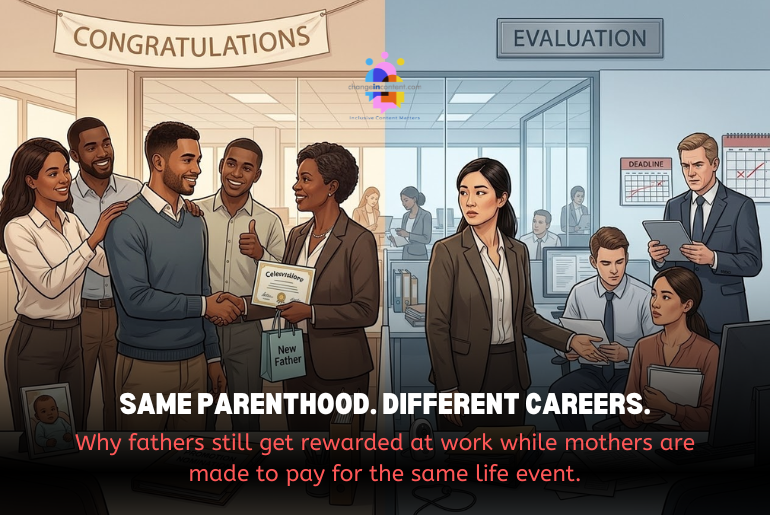
A new Naukri report has put something painfully familiar into words. It shows that many women in India still do not feel safe discussing marriage or maternity in job interviews. 1 in 2 women say they hesitate to disclose those plans because they fear workplace bias. That concern rises sharply among women as they progress further in their careers. That anxiety does not come from nowhere. It reflects a workplace reality in which the fatherhood premium and motherhood penalty still operate side by side.
When women become mothers, employers often start to read them through the lens of risk. This language includes terms like “less available”, “less committed”, and “more likely to step back”. But when men become fathers, they are often read through the language of stability. That means more responsible, more dependable, more deserving of higher pay and leadership trust.
Research across labour markets has repeatedly shown that earnings and career trajectories tend to diverge after parenthood. That is not because women become less capable, but because workplaces still reward fatherhood and punish motherhood in unequal ways.
That is what makes this conversation so important. The problem is not motherhood alone. It is the system that turns parenthood into a career advantage for one gender and a professional liability for the other.
What the Fatherhood Premium and Motherhood Penalty really mean at work
The fatherhood premium, sometimes called the fatherhood bonus, refers to the workplace advantage many men receive after becoming fathers. Employers often view fathers more positively at work. That perception leads to benefits such as higher pay, better salary growth, promotions, or greater trust in leadership roles.
When women become mothers, employers often question their availability, commitment, or long-term career plans. This reaction leads to what many call the motherhood penalty, where women face slower promotions, pay gaps, or fewer opportunities after having children. But when men become fathers, they are seen as more responsible, more stable, and more motivated to work harder to support their families.
How the Fatherhood Premium and Motherhood Penalty show up in pay and job security
Even during a major job crisis, men with children still had a better chance of keeping their jobs than women with or without children.
The layoff gap that parenthood did not close
A study on employment inequality along the lines of gender and parenthood during the COVID-19 pandemic reports this gap. Even though layoffs increased across the board during the crisis, fathers still faced a lower risk of losing their jobs. The probability of being laid off increased by about 6.1% for fathers during COVID. However, the increase was much higher for women. For mothers, it rose to about 10.1%, and for women without children, it went up to around 12.5%.
Among college graduates aged 35 to 39, women with children earn about 11% less than those without children. That reflects the motherhood penalty. However, when researchers compare mothers and fathers in the same group, mothers earn about 42% less than fathers.
Why does the earnings gap widen after children?
Studies show that fathers often receive about a 6% pay increase for each child, while mothers usually see the opposite effect. Women’s earnings tend to drop by around 4–7% after having a child. Over time, this difference adds up. By the time many workers reach their early forties, the fatherhood premium can provide roughly a 21% pay advantage for individual men by age 42. At the same time, mothers continue to experience slower wage growth during the same years.
Why Academia often amplifies the Fatherhood Premium
Fathers publish about 1.4 more papers than men without children, while mothers publish only around 0.7 more papers than women without children. When researchers compare parents directly, the gap becomes even more noticeable. Fathers publish about 0.8 more papers than mothers, which creates a clear gender productivity gap among academic parents.
Several factors explain why this happens.
When productivity metrics ignore care work
Academic careers depend heavily on continuous research, conference participation, and publishing papers. Mothers often face interruptions during pregnancy, maternity leave, and the early years of childcare. They also tend to take on a larger share of household and caregiving responsibilities. All of this can reduce the time available for research and writing.
Fathers, on the other hand, often continue their work routines without the same level of interruption. In some cases, becoming a father can even increase professional stability or motivation, which may lead to higher productivity.
For this reason, some researchers describe Academia as showing a “fatherhood super-premium.” Fathers often outperform not only academic mothers but also male academics without children.
Changing roles at home
At the same time, a new generation of fathers has started to challenge these old ideas. Many younger men today see themselves as involved and engaged parents who share childcare, school runs, and household work with their partners. However, society as a whole still moves slowly.
Many employers continue to expect women to take on most caregiving responsibilities, while they see men as the ones who stay fully focused on work. Because of this mindset, women often face questions about flexibility, availability, or career breaks after becoming parents. Men, on the other hand, rarely face the same doubts.
In many offices, long working hours, limited parental leave for fathers, and rigid work policies still make it harder for parents to share responsibilities equally. So even if families want a more balanced approach at home, workplace systems often push them back into traditional roles.
The changeincontent perspective
The most uncomfortable truth here is that many workplaces still do not evaluate parents equally. They evaluate them through gendered assumptions. They often see a father as settled and dependable. Conversely, they see a mother as distracted and costly. That is not a talent problem. It is a design problem.
If organisations are serious about inclusion, they have to stop treating caregiving as a women’s issue and start rebuilding work around shared parenthood. That means normalising paternity leave, removing bias from hiring and promotion decisions, auditing pay progression after parenthood, and questioning productivity models that reward constant availability over actual contribution.
The point is not to ask women to “lean in” harder while systems remain tilted. The point is to make parenthood stop being a career penalty for one gender and a career premium for the other.
Also Read: Mother’s Day is over. Now let’s talk about the ‘Motherhood Penalty’.
Conclusion: Why workplaces still reward fathers and penalise mothers
Why do women still face a motherhood penalty while the other parent often receives a fatherhood premium? When workplaces continue to push the image of the “ideal worker” as a married man with children, they also end up pushing women out of the workforce. This idea treats fathers as stable providers who will focus on work, while mothers are seen as people who will step back for caregiving.
As long as this image stays at the centre of hiring, promotions, and workplace expectations, women will continue to face the motherhood penalty while men benefit from the fatherhood premium.
Disclaimer: The views expressed in this article are based on the writer’s insights, supported by data and resources available both online and offline, as applicable. Changeincontent.com is committed to promoting inclusivity across all forms of content. We broadly define inclusivity in terms of media, policies, law, and history. It encompasses all elements that influence the lives of women and marginalised individuals. Our goal is to promote understanding and advocate for comprehensive inclusivity.
