
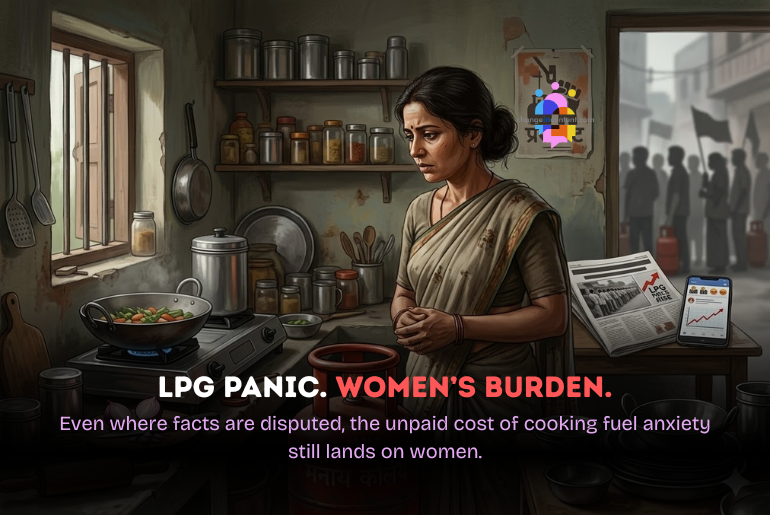
For many Indian households, what is now being discussed as the LPG Crisis in India is not just about fuel. It is about fear, uncertainty, and the quiet reshuffling of daily life inside the kitchen. Reports of panic buying, delayed deliveries, black-market rates, and long queues constantly create real anxiety. But even where facts remain contested, one truth is hard to ignore. Whenever cooking fuel becomes uncertain, women are usually the first to bear the brunt of the disruption.
The government has repeatedly said that household LPG supply remains protected, that oil marketing companies hold adequate stocks, and that people should avoid panic booking. The Prime Minister has also urged responsible public discourse and warned against misinformation amid wider global energy instability. At the same time, official steps to divert more supply toward domestic cooking gas and multiple reports of commercial LPG disruption show why confusion has spread so quickly.
That is why we cannot reduce this story to a question of whether there is a full-blown household crisis. Even a rumour-driven squeeze, a local shortage, a delivery delay, or a price shock can change how families cook, what they eat, and who carries the extra burden. In India, that burden still falls disproportionately on women, who we expect to keep meals running no matter what the supply chain says.
Why “Just Use Firewood” cannot solve the LPG crisis in India.
When LPG shortages hit, many people quickly say just switch to firewood. It sounds easy, but for millions of women across India, that simple switch means hours of extra work every single week. Someone has to collect that wood, carry it home, break it down, and prepare it for cooking. And in most households, that someone is a woman.
The unpaid hours hidden inside “alternative fuel”
In India, women spend around 374 hours every year just collecting firewood. That is more than 15 full days spent only on gathering fuel. In many rural areas across South Asia, women already handle most of the cooking. They also take on the exhausting task of collecting biomass fuels like wood, crop waste, or dung cakes.
This work can take 20 hours or more every week. Imagine adding that on top of daily chores, childcare, and paid work. It is physically draining and often entails long walks, heavy loads, and lost time that women could have spent on rest, education, or income.
What women lose when clean cooking access becomes uncertain
When households adopt LPG, women spend far less time hunting for fuel. They collect firewood less often and prepare fewer dung cakes compared to families that still depend on traditional fuels. Even cooking itself becomes faster. Studies show that LPG users save around 15 minutes of cooking time every day. Over a year, that adds up to hours that women get back.
Women who use improved cookstoves save around 70 hours every year compared to traditional methods. That is time that can go into work, rest, or simply having a little breathing space in the day.
When cooking fuel changes, women breathe the consequences
In many South Asian homes, women handle most of the cooking. When families rely on biomass fuels like firewood or dung, they spend hours in smoke-filled kitchens. This daily exposure creates serious health risks over time. Air pollution, both inside the house and outside, takes a heavy toll on women’s health across the region.
Research shows that air pollution causes about 29% of miscarriages in South Asia, including in India, Pakistan, and Bangladesh, between 2000 and 2016. Studies also highlight the difference cooking fuel can make. A study from West Bengal found that households using biomass fuels faced a toxicological risk score of 1.15, while those using LPG recorded a much lower score of 0.14.
How the LPG Crisis in India hurts women entrepreneurs and small food businesses
Across rural and semi-urban India, many women run small food businesses, such as home catering units, roadside eateries, and messes that serve daily meals to workers and students. In Kerala, the women’s collective Kudumbashree runs small eateries and community messes that serve affordable homemade food every day. These kitchens often operate on tight budgets and small margins, but they provide steady income for thousands of women entrepreneurs.
For these women entrepreneurs, an LPG shortage or a sudden price spike is both an inconvenience and a negative impact on their income. Small hotel owners and mess operators already deal with rising food prices and high operating costs. If LPG becomes scarce or expensive, they must either increase meal prices or absorb the loss.
Why “just switch to induction” is not a realistic answer
Some might now say, why not just switch to an induction cooktop? But realistically, how many households have ₹2,000 or ₹3,000 lying around just to buy a new stove? And the spending does not stop there. Induction cooktops need special utensils that work with them, which means buying new pots and pans, too.
On top of that come higher electricity bills, something many families already worry about. For households already struggling with rising food prices and daily expenses, switching to induction is neither quick nor affordable.
The question itself comes from a place of privilege.
The changeincontent perspective
The most revealing part of this moment is not only whether India is facing a full domestic LPG shortage. It is how quickly women’s labour becomes the fallback system whenever essential infrastructure feels shaky. That is the real warning here.
A country cannot talk about clean energy access, women’s dignity, public health, and economic participation, then treat cooking fuel as a minor household inconvenience. If supply remains stable, the government must communicate that stability clearly and deliver fairly. If disruptions are local or sectoral, they must still be taken seriously before they spill into homes.
The answer is not to romanticise resilience or tell women to “manage somehow”. It is to strengthen transparent communication, protect affordable household access, aggressively crack down on black marketing, and stop pretending that domestic energy stress is gender-neutral. Because in India, it still is not.
Also Read: Sustainability by Indian Women: How the average Indian woman made sustainability a daily habit.
The final thoughts: India cannot afford to slip back to smoky kitchens
For decades, many Indian homes depended on firewood, crop waste, or dung cakes to cook daily meals. But these fuels filled kitchens with thick smoke and created a serious health risk, especially for women who spend the most time near the stove. To address this, India gradually began moving toward LPG as a cleaner cooking fuel.
Official reassurance does not erase household anxiety
Today, India stands as the world’s second-largest consumer of LPG. More than 300 million households now hold LPG connections, and a big push came from the Pradhan Mantri Ujjwala Yojana, which expanded access to clean cooking fuel for millions of low-income families.
Nearly 7.2 million tons of fuelwood were replaced by increased access to LPG in the country. However, the LPG shortage shows how something as basic as cooking fuel still deeply connects to gender, health, and livelihoods in India.
Why women will still carry the shock first
An LPG shortage may start as a supply issue, but inside households, the impact reaches much further. The kitchen still depends heavily on women’s time and labour. Every disruption, whether through shortages, price spikes, or weak distribution, adds extra work to their daily lives.
It is not only about cooking faster or saving time. It also means fewer smoky kitchens, less daily exposure to harmful fumes, and protecting women’s health in the long run.
Disclaimer: The views expressed in this article are based on the writer’s insights, supported by data and resources available both online and offline, as applicable. Changeincontent.com is committed to promoting inclusivity across all forms of content. We broadly define inclusivity in terms of media, policies, law, and history. It encompasses all elements that influence the lives of women and marginalised individuals. Our goal is to promote understanding and advocate for comprehensive inclusivity.
