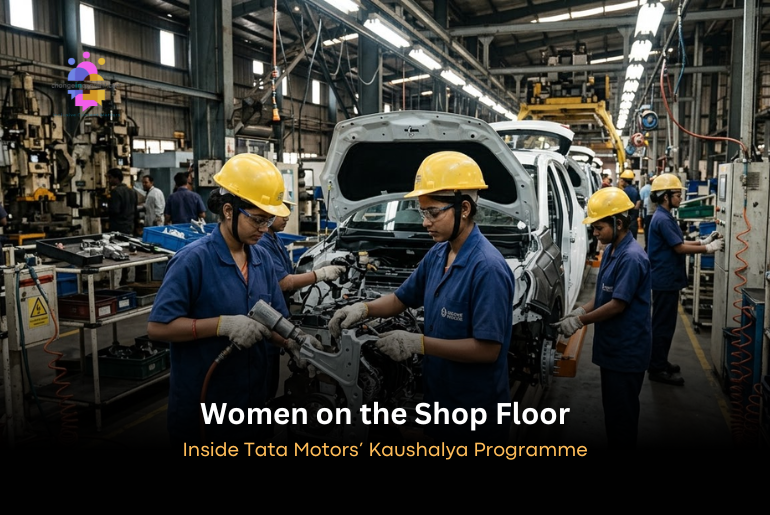
The Kaushalya Programme by Tata Motors is doing something that many diversity conversations in India often struggle to achieve. It is not limited to intent, policy language, or corporate messaging. Instead, the programme is placing women directly on the shop floor. Tata Motors is giving them roles that have historically remained male-dominated. The company is doing so through a structured pathway that combines work, education, and long-term employability.
At Tata Motors’ TCF-2 plant in Pune, where vehicles like the Harrier and Safari are assembled, young women are no longer exceptions on the line. They are part of the workforce, trained, deployed, and increasingly trusted with responsibility. This shift is not incidental. It is the outcome of a deliberate programme to address the structural gaps that have traditionally kept women out of manufacturing roles.
What makes this initiative worth examining is not just its scale, but its design. It acknowledges that we cannot achieve inclusion by hiring alone. We must build it into how we discover, train and sustain talent.
What the Kaushalya Programme by Tata Motors actually does
The Kaushalya Learn and Earn Programme is a hybrid model that integrates shop-floor experience with formal education. It is open to ITI graduates and students who have completed their 12th standard. The programme offers them the opportunity to begin working while pursuing a diploma through partner institutions such as the Nettur Technical Training Foundation.
This dual structure is central to the programme’s impact. It allows participants to gain hands-on industry exposure while continuing their academic journey, effectively removing the traditional trade-off between earning and learning. For many young workers, particularly women, this model reduces both financial and social barriers to entering the workforce.
According to Tata Motors, over 20,000 students are currently enrolled in the programme. Tata Motors has ensured approximately 4,600 placements over the last three years across the company, its suppliers, dealers, and the broader automotive ecosystem.
Women on the shop floor: What is changing
While the programme is open to all, one of its most significant outcomes has been the gradual increase in women’s participation in manufacturing roles. Women currently make up around 21% of the trainees. That figure may appear modest, but it represents a meaningful shift in an industry where female representation on shop floors has historically been negligible.
The change becomes more visible when one looks beyond entry-level numbers. At the Pune plant, 69 women from earlier batches have moved into team leader roles. It does not merely indicate participation but progression. Some have also begun exploring opportunities in engineering and managerial functions within the organisation.
That is where the programme distinguishes itself from many diversity initiatives. It does not stop at inclusion. It creates pathways for advancement.
The geography of opportunity
One of the more nuanced aspects of the Kaushalya Programme by Tata Motors is how it addresses geographical and social constraints.
A significant number of women trainees come from towns and villages within a 100- to 150-kilometre radius of Pune. It is not accidental, as it reflects a practical understanding of the barriers that still exist for women entering the workforce.
In many parts of India, families remain hesitant to send young women to distant cities for work. By creating localised employment and training opportunities, the programme makes participation more acceptable and accessible.
This approach reveals that inclusion is not only about opportunity. It is also about proximity.
Learning while Earning: Why the model works
The success of the Kaushalya Programme lies in its ability to align three critical elements.
- First, it offers financial independence from the start. Trainees earn while they learn. That reduces the economic burden on families and increases acceptance of their career choices.
- Second, it builds practical competence alongside academic knowledge. Unlike traditional education pathways, which often lack industry exposure, this model ensures participants are job-ready from day one.
- Third, it provides placement assurance across the ecosystem. Tata Motors states that it offers 100% placement assistance after completion of the programme, whether within the company or through its extended network.
For young women entering the workforce, this combination of income, skill development, and career continuity significantly reduces uncertainty.
The larger industrial context
India’s manufacturing sector has long struggled with low female labour force participation, particularly in shop-floor roles. While sectors such as services and IT have seen increased gender diversity, manufacturing has remained slower to adapt.
That is partly due to structural issues such as shift timings, workplace infrastructure, safety concerns, and long-standing perceptions about the nature of industrial work.
Programmes like Kaushalya attempt to address these challenges indirectly by:
- Creating structured entry pathways
- Building confidence through training
- Normalising women’s presence in industrial settings
However, the scale of the challenge remains large. A single programme, even one with thousands of participants, cannot by itself transform an entire sector.
What still needs attention
While the Kaushalya Programme by Tata Motors marks meaningful progress, it also raises certain questions.
The current 21% representation of women indicates growth, but also highlights how much further there is to go. Increasing this number will require sustained outreach, policy alignment, and industry-wide replication of similar models.
Retention is another critical factor. While entry numbers are encouraging, long-term participation depends on workplace conditions, career growth opportunities, and continued support.
There is also the question of scale. Can this model be replicated across other manufacturing clusters in India, or will it remain concentrated within a few progressive organisations?
At Changeincontent, we have previously explored how Tata Motors has approached women’s inclusion more broadly.
Read more here.
What organisations can learn from the Kaushalya Programme by Tata Motors
The Kaushalya Programme offers a few clear lessons for organisations looking to move beyond symbolic inclusion.
- First, design matters more than intent. Companies must build inclusion into the structure of hiring, training, and progression.
- Second, early-stage intervention is critical. Waiting until mid-career to address diversity gaps often limits impact.
- Third, local context cannot be ignored. Programmes must account for social realities, not just corporate objectives.
- Finally, career pathways must be visible. Entry without progression does not create long-term change.
The changeincontent perspective
The Kaushalya Programme is not a perfect solution. But it is a serious one. It recognises that we cannot achieve inclusion through isolated hiring decisions or short-term initiatives. It requires systems that support individuals from entry to progression.
What stands out is its focus on execution. It moves the conversation from policy to practice, from intent to impact. At a time when diversity discussions often remain abstract, this programme offers something tangible. It puts women on the shop floor.
Conclusion: Real inclusion is built, not announced
The story of the Kaushalya Programme by Tata Motors is not just about numbers. It is about how those numbers come into existence. Inclusion does not begin when you hire someone. It begins much earlier, in how opportunities are created, communicated, and made accessible.
India’s manufacturing sector still has a long way to go in achieving gender balance. But programmes like this show that change is possible when it is approached with clarity and commitment.
The question now is not whether such models work. It is whether more organisations are willing to build them.
Disclaimer: The views expressed in this article are based on the writer’s insights, supported by data and resources available both online and offline, as applicable. Changeincontent.com is committed to promoting inclusivity across all forms of content. We broadly define inclusivity in terms of media, policies, law, and history. It encompasses all elements that influence the lives of women and marginalised individuals. Our goal is to promote understanding and advocate for comprehensive inclusivity.