
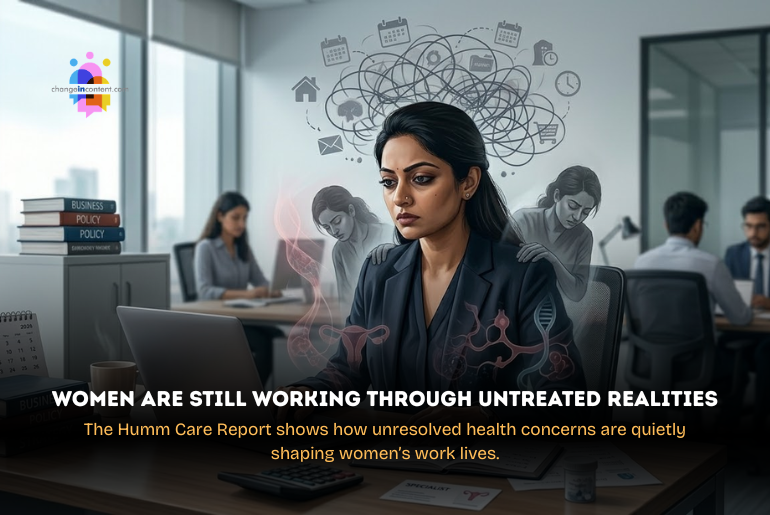
The Humm Care Report forces attention onto something workplaces still prefer to treat as secondary. That is the unresolved health concerns women carry into work every day. These are not occasional disruptions. They are recurring realities tied to reproductive health, hormones, mental well-being, maternity, caregiving, and midlife change. All these shape how consistently women can participate in the workforce.
Humm Care’s Women’s Health & Workplace Report 2026, based on responses from 200+ working women across India, frames these concerns not as fringe issues, but as systemic barriers to continuity and performance.
That matters because organisations often talk about inclusion in terms of hiring, representation, and policy language. Still, they leave women to privately manage the physical and emotional cost of staying employable.
The stronger takeaway, then, is not simply that women need more empathy. Employers need to stop designing health support around a generic worker who does not exist. If health systems at work keep ignoring the actual life stages and conditions women navigate, the workplace will continue to lose them and then call it an individual choice.
89% young women feel that health issues impact work: Humm Care Report
The Humm Care report surveyed 211 women across Tier 1, Tier 2, and Tier 3 cities in India. Of these, 55.9% women were from Tier 1, 28.4% from Tier 2, and 15.6% from Tier 3. Women report a noticeable drop in productivity due to health concerns at every stage of life. Among women aged 18 to 24, the Humm Care Report says 89% report that health concerns affect their productivity. That makes early-career work far less stable than most employers assume. Many of them deal with symptoms that workplaces do not acknowledge or accommodate.
Taking time off, asking for flexibility, or even speaking about these issues is not always easy, especially when they are new to the workforce. Alongside this, women in their early 20s report poorer mental health compared to other age groups. That makes it harder to balance work expectations with personal well-being.
The conditions that workplaces still do not know how to support
Some of these conditions remain deeply under-discussed at work, especially PCOS and thyroid disorders. Humm Care’s findings indicate that nearly 5% of respondents specifically want employers to cover PCOS and thyroid treatments. That demand makes sense in a country where outside research continues to show that these are not rare concerns. A 2025 Delhi NCR study of 1,164 women aged 18 to 25 reported a PCOS prevalence of 17.4%, with 70.3% already diagnosed and 29.7% newly diagnosed during the study.
How caregiving and health strain push women out of the workforce
The Humm Care Report also shows how quickly health and care burdens overlap. That makes it harder for women to stay in the workforce even when they want to.
The report shows that 58% of women have either left or considered leaving a job due to a lack of caregiving or childcare support. It shows how common it is for women to reach a point where work and caregiving responsibilities start to clash in ways that are hard to manage. 56% of women said they sometimes felt overwhelmed balancing work and caregiving responsibilities.
It also affects women at different stages. Early in their careers, it may be about supporting family members. Later, it often includes childcare along with other responsibilities.
Childcare, eldercare, and even day-to-day household responsibilities require time, flexibility, and often money. When workplaces do not provide options like flexible hours, remote work, or caregiving support, women end up adjusting their careers instead. It can mean stepping back, switching to low-paying roles, or leaving altogether.
Why maternity still triggers career anxiety and health pressure
Returning to work after maternity leave is not a smooth transition for many women. About 47% say they fear losing out on career growth or promotion opportunities after taking maternity leave. There is also a sense that maternity leave can change how workplaces see women. Roles, responsibilities, and expectations may shift. As a result, women often return to find fewer opportunities or feel the need to prove their commitment all over again.
Financial concerns add to this. Around 32% of women say they worry about the financial impact of maternity leave and returning to work. It includes loss of income, added childcare expenses, and the uncertainty of career progression.
What women actually want from workplace health support, according to the Humm Care Report
As women enter their late 20s and early 30s, their health needs become more specific, and many women in this age group actively seek healthcare support from employers. There is a rising expectation that workplaces should share responsibility for employee well-being. Nearly 41% say that they want company-paid healthcare benefits.
When asked what kind of employer-paid support would help them the most, there was a higher preference for preventive care and specialist access. However, it needs to be easy to use, confidential, and paid for or supported by employers.
About 53% of respondents say they want easier, more direct access to specialists such as OB-GYNs and endocrinologists. Working women are also seeking regular preventive check-ups and diagnostic tests, as well as mental health therapy.
From fertility support to midlife care, the gaps are widening.
As per the report, 20% of women say they need fertility-related insurance or support. After all, a significant portion of working women are at a stage in their lives where they are making decisions about family planning, often while managing demanding careers. Moreover, 39% women said workplaces with family-supportive infrastructure and flexible leave policies are the strongest enablers of long-term career continuity.
Midlife women (45+) face rising challenges such as perimenopause, chronic pain, and sleep issues, yet most employer health plans do not cover these needs. At 45+, 91% say an employer-funded OPD wallet would help them take better care of their health.
From early preventive care to fertility support and midlife health needs, healthcare at work should be accessible, relevant, and actually usable. When these needs are not met, women are left to fill the gaps on their own, often at the cost of their health and continuity at work.
The Changeincontent perspecitve
The biggest mistake workplaces make is treating women’s health as a private matter that should remain invisible unless it becomes a medical emergency. That mindset is costing women continuity and costing organisations talent. If a large share of women are working through pain, hormonal disruption, specialist-care gaps, caregiving overload, maternity-related fear, and midlife symptoms without meaningful support, then the problem is no longer individual resilience. It is structural neglect.
What makes this especially serious is that unresolved health concerns rarely appear dramatically. They show up as quieter consequences, such as:
- Lower concentration
- Delayed care
- Avoidable burnout
- Abandoned promotions
- Broken career continuity
- Women opting out before the workplace ever admits it has failed them.
That is why talking about equity without talking about women’s health is incomplete. The solution is not performative wellness language. It is a practical redesign.
- Easier specialist access.
- Employer-supported preventive care.
- Fertility and hormonal health coverage.
- Menopause and midlife support.
- Better return-to-work policies after maternity.
- A workplace culture where women do not have to sound “serious enough” to justify care.
Organisations that understand this early will not only retain more women. They will build healthier, more stable teams.
Also Read: Women and illness: Why organisations must know more about women’s health.
The real workplace problem is not women’s health. It is organisational neglect.
Women are not falling behind at work because they lack ambition. They are navigating systems that continue to ignore how health, caregiving, and life-stage needs shape their ability to participate fully.
Workplaces continue to treat women’s health as an individual responsibility, even when the data shows how directly it affects participation, performance, and retention.
It is time employers move beyond one-size-fits-all policies and provide personalised support that reflects these different needs. Without that, the burden will keep falling back on women, and the workforce will continue to lose them.
Disclaimer: The views expressed in this article are based on the writer’s insights, supported by data and resources available both online and offline, as applicable. Changeincontent.com is committed to promoting inclusivity across all forms of content. We broadly define inclusivity in terms of media, policies, law, and history. It encompasses all elements that influence the lives of women and marginalised individuals. Our goal is to promote understanding and advocate for comprehensive inclusivity.
