
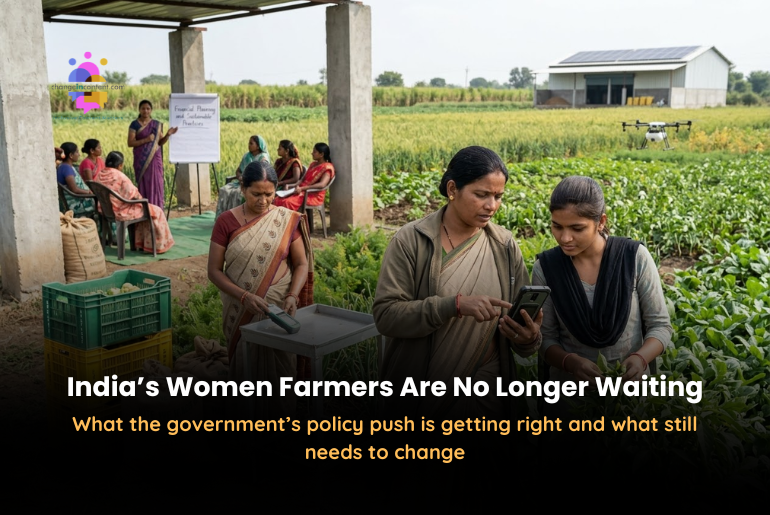
The phrase “Empowering Women Farmers” can often sound like policy shorthand. That is the kind of language governments use generously, and institutions repeat dutifully. Yet the latest press release from the Government of India does something more substantial than offer a slogan.
It assembles, in one place, the financial schemes, technology missions, training systems, farmer collectives, and institutional mechanisms. The government is now positioning all of them as the backbone of women’s agricultural advancement in India.
India is publicly signalling seriousness about women in agriculture, especially with the United Nations designating 2026 as the International Year of the Woman Farmer. It is also relevant as New Delhi is hosting the Global Conference on Women in Agri-Food Systems (GCWAS–2026) from 12 to 14 March 2026.
But for all the movement in policy, the deeper test remains unchanged: can the state move women farmers from participation to power, from labour to leadership, and from welfare access to economic control?
Why does it matter for empowering women farmers in agriculture?
That matters because women are not peripheral to Indian agriculture. According to the government’s own framing, agriculture and allied sectors are the primary source of livelihood for 80% of rural women in India. Of these, 33% are agricultural labourers and 48% are self-employed farmers.
At the same time, older Agriculture Census data show that women remain underrepresented among formal operational landholders. That means their labour is visible in fields but often not fully recognised in ownership, credit access, and decision-making systems.
This tension sits at the heart of the current policy moment.
Empowering women farmers: Why this policy moment matters more than usual?
The timing is not incidental. The UN’s designation of 2026 as the International Year of the Woman Farmer gives governments an unusually visible opportunity to move beyond token recognition and push structural reform. India appears to be using that opening to present itself as both a policy actor and a convenor.
The GCWAS–2026 conference brought together more than 700 participants. These included policymakers, scientists, entrepreneurs, women farmers, start-ups, and students. The conference explicitly focused on gender-responsive policies, women’s leadership, climate-smart innovation, and women-friendly technologies.
It is important because agriculture is not a single problem waiting for a single solution. Women farmers do not need only subsidies, only training, or only market access. They need a connected system that links land, finance, infrastructure, mechanisation, extension, storage, procurement, and collective bargaining.
The government’s press release is significant precisely because it reveals that they are attempting such a system. Whether they will achieve it is a more difficult question.
The financial architecture: Where the policy muscle is concentrated
A large part of the state’s effort to empower women farmers revolves around credit, subsidies, and direct financial support.
Agriculture Infrastructure Fund (AIF)
The Agriculture Infrastructure Fund (AIF) offers medium to long-term debt financing for post-harvest and productive farm infrastructure. It offers loans carrying a maximum interest rate of 9%. At the same time, it offers a 3% per annum interest subvention on loans up to Rs 2 crore for up to seven years. As of 28 February 2025, 8,190 projects worth Rs 2,377 crore had been sanctioned to women farmers under the scheme.
Integrated Scheme for Agricultural Marketing (ISAM)
Through its Agricultural Marketing Infrastructure component, the ISAM shows how support is directed towards rural storage and marketing systems.
Women farmers, SC/ST promoters, FPOs, and beneficiaries in the North-East and hilly states are eligible for a 33.33% subsidy. At the same time, farmers in plain areas are eligible for 25%.
As of 31 January 2026, 10,631 storage projects linked to women beneficiaries had been sanctioned. That creates a combined storage capacity of 395.53 lakh metric tonnes, with subsidy releases of Rs 17,3971.41 lakh. In addition, 1,095 non-storage projects linked to women beneficiaries had received subsidies worth Rs 11,767.67 lakh. These are not symbolic numbers. They indicate that women are being written into agricultural infrastructure policy, not merely training rhetoric.
MISS and KCC
The Modified Interest Subvention Scheme (MISS) and the Kisan Credit Card (KCC) ecosystem are also part of this design.
Under MISS, farmers can access short-term credit of up to Rs 3 lakh at 7% interest, with 1.5% interest subvention to lending institutions. The collateral-free credit limit was raised from Rs 1.6 lakh to Rs 2 lakh from 1 January 2025.
On paper, that improves access to credit. In practice, its success for women depends heavily on whether banks, local officials, and financial literacy campaigns can bridge the longstanding gap between women’s participation in agriculture and women’s formal visibility in agricultural finance.
PM-KISAN
The most visible example of direct transfer remains PM-KISAN. The scheme gives eligible landholding farmers Rs 6,000 a year in three instalments, routed via DBT into Aadhaar-seeded bank accounts.
According to the government, around 25% of total PM-KISAN benefits go to women beneficiaries. In the 22nd instalment, more than 2.15 crore women farmers received Rs 4,309.46 crore. So, the cumulative disbursement to women since the scheme’s inception has crossed Rs 1.01 lakh crore.
More broadly, the 22nd instalment involved over Rs 18,640 crore to 9.32 crore farmer families nationwide. These are large transfers, but they also expose a key limitation. PM-KISAN is only for those having a landholding status. It can blunt inclusion where women work the land without holding the title.
Technology, mechanisation, and the attempt to move women beyond manual labour
One of the most striking aspects of the government’s framework is that it does not confine women farmers to subsistence language. It increasingly speaks in the vocabulary of drones, mechanisation, digital platforms, and entrepreneurship. The Namo Drone Didi scheme is the clearest example.
Namo Drone Didi Scheme
The scheme aims to provide 15,000 drones to women Self-Help Groups between 2023–24 and 2025–26, with a total outlay of Rs 1,261 crore. Selected SHGs receive 80% central financial assistance, capped at Rs 8 lakh per drone package. It comes with structured training for a drone pilot and a drone assistant.
In 2023–24, Lead Fertiliser Companies distributed 1,094 drones across 22 states. Of these, 500 were directly under the scheme. It matters because it shifts women’s place in agriculture from labour to service provision. A woman-led SHG operating a drone is not only a beneficiary. It is a local technology enterprise.
Sub-mission on Agricultural Mechanism
The linked support under the Sub-Mission on Agricultural Mechanisation goes in the same direction as the Namo Didi Drone scheme. It offers 50% assistance up to Rs 5 lakh for drone purchases by women farmers and other priority categories. At the same time, it also supports Custom Hiring Centres. That is a serious policy signal: the state is attempting to place women not only in farming but in the machinery economy around farming.
National Beekeeping and Honey Mission
The same logic extends, in smaller but still meaningful ways, to the National Beekeeping and Honey Mission. This mission supports scientific beekeeping, income generation, and women’s training in honey and hive-product value chains.
Beekeeping may seem modest compared with drones or large procurement systems, but in livelihood policy, diversification is often where resilience begins.
Collectivisation: The strongest part of the story
If there is one area where the government’s policy approach looks especially strategic, it is women-led collectivisation. The most consequential numbers in the press release arguably sit here.
Under DAY-NRLM, more than Rs 11 lakh crore in credit has been disbursed to women SHGs through formal financial institutions. Between FY 2022–23 and 2024–25, 2.58 crore women farmers received training in agroecology and livestock management.
At the same time, 2.50 lakh community resource persons, such as Pashu Sakhis, were trained. Moreover, 70,021 SHG women were trained in natural farming, and 503 Krishi Sakhis got training as Drone Sakhis. Furthermore, 800 women-led producer companies were promoted under the FPO scheme.
That scale matters because individual women farmers often face structural weakness in markets, procurement, and bargaining. Collective organisation changes the equation. It reduces isolation, increases negotiating power, and creates a route into market-oriented agriculture. The 10,000 FPOs scheme is especially relevant here.
10000 FPO Scheme
As of 1 January 2026, 10,000 FPOs had been formed under the central scheme, with 56.32 lakh farmers mobilised. That includes 21.96 lakh women farmers. Among them, 1,175 FPOs had 100% women members. Interestingly, 1,084 FPOs have between 50% and 99% women members. States such as Odisha, Jharkhand, Bihar, Maharashtra, and Telangana are emerging as strong players in the women-led FPO landscape.
That is where policy becomes genuinely interesting. FPOs are not charity vehicles. They are institutional attempts to convert fragmented smallholders into economic actors. They offer better access to aggregation, processing, markets, and finance. When women enter them in large numbers, empowerment becomes less rhetorical and more commercial.
Training and extension: Where empowerment becomes executable
Policy fails when it cannot travel the last mile. That is why the extension and training ecosystem matters so much in this story. The government highlights a layered institutional structure that includes MANAGE Hyderabad, the National Gender Resource Centre in Agriculture, ICAR-CIWA, and the Farm Machinery Training and Testing Institutes. Together, these institutions aim to create a gender-responsive agricultural knowledge system.
MANAGE Hyderabad
MANAGE’s Centre for Gender in Agriculture has trained 61,496 women participants since 2020. The training happens across areas such as gender mainstreaming, entrepreneurship, market access, financial literacy, leadership, and digital technologies.
NGRCA functions as the national coordinating body for gender-focused agricultural initiatives and has taken on work on gender-disaggregated data, access to land, barriers to the Kisan Credit Card, gender-friendly tools, and gender-sensitisation modules.
It matters because a policy ecosystem that does not generate gender-disaggregated evidence eventually begins to govern blindly.
ICAR-CIWA
Then there is ICAR-CIWA, whose contribution is often underrated in public discussions. The institute is not just doing research. It is developing and testing women-friendly farm tools, drudgery-reducing technologies, and gender-responsive extension models across climate-smart agriculture, mushroom cultivation, backyard poultry, nutri-gardens, and integrated homestead systems.
The case study of Kamini Nathsharma from Odisha is not merely a success story. It shows what happens when training, handholding, seeds, livestock support, fodder planning, and diversified farm systems are combined intelligently. Her household adopted a more sustainable farming model and reportedly raised its annual income to Rs 96,000, with every Re 1 invested generating Rs 1.75.
Krishi Sakhi Model
The Krishi Sakhi model is another major piece of execution architecture. The Ministry of Agriculture and the Ministry of Rural Development are jointly training 70,000 Krishi Sakhis in phases. The training helps them serve as para-extension workers, providing doorstep guidance on natural farming and soil health.
That move matters because a woman farmer is often more likely to trust, learn from, and adopt practices explained by another woman embedded in her local context. The state is trying to build a distributed, women-led extension system rather than relying solely on formal, top-down advisory channels.
What the numbers say, and what they still do not solve
Taken together, the policy stack is impressive. There is money in it, scale in it, and institutional thought in it. There are subsidies, credit lines, direct transfers, training pipelines, women-led FPOs, climate-sensitive models, and technology-linked interventions. It would be dishonest to describe this as a shallow or symbolic framework. It is not.
But this is also where a more difficult conversation becomes necessary. Women’s participation in agriculture has long exceeded women’s control over agricultural assets. The Agriculture Census 2015–16 showed the share of female operational holders rising to 13.96% from 12.79% in 2010–11. That is progress, but it is still far below women’s actual labour presence in the sector.
This gap matters because ownership and operational recognition influence access to institutional credit, eligibility for schemes, procurement systems, and decision-making power. A woman may work every day on the farm, and the systems still may not see them as the farmer.
That is why we cannot measure policy success only through beneficiary counts. We must also measure it through deeper indicators, such as:
- whether women gain more land rights
- whether they control more income
- whether they move into leadership inside FPOs and SHGs
- whether they access procurement and post-harvest value chains directly
- whether time-saving technologies actually reduce drudgery rather than simply add new expectations.
What policymakers, agri-businesses, and institutions can actually execute next?
The next step is not more slogans. It is a sharper execution.
1. Address land-linked barriers more honestly.
Where schemes depend on landholding, governments and states need stronger workarounds for women cultivators without clear title documentation. Without that, policy will continue to reward formal ownership more than real labour.
2. Beneficiary data must become more granular and public-facing.
Gender-disaggregated tracking cannot stop at how many women received assistance. It should show how many accessed higher-value infrastructure, larger-ticket credit, procurement systems, and leadership roles within collectives.
The NGRCA’s push to revise formats and generate better gender-disaggregated data is a promising sign. However, it needs to become visible in regular public dashboards and policy reviews.
3. Private agri-businesses, food companies, banks, and input firms should stop treating women farmers as an auxiliary category.
If women are central to production, they should also be central to procurement design, extension partnerships, farmgate service models, and agri-tech onboarding.
A serious corporate inclusion strategy in agriculture should include women-led FPO sourcing, women-focused mechanisation credit, women advisory networks, and market linkages that recognise time, mobility, and social constraints.
4. The women-led para-extension system deserves sustained investment.
Krishi Sakhis, Pashu Sakhis, Van Sakhis, and Matshya Sakhis are not side programmes. They are the delivery architecture that can convert policy from paper to practice.
The MKSP data makes that plain. By June 2025, 4.62 crore Mahila Kisans had been supported in adopting agro-ecological practices. It includes 2.09 crore trained in livestock management. The support comes from more than 3.5 lakh community resource persons. That is not peripheral work. It is state capacity at the grassroots.
The Changeincontent perspective on empowering women farmers
What the government has laid out is substantial enough to take seriously and important enough to examine critically. There is genuine policy movement here. The architecture is broader than many casual conversations about women in agriculture admit. It is not a story of symbolic empowerment. It is a story of bringing finance, extension, collectivisation, and technology into the same frame.
At the same time, the real benchmark for empowering women farmers cannot be whether a press release sounds ambitious. It has to be about whether women become more visible as decision-makers in agriculture, not only as labourers in it.
India is preparing itself for the International Year of the Woman Farmer with a policy-heavy, institution-rich approach. The opportunity now is to ensure that this momentum is not limited to visibility alone. It must produce voice, ownership, market strength, and durable economic agency.
We have explored related questions earlier in our coverage of women in agriculture and leadership spaces. That conversation continues here.
Conclusion: The farmer that the policy must finally see
India’s policy framework for women in agriculture is no longer thin. It is wide, layered, and increasingly ambitious. That is the good news. The harder truth is that scale does not automatically become transformation.
The state has built multiple entry points, such as credit, DBT, drones, beekeeping, FPOs, extension networks, natural farming, and women-friendly technologies. What comes next is the real test. Can these initiatives move women farmers from assisted inclusion to institutional power? Can they turn participation into ownership and visibility into bargaining strength?
If India wants to lead the International Year of the Woman Farmer with credibility, that is the standard it will have to meet. Not just more women in agriculture, but more women recognised as the ones shaping it.
Official sources and data used
PIB backgrounder on women farmers, the official GCWAS–2026 circular, NGRCA information, ATMA guidelines, the Krishi Sakhi note, and official PIB updates on PM-KISAN and the 10,000 FPOs scheme informed this analysis.
Disclaimer: The views expressed in this article are based on the writer’s insights, supported by data and resources available both online and offline, as applicable. Changeincontent.com is committed to promoting inclusivity across all forms of content. We broadly define inclusivity in terms of media, policies, law, and history. It encompasses all elements that influence the lives of women and marginalised individuals. Our goal is to promote understanding and advocate for comprehensive inclusivity.
