
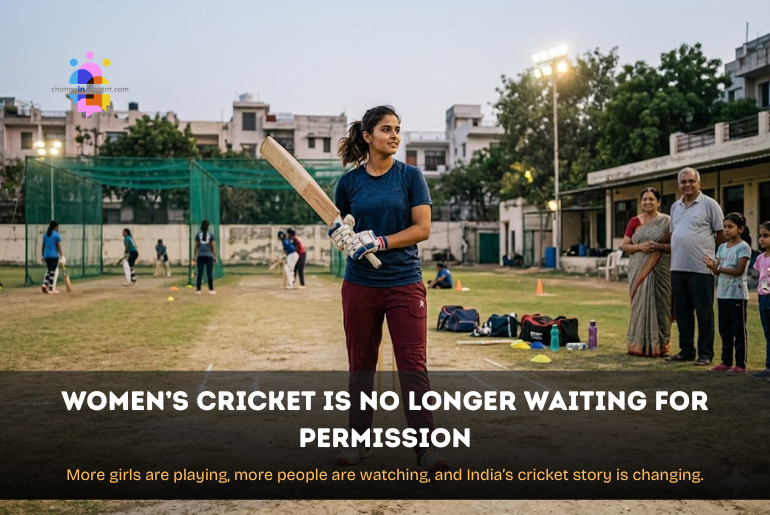
For years, Women’s Cricket in India lived in the shadows of the men’s game. People admired it in moments but rarely backed it with the same certainty, structure, or belief. That is changing now, and not in small ways. The conversation has moved beyond symbolic support. More girls are entering the sport, more families are taking it seriously, and more viewers are beginning to watch women’s cricket as a main event rather than an occasional exception.
What makes this moment especially significant is that the shift is no longer visible only at the elite level. It is showing up in participation, ambition, and public attention at the ground level, too. That suggests something deeper than a temporary spike. It suggests that women’s cricket in India is building cultural legitimacy.
The challenge now is not whether interest exists. It clearly does. The challenge is whether access, safety, infrastructure, and long-term support will grow fast enough to keep pace with it.
Women’s cricket is seeing a real rise in participation across India
A study commissioned by the BBC and Collective Newsroom shows that women’s participation in cricket has doubled across 14 states since 2020. The survey is part of the Indian Sportswoman of the Year initiative and looks at how many women play sports, societal attitudes, and how people view women athletes.
The study surveyed 10,304 respondents aged 15 and above across 14 states between December 26, 2025 and January 30, 2026. It found that the share of women who say they play cricket has increased from 5% in 2020 to 10% now.
Young women are driving the shift.
In the 15–24 age group, 16% now say they play cricket, up from just 6% in 2020. This age group is leading the change, not just in participation but also in interest and viewership of women’s sports. In fact, 26% of young women said they have considered pursuing sports as a career, compared with 16% in 2020.
The gender gap has narrowed, too. In 2020, there were roughly five male cricket players for every one woman. By 2026, that ratio had fallen to roughly 3 to 1. So, men still outnumber women, but not by as much as before.
The survey defines “playing” as anyone currently participating in the sport, whether casually or regularly. Among women who do play cricket, 40% say they play at least once a week.
Women’s cricket is growing beyond the pitch and into screens, stadiums, and daily conversation.
Viewership in women’s sports has also picked up, both on screens and in stadiums. The study shows that 43% of respondents said they watched women’s matches live in the past six months.
While men’s events still draw higher numbers at 54%, the difference is not as big as it used to be. Around 29% of people said they had attended women’s sporting events in person, compared with 37% for men’s games.
What India’s World Cup moment revealed
India’s 2025 Women’s ODI World Cup title win over South Africa pushed women’s cricket viewership to record levels, with JioHotstar reporting a total tournament reach of 446 million and 185 million users for the final alone.
The broadcaster called the 446 million figure the highest ever recorded for women’s cricket. It also went past the combined viewership of the last three Women’s World Cups, showing just how much interest has grown in a short time.
Also Read: Advertising in IPL 2025: When cricket becomes a billboard for ‘Betting and Pan Masala’.
Women’s cricket is rising, but barriers still shape who gets to stay
On one hand, more women are playing sports, and more people are watching. On the other hand, several barriers still impact how women experience sport.
Safety is one of them. The report notes that more women may consider taking up sport if they feel safer in these spaces. In fact, 13% of women who do not play any sport cite safety concerns as a barrier.
The old stereotypes have not disappeared.
Even as more women take up sports, the study shows that societal attitudes have not moved at the same pace. When 43% of respondents say women’s sports feel less entertaining than men’s (up from 38% in 2020), it suggests that many viewers still compare the two through a biased lens.
The study also suggests that women athletes are still judged through gendered expectations that have little to do with sport. That includes comments about appearance, femininity, and how a sportswoman is “supposed” to behave. That points to blatant sexism.
Rupa Jha, Editor-in-Chief and co-founder of Collective Newsroom, said, “The findings show both progress and continuing barriers. While participation and viewership are rising fast, stereotypes and practical challenges remain. We hope this data will prompt further discussion and action to support women athletes.”
The Changeincontent perspective
The rise of women’s cricket in India is not only a sports story. It is a cultural shift. For a long time, girls who played cricket were treated as exceptions, novelties, or temporary rebels against expectation. What the latest data shows is that they are no longer on the margins in the same way. More are playing, more are watching, and more are imagining sport as a real future. That matters because visibility does not just create stars. It creates permission.
But growth in interest is not the same as equality in conditions. If women’s cricket is truly to flourish, the ecosystem around it has to catch up. Safety, access to facilities, serious coaching pathways, local support, and social legitimacy still decide who gets to continue and who quietly drops away.
The next stage of progress will not come from applause alone. It will come from making the sport easier, safer, and more sustainable for girls to stay in the sport.
The final thoughts
More women in India are stepping into cricket and staying connected to the sport, both as players and viewers. At the same time, concerns around safety and long-held beliefs continue to affect how far this growth can go. The rise in participation proves that interest is already there. What matters now is whether the conditions around the sport improve enough to support it.
Disclaimer: The views expressed in this article are based on the writer’s insights, supported by data and resources available both online and offline, as applicable. Changeincontent.com is committed to promoting inclusivity across all forms of content. We broadly define inclusivity in terms of media, policies, law, and history. It encompasses all elements that influence the lives of women and marginalised individuals. Our goal is to promote understanding and advocate for comprehensive inclusivity.
