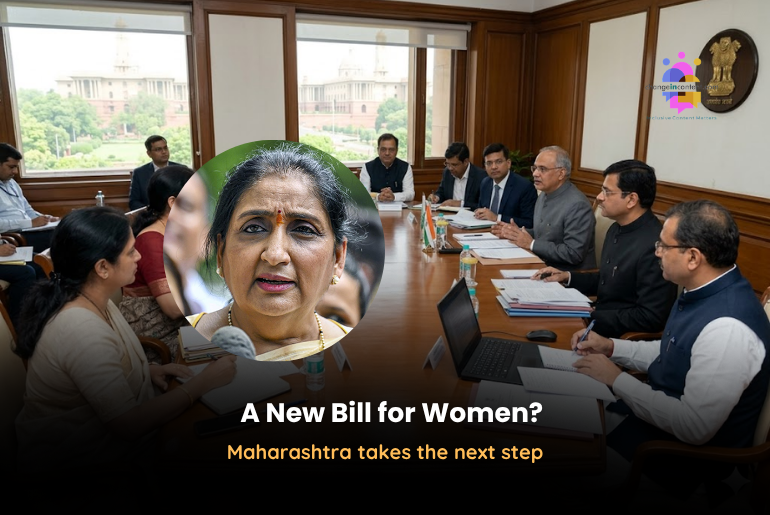
The Maharashtra Government has set up a panel to draft a bill on women empowerment. That marks a significant step toward institutionalising gender-focused policymaking in the state. By setting up a dedicated panel to draft a new bill, the Maharashtra Government has signalled an intent to move beyond fragmented schemes and toward a more structured legislative framework for women’s empowerment.
This newly constituted panel will examine existing gaps across sectors. These gaps range from employment and safety to access to resources. The panel will recommend a comprehensive bill that addresses both urban and rural realities. Early reports indicate that the panel will also specifically consider the challenges faced by women farmers. That is a segment which remains under-recognised despite its central role in India’s agricultural economy.
What the Maharashtra Government has announced about the panel on women empowerment
According to multiple reports, including coverage by The Times of India, the Maharashtra Government has set up a specialised panel to draft a new law to strengthen women’s empowerment across sectors.
Key aspects of the announcement include:
- Formation of a dedicated panel comprising experts and stakeholders
- Mandate to draft a comprehensive women empowerment bill
- Focus on policy integration across sectors, rather than isolated interventions
- Special attention to women farmers and rural participation
The move comes at a time when states are increasingly looking to design more targeted, localised gender policies rather than relying solely on central schemes.
A closer look: Why a panel, and why now?
The creation of a panel, rather than a direct policy rollout, suggests a recognition of complexity.
Women’s empowerment is not a single-sector issue. It spans:
- Labour participation
- Land ownership
- Financial access
- Safety and mobility
- Education and skill development
In Maharashtra, like much of India, these issues are interconnected. A woman’s ability to work is tied to mobility. Mobility is tied to safety. Financial independence is tied to land ownership and access to credit.
A panel allows for:
- Stakeholder consultation
- Data-backed policy design
- Cross-sector alignment
But it also introduces a familiar risk: delays between consultation and implementation.
The focus on women farmers: A critical inclusion
One of the more significant signals from the Maharashtra Government is the inclusion of women farmers within the scope of the panel’s work. This matters. Women constitute a substantial portion of India’s agricultural workforce, yet:
- Many do not own land
- Many are not recognised as “farmers” in policy frameworks
- Access to credit, insurance, and subsidies often bypasses them
The panel’s proposed focus aligns with broader national conversations on agricultural inclusion. We have previously explored these systemic gaps in detail here. If the bill meaningfully addresses land rights, access to institutional credit and inclusion in farmer registries, it could mark a structural shift rather than a symbolic one.
What could this bill potentially cover?
While the draft is yet to be finalised, policy experts suggest that such a bill could include:
1. Legal Recognition and Rights Expansion
- Clearer definitions of women’s economic roles
- Strengthening of property and inheritance rights
2. Financial Inclusion Measures
- Improved access to credit and subsidies
- Dedicated financial products for women-led enterprises
3. Workforce Participation Support
- Skill development initiatives
- Employment-linked incentives
4. Safety and Infrastructure
- Workplace safety regulations
- Public infrastructure improvements
5. Institutional Mechanisms
- Monitoring bodies
- Grievance redressal systems
The effectiveness of the bill will depend on whether these elements are integrated into a cohesive framework or remain isolated provisions.
The data reality: Why policy alone is not enough
India’s gender gaps remain significant across key indicators:
- Female labour force participation, while improving, still trails global benchmarks
- Women’s land ownership remains disproportionately low
- Informal work continues to dominate women’s employment
In Maharashtra specifically:
- Rural women are heavily engaged in agriculture and allied sectors
- Urban women face barriers in workforce retention and leadership representation
A policy framework must therefore address not just access, but structural barriers and cultural norms.
The implementation question: Where policies often falter
India has no shortage of schemes aimed at women’s empowerment. The challenge lies in:
- Fragmentation across departments
- Limited awareness among beneficiaries
- Gaps in last-mile delivery
- Weak monitoring mechanisms
If the Maharashtra Government’s panel that will draft a bill on women empowerment can address these issues at the design stage, the bill has the potential to avoid the pitfalls seen in earlier initiatives.
If not, it risks becoming another well-intentioned but underutilised policy.
The Changeincontent perspective
At Changeincontent, we believe policy conversations often stop too early, at announcement. The real questions begin after:
- Who benefits first?
- Who gets left out?
- What changes on the ground in 12 months?
A panel on women empowerment is a strong starting point by the Maharashtra Government. But you cannot draft empowerment in isolation. It must be measurable, accessible, and enforceable. And most importantly, it must reflect the lived realities of women across economic and geographic segments.
Conclusion: Can the Maharashtra Government panel on women empowerment deliver real change?
The Maharashtra Government Panel on women empowerment has the opportunity to move beyond intent and create a framework that actually works. But the success of this initiative will not be judged by the bill it drafts.
It will be judged by:
- How many women does it reach
- How many barriers does it remove
- How many lives does it change
Because policy is not empowerment, execution is.
Disclaimer: The views expressed in this article are based on the writer’s insights, supported by data and resources available both online and offline, as applicable. Changeincontent.com is committed to promoting inclusivity across all forms of content. We broadly define inclusivity in terms of media, policies, law, and history. It encompasses all elements that influence the lives of women and marginalised individuals. Our goal is to promote understanding and advocate for comprehensive inclusivity.