
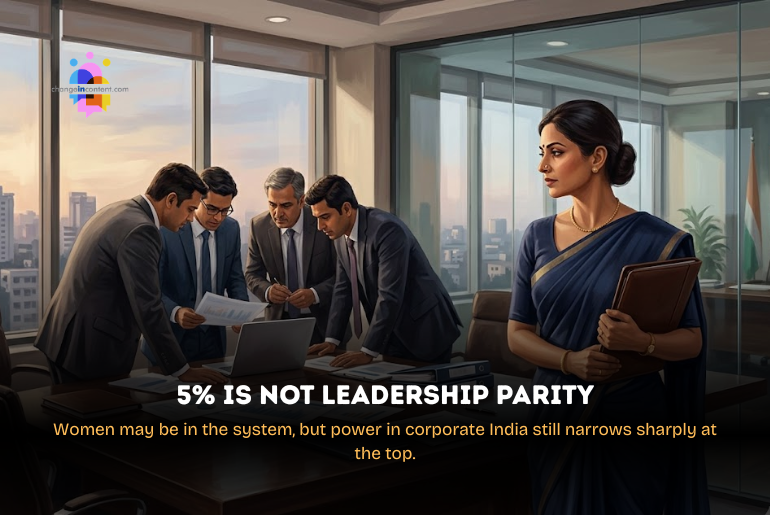
Women CEOs remain rare enough in India’s listed companies that the number itself feels like a warning. In a corporate economy that often celebrates diversity milestones, only 119 of 2,285 NSE main-board-listed firms currently have a woman serving as managing director or chief executive officer. That is just 5%. The number matters not only because it is low, but because it reveals how far women still are from the roles where strategy, capital, culture, and power are truly shaped.
What makes this especially telling is that the gap is no longer easy to explain away as a talent pipeline issue alone. Women are present across the workforce and increasingly visible at the board level. Still, their presence thins dramatically where executive authority begins.
The Prime Database report turns that pattern into a hard question for India Inc. It asks that if women are already in the system, why do so few reach the very top? And why does leadership still look so overwhelmingly male when the seat carries the most influence?
Women CEOs and the ‘Leaky Bucket’ phenomenon
Data from Primeinfobase shows a gender disparity in leadership, with just 5% of listed companies led by women as CEOs. Women comprise approximately 23% of the total workforce in these companies. However, this presence does not grow into leadership roles. Women account for only 14% of Key Management Personnel (KMPs) and 10% of executive directors.
Pranav Haldea, Managing Director at PRIME Database Group, described this trend as a classic “leaky bucket” phenomenon where women gradually drop out of leadership roles.
In 2024, among the Nifty 500 companies, approximately 63.8% (319 of 500) had no women in key managerial personnel (KMP) roles. It means that in the majority of top firms, women do not participate in core decision-making at all.
Even the 2024 Primeinfobase report on Nifty 500 shows that only 27 out of 500 companies, which is just 5.4%, are led by women as CEOs or managing directors. Even within this small group, representation remains limited. Only 4 companies, or 0.8%, have more than one woman in these top positions. The data shows that representation drops sharply as roles become more senior, keeping leadership spaces largely male-dominated.
Women reach the boards, but power still stays out of reach
Today, 98% of NSE-listed companies have at least one woman director. However, many of these companies had to comply with the Companies Act. Therefore, most of these companies added one woman to meet the requirement. But many stopped at that minimum.
Women now hold 21% of board seats, up from 18% in 2021 and just 5% in 2014. However, only 47% of companies have two or more women directors.
On the positive side, the number of independent women directors has gone up. Women make up 28% of all independent directors. About 88% of companies now have at least one independent woman director. At the same time, companies with two or more independent women directors have risen from 10% to 21% during the same period.
Despite the growth, the slowdown is also a reality. Read more about the slowdown in this analysis of the latest KPMG report.
Why do many women CEOs still come through promoter family routes?
In many cases, women who reach top leadership positions come from the founding families of the company. Leadership does not become more accessible to women overall. Instead, it remains limited to those who already have close connections within the business. That leaves most women outside these networks without the same chances to rise to the top.
Just 5% of companies have a woman CEO or managing director. And even here, access stays limited. Around 69% of these women come from promoter families. Only 7% of professional executive directors outside promoter groups are women. Only 135 companies, or about 6%, have a woman chairing the board. Nearly half of these chairpersons come from promoter families.
In the 2024 report, out of the 500 companies, only 4 companies had more than one woman serving as CEO or managing director. Among them, Jindal Saw Ltd stands out with the highest representation. The company has three women in top leadership roles. Sminu Jindal serves as Managing Director, while Tripti Puneet Arya and Shraddha Jatia hold positions as Joint Managing Directors. All three of them are granddaughters of OP Jindal, the company’s founder, and the daughters of OP Jindal’s son, Prithviraj Jindal.
The ‘Gender Pay Gap’ remains even when women reach leadership
Male executive directors earn a median salary of ₹120 lakh in FY25. Women at the same level earn ₹69 lakh. That puts women about 74% behind men. So for every ₹100 a man earns, a woman earns roughly ₹57.
Among non-promoter executive directors, men earn a median of ₹104 lakh, while women earn just ₹43 lakh. That is less than half. That shows the issue is not just about how many women reach leadership. Even when they do, companies pay them far less for similar roles.
What still stops more women CEOs and leaders from emerging in India?
The issue does not stop at hiring. Many workplace practices quietly slow down women’s growth, even when they start their careers on equal footing.
Promotion systems often reward constant visibility and long, uninterrupted work hours. This makes it harder for many women to stay in the race, especially when they take on a larger share of caregiving at home. As a result, they may miss out on key assignments that lead to leadership roles.
Why sponsorship matters more than good intentions?
Access to informal networks plays a big role in who moves ahead. Many important decisions are made in these “boy’s club” circles, and women often find themselves left out. Without the same level of mentorship or sponsorship, their chances of moving up become limited.
There is also a tendency to view leadership through a narrow lens. Qualities often associated with authority and decision-making are recognised more readily in men, while women may have to work harder to be seen in the same light.
Career breaks for pregnancy, childbirth, or caregiving add another layer. Even when women return to work, companies do not always place them back on strong growth paths. Over time, these factors build up and reduce their chances of reaching top roles.
The Changeincontent perspective
The most revealing part of this report is not that women are absent from Indian companies. It is that they are still kept furthest from executive authority. India Inc has clearly shown that regulation can move numbers at the board level. But regulation cannot, on its own, produce trust, succession pathways, sponsorship, or a culture that sees women as natural claimants to power rather than exceptional occupants of it. That is why boards may diversify while CEO pipelines remain stubbornly narrow.
That is also where the conversation becomes uncomfortable. Many organisations still praise merit while quietly filtering leadership through networks, continuity expectations, promoter structures, and gendered assumptions about who looks decisive, available, and “boardroom-ready”.
The result is predictable: women may enter the company, even the boardroom, yet remain undercounted in strategic control. We do not see this as a pipeline accident. It is a power design problem.
The next step for companies is not another celebratory diversity panel. It is to build leadership pathways that do not collapse for women by mid-career and to stop confusing minimal compliance with structural change.
India does not need more symbolism. It needs more women leaders with real power.
Women may be part of the workforce, but they are still missing where power sits. Real change will not come from simply bringing more women into companies. It will depend on whether organisations are willing to rethink how they identify leaders, who they invest in, and whose voices they take seriously in decision-making spaces.
As long as the same patterns continue, progress will remain slow and limited to a select few. For any real shift to happen, companies need to move beyond surface-level inclusion and actively open leadership pathways in ways that are fair, consistent, and accessible to all women.
Disclaimer: The views expressed in this article are based on the writer’s insights, supported by data and resources available both online and offline, as applicable. Changeincontent.com is committed to promoting inclusivity across all forms of content. We broadly define inclusivity in terms of media, policies, law, and history. It encompasses all elements that influence the lives of women and marginalised individuals. Our goal is to promote understanding and advocate for comprehensive inclusivity.
