
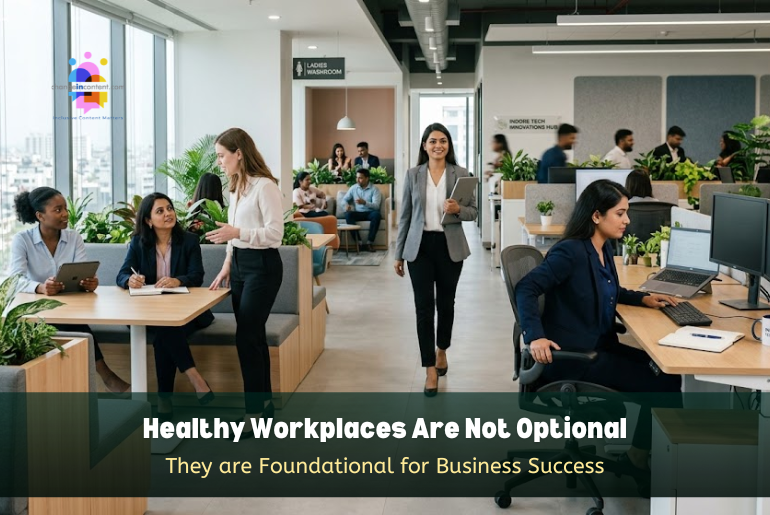
Policies on paper or occasional wellness programmes no longer define healthy workplaces for women. In 2026, the real measures are the depth with which organisations understand the everyday realities women navigate at work, physically, mentally, and socially.
From menstrual health to workplace hygiene, from burnout to silent bias, the gaps are no longer hidden. They are documented, discussed, and increasingly, they are costing organisations talent.
This article is for leaders, HR teams, founders, and decision-makers who want to move beyond performative inclusion. It explores the real issues women face at work today, the impact of ignoring them, and what organisations must do to build workplaces that are not just inclusive, but genuinely healthy and sustainable.
Why healthy workplaces for women are a business imperative
There is a significant shift in the conversations around workplace health. It is no longer about offering yoga sessions or insurance benefits. It is about structural design.
According to the World Health Organisation, a healthy workplace is one where workers and managers collaborate to use a continuous improvement process to protect and promote health, safety, and well-being. Yet, most workplaces still operate on a “neutral” model that assumes all employees have the same needs. They do not. (Source: McKinsey)
Women experience:
- Higher rates of workplace burnout
- Greater exposure to invisible labour and emotional load
- Health conditions that are rarely accounted for in workplace design
Ignoring this is not just unfair. It is inefficient.
The reality check: What women experience at work today
Experiences shape the workplace atmosphere, and that shapes the business success. Unfortunately, women’s experiences in the workplace are far from what they expect regarding their health.
1. Health is still an afterthought
Many workplaces still do not account for:
- Menstrual health
- PCOS and hormonal conditions
- Pregnancy-related fatigue
- Menopause symptoms
In India alone, over 50% of women suffer from anaemia, according to the National Family Health Survey (NFHS-5). Yet most workplaces do not even factor in fatigue or nutritional needs when setting productivity expectations.
2. Hygiene is the most ignored workplace issue
That is where the conversation becomes uncomfortable (and necessary.) A truly healthy workplace must address:
- Clean and accessible washrooms
- Availability of sanitary products
- Safe disposal systems
- Clean drinking water
- Hygienic shared spaces
In many offices, factories, and field roles, women still struggle with basic hygiene infrastructure. It directly impacts:
- Attendance
- Comfort
- Health outcomes
- Dignity
If a workplace cannot guarantee hygiene, it cannot claim to be inclusive.
3. Ergonomics are designed for the “Default Male Body”
From chair design to workstation height, most office infrastructure is built around male physical averages. That leads to:
- Chronic back and neck pain
- Increased fatigue
- Long-term health issues
The International Labour Organisation (ILO) highlights that gender-responsive workplace design significantly reduces physical strain and improves productivity.
4. Mental load and burnout are invisible but real
Women are not just managing work. They are managing:
- Caregiving responsibilities
- Social expectations
- Emotional labour at work
Studies show that women leaders are significantly more likely to experience burnout than men, especially when they are also primary caregivers.
Building healthy workplaces for women: What must change in 2026
With women’s health constantly remaining at stake in the workplace, it is time organisations revamp their policies. Here is what it takes to build a healthy workplace for women.
1. Build health into workplace design, not policies
Stop treating health as a benefit. Start treating it as infrastructure. It includes:
- Flexible work models
- Realistic workload expectations
- Health-sensitive scheduling
2. Prioritise hygiene as a non-negotiable standard
That is the most basic and most neglected step. Organisations must ensure:
- Clean, well-maintained washrooms
- Sanitary product availability
- Private and safe spaces
- Regular hygiene audits
If employees cannot feel physically safe, nothing else matters.
3. Introduce gender-sensitive health policies
Policies should cover:
- Menstrual leave or flexible work
- Maternal and postnatal support
- Menopause awareness and support
- Access to preventive healthcare
We explored this further in our earlier piece about menstruation-friendly workplaces.
4. Redesign workspaces with inclusivity in mind
From seating to lighting, from safety to accessibility, everything matters. A healthy workplace:
- Adapts to people
- Does not force people to adapt to it
5. Train managers to recognise and respond
The biggest gap is not policy. It is behaviour. Managers must be trained to:
- Recognise burnout signals
- Have empathetic conversations
- Support without bias
The cost of getting this wrong
When workplaces ignore women’s health, the consequences show up in metrics:
- Higher attrition
- Lower engagement
- Reduced productivity
- Poor employer branding
According to Deloitte, organisations that prioritise well-being see up to 2.5 times higher employee retention.
The Changeincontent perspective
At Changeincontent, we believe the idea of a “healthy workplace” has been oversimplified for too long. For women, health at work is not just about fitness or mental well-being. It is about:
- Safety
- Hygiene
- Respect
- Structural fairness
Organisations often invest in leadership programmes while ignoring washrooms. They talk about diversity while ignoring burnout. That disconnect is where the problem lies.
The future belongs to organisations that understand one simple truth: A workplace cannot be productive if it is not humane.
Conclusion: Healthy workplaces for women will define the future of work
Healthy workplaces for women are not a trend. They are the foundation of sustainable organisations. In 2026, the companies that will win are not the ones offering perks. They are the ones fixing fundamentals.
Because when women feel safe, respected, and supported, they do not just stay; they lead. And when they lead, organisations do not just grow. They evolve.
Disclaimer: The views expressed in this article are based on the writer’s insights, supported by data and resources available both online and offline, as applicable. Changeincontent.com is committed to promoting inclusivity across all forms of content. We broadly define inclusivity in terms of media, policies, law, and history. It encompasses all elements that influence the lives of women and marginalised individuals. Our goal is to promote understanding and advocate for comprehensive inclusivity.
