
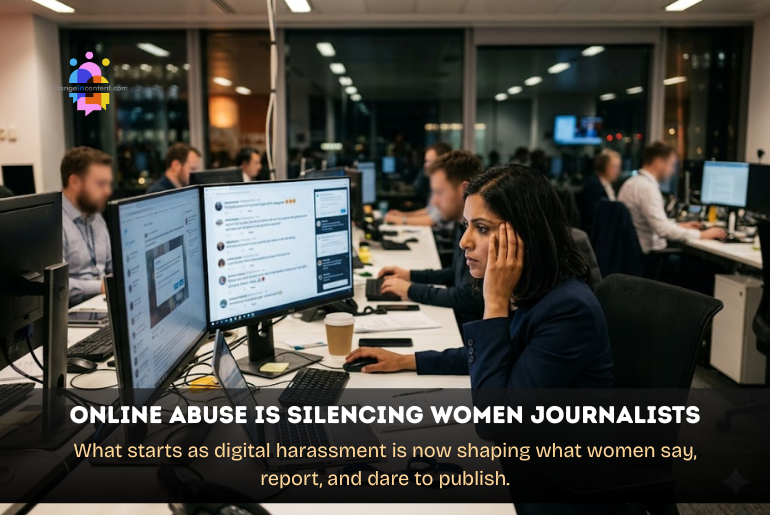
A new report by UN Women and The Nerve warns that online violence against women is becoming more targeted, more invasive, and more dangerous. It is especially more concerning for those in public-facing professions. Among the groups facing the sharpest impact of online harassment are women journalists. Their work increasingly places them at the centre of coordinated abuse, sexualised attacks, and digitally amplified threats.
As generative AI tools spread faster, online harassment is no longer limited to trolling or insults. It is becoming more manipulative, more intimate, and far more difficult to contain.
The report, The Tipping Point, makes it clear that this is no longer just a problem of the internet. Digital abuse is now spilling into real life, affecting women’s mental health, safety, professional confidence, and public participation. For women journalists, the consequences are especially serious. When abuse shapes what they say, what they report, or whether they speak at all, it stops being a personal burden alone. It begins to affect journalism itself.
It is not the first time the issue has surfaced. In our earlier piece, Women in Journalism and Online Abuse, we explored how digital attacks against women in media often go beyond criticism and become tools of intimidation.
Deepfakes, sexualised abuse, and image-based attacks are escalating against women journalists
The findings in The Tipping Point report reveal how often online abuse against women in public-facing roles takes deeply sexualized forms.
Among women human rights defenders, activists, journalists, media workers, and public communicators surveyed:
- 12% said their personal images, including intimate or sexual content, had been shared without their consent.
- Nearly 6% reported being targeted through AI-generated “deepfakes”
- Nearly 1 in 3 said they had received unsolicited sexual advances through digital messaging.
Among women working specifically in media:
- 24% of women had received unwanted sexual messages in direct chats.
- Others reported having intimate images shared without consent or being targeted through manipulated photos and videos, including AI-generated content.
The findings show that online abuse against women has gone from insults or trolling to deeply personal and sexual territory. There are direct consequences for women’s safety, dignity, and ability to work freely.
The mental health cost of online harassment against women journalists is becoming harder to ignore
Among women journalists and media workers surveyed:
- 24.7% said they had been diagnosed with anxiety or depression linked to the online abuse they faced.
- Another 13% said they had been diagnosed with post-traumatic stress disorder (PTSD). The condition is often linked to repeated fear, threats, or traumatic experiences.
What repeated digital violence does over time.
Many women face repeated threats, sexual harassment, doctored images, coordinated trolling, and personal attacks over long periods of time. Constant exposure to this can affect sleep, concentration, confidence, and a person’s sense of safety.
At the same time, legal protection remains weak in many parts of the world. According to the World Bank, fewer than 40% of countries have laws that protect women from cyber harassment or cyberstalking.
Women journalists reporting online abuse
Even with these gaps, more women journalists are choosing to report abuse and seek accountability.
- In 2025, 22% reported incidents of online violence to the police. That is double from the 11% recorded in 2020.
- Nearly 14% are now taking legal action against perpetrators, platforms, enablers, or even employers. It is up from 8% in 2020.
While the abuse continues, more women are refusing to stay silent and are demanding systems that take digital violence seriously.
Online harassment is pushing more women journalists toward self-censorship
In many cases, the online harassment is coordinated and intentional, aimed at discrediting women in public life, damaging their reputations, and pushing them out of public conversations. One of its highest impacts is self-censorship.
Among all women surveyed:
- 41% said they now hold back on social media to avoid abuse
- 19% said online violence has affected what they say or report in their professional work.
- In 2025, 45% women journalists and media workers said they censor themselves on social media. That is a 50% increase since 2020.
- Nearly 22% also said online abuse has influenced what they choose to publish, report on, or publicly speak about.
Silence as a survival strategy
Self-censorship can mean many things. It can mean not posting an opinion, avoiding certain stories, not speaking on political issues, skipping TV debates, or not responding to public criticism. Some may stop sharing their work altogether. Others may avoid topics they know could bring abuse.
That has bigger consequences because women are already underrepresented in many parts of journalism, especially in leadership, political reporting, and opinion spaces. When women start pulling back, not because they want to, but because they feel unsafe, the industry loses voices that are already fewer in number.
Conclusion: When women journalists go silent, journalism itself pays the price
When women journalists begin to speak less for their own safety, this is no longer only a women’s issue or a workplace issue. It becomes a press freedom issue and a democracy issue.
A newsroom cannot claim to represent society if half the population is forced to stay quiet online, avoids certain stories, or disappears from public debate altogether. The answer cannot be to tell women to be more careful online.
The real question is why speaking publicly has become so risky for them in the first place and what governments, tech platforms, media organisations, and legal systems are willing to do about it.
Disclaimer: The views expressed in this article are based on the writer’s insights, supported by data and resources available both online and offline, as applicable. Changeincontent.com is committed to promoting inclusivity across all forms of content. We broadly define inclusivity in terms of media, policies, law, and history. It encompasses all elements that influence the lives of women and marginalised individuals. Our goal is to promote understanding and advocate for comprehensive inclusivity.
