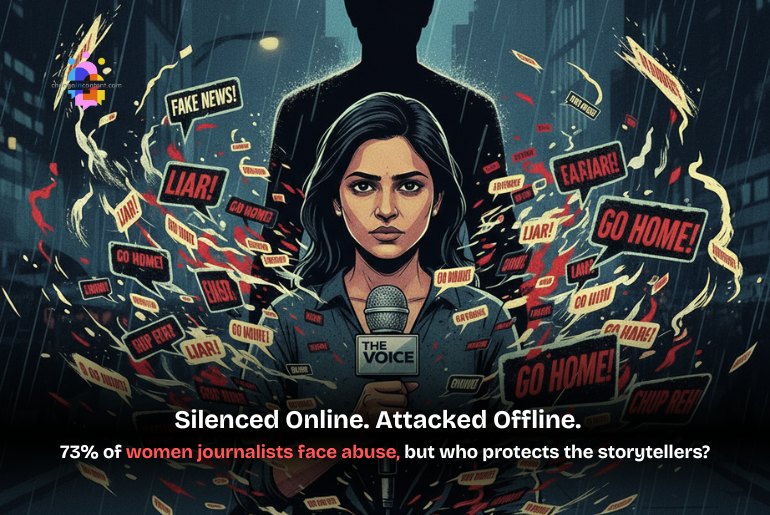
Women in journalism are paying a dangerous price for visibility. According to the GMMP and IFJ surveys, nearly three out of four women reporters have faced online violence, often coupled with offline intimidation. The same profession that promises to shine a light on injustice has failed to shield its own. It isn’t just a “women’s issue”; it’s a press freedom crisis.
The frontline: Online abuse against women in journalism
In a previous article, we discussed the latest UN Women and Global Media Monitoring Project (GMMP) report, which found that while women make up half of the world’s population, they appear in only 26% of the news. The report also noted that the presence of women journalists makes a significant difference. When more women report, more women’s stories are represented in the news.
Stories covered by women journalists are also more likely to address issues such as sexual harassment, assault, and intimate partner violence. The problem, however, is that there are not enough women in journalism, and those who are in the field face many challenges, from gender bias to online abuse.
The rising dangers of cyber abuse in journalism
The digital space, which people once saw as a tool to democratise news, has instead created new threats for women journalists. Surveys conducted by the International Federation of Journalists (IFJ) reveal that almost two-thirds of women journalists have faced some form of online abuse. The forms of harassment are often rape and death threats, obscene images, sexist comments, cyber-stalking, and even impersonation.
Many women report experiencing anxiety and stress because of these attacks. Some have resorted to self-censorship, while a smaller percentage have lost their jobs. Shockingly, almost half of those who faced abuse never reported it. Even when they did, the complaints rarely went beyond media management with no proper accountability.
Global numbers, local consequences
A 2020 global survey with 714 women journalists from 125 countries found that 73% had encountered online violence at some point in their careers. In the Philippines, cyber harassment has grown in the last 15 years, creating unsafe conditions for women reporters. Regina Cabato, a freelance journalist and former Manila-based reporter for The Washington Post, shared how she had to deactivate her Facebook account after years of harassment campaigns, hacking attempts, and data breaches.
“The last straw was a string of harmful events: a hacking scare, a data breach, harassment campaigns and an influx of unsolicited friend requests from strangers,” shared Regina Cabato for the UN Women Journalists Journal.
In 2022, UN Women, in partnership with the Office of the UN High Commissioner for Human Rights, launched the initiative Women Journalists Journal: Stories of Gender Justice from Women Journalists across the Asia-Pacific.
Supported by the Swedish International Development Cooperation Agency, the project collected the personal stories of ten women journalists who shared their lived experiences of working in the media. Their stories reveal the determination it takes to cover sensitive topics while confronting hostility both online and offline.
Double attacks: Online and offline
The danger for women journalists does not stop at the internet. The United Nations describes this as “double attacks,” meaning women face harassment both online and in real life. A woman journalist may receive abusive messages on Twitter while also being followed or threatened outside her workplace.
Social media has become the main space where this abuse grows. Women reporters often receive sexualised insults, with attackers targeting their looks, background, or even religion. Rape and death threats arrive through anonymous accounts, sometimes in coordinated campaigns meant to silence them. Yet even with the seriousness of these attacks, protective measures remain weak. Few perpetrators are ever punished, and most women are left to deal with the abuse alone.
Rising attacks on women in journalism
In July 2025, Journalist Sneha Barwe was violently assaulted in broad daylight with a wooden rod and left unconscious while reporting on illegal construction activities in Nigothwadi village in Maharashtra state. The IFJ’s South Asia Press Freedom Report 2024-25 recorded a total of 13 targeted attacks against journalists in India in the period May 2024 to April 2025, as well as the killing of five journalists.
The 2024 Women’s Press Freedom Report recorded 951 violations against women journalists in 2024, representing a 56% increase compared to 2023. Out of these, 128 cases involved physical assault, and almost 40% of those incidents happened during protests. It illustrates how public campaigns and protests, which are intended to be platforms for free expression, have instead become some of the most perilous environments for female reporters.
Certain countries, particularly politically tense regions, reported the highest number of violations. Türkiye reported 128 cases, followed by Russia with 105 and Venezuela with 45. Perhaps the most alarming statistic is that 21 women journalists were killed in 2024, the highest number since Women Press Freedom began keeping records in 2019.
Media houses are failing to protect women journalists.
Media organisations should play a central role in keeping journalists safe, yet many have done little to address the dangers women face. An IFJ survey revealed that only 20% of respondents reported that their workplaces had proper guidelines in place to deal with online abuse. For most women, there were no clear rules on how to report harassment or how management should respond when complaints were made.
There is also a gap between awareness and action. While 79% of respondents knew that online violence cases existed within their organisations, more than a third admitted they did not know the details or whether someone even reported these incidents. It indicates that even when problems are apparent, they are often not taken seriously.
The lack of strong internal policies leaves women journalists exposed. Without safe reporting systems, psychological support, or accountability measures, many have to handle abuse on their own. This silence from institutions not only undermines women’s safety but also signals to abusers that such behaviour will go unpunished.
The gender pay gap
Alongside safety concerns, women journalists also face another long-standing issue: unequal pay. According to the International Federation of Journalists, women worldwide earn about 20% less than their male counterparts. Women journalists in developing countries often earn 60% less than their male counterparts with the same skill sets. For example, female journalists in Uganda receive 17 to 35% less than their male counterparts doing the same work. In Somalia, women journalists can expect an average monthly salary of just $120, compared to over $1,200 for men.
In India, salaries for women differ depending on the type of press. Women working in English-language media generally earn better pay and benefits compared to those in regional press outlets. However, even in the better-paying segments, women continue to be underpaid compared to men with similar roles and skills.
Globally, the International Labour Organisation’s 2023 report found that women earn on average 80% of what men earn. At the current pace, wage equality may not be achieved until 2086. For journalism, a profession built on principles of truth and fairness, this disparity damages credibility and weakens ethical standards.
The final thoughts
When women journalists are silenced through harassment, ignored by their organisations, or paid less than men, the stories that matter to half the population risk going untold. Journalism loses its integrity when it fails to represent diverse voices and perspectives.
When a woman journalist covers a protest, she should not have to worry about sexist abuse or physical attacks. When she writes an investigative story, she should not have to deal with rape threats on social media trolls just because she is a woman. It is not about giving women special treatment. Women journalists are asking for what every professional deserves: fairness, safety, and dignity at work.
Changeincontent perspective
At ChangeInContent, we believe silencing women journalists isn’t just an attack on individuals. Instead, it is an attack on truth. Every time a woman reporter censors herself out of fear, the public loses a story it deserves to hear. Safety policies, pay parity, and institutional accountability are not optional; they are the bare minimum. Until then, freedom of the press remains half-free.
Also Read: Women in news: Why half the population gets only 26% of the headlines.
Disclaimer: The views expressed in this article are based on the writer’s insights, supported by data and resources available both online and offline, as applicable. Changeincontent.com is committed to promoting inclusivity across all forms of content. We broadly define inclusivity as media, policies, law, and history. It encompasses all elements that influence the lives of women and marginalised individuals. Our goal is to promote understanding and advocate for comprehensive inclusivity.