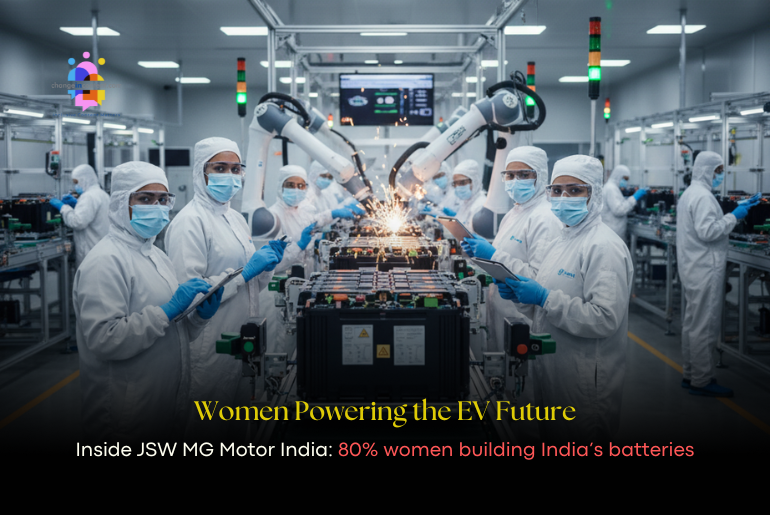
The story of JSW MG Motor India empowering women isn’t a CSR bumper sticker. Instead, it is a factory-floor reality. In Halol, Gujarat, an 80% women workforce builds EV battery packs across three precision lines. Inside a company that’s already 41% women (and with one-third in lead roles), this is what inclusive manufacturing looks like when it moves from policy to production.
JSW MG Motor India empowering women: From policy to production
Electric Vehicles (EVs) are the future of the automobile industry. Goldman Sachs predicts that by 2035, almost half of all cars sold worldwide could be electric. Just five years after that, around 2040, advanced autonomous or partially autonomous vehicles are expected to make up about half of sales. If that happens, the automotive industry will undergo a massive transformation. It won’t just affect the type of vehicles people buy. It will also change the kinds of jobs available, the skills workers need, and how the entire automobile workforce operates.
Women currently comprise 11-15% of the overall EV workforce, which is approximately 1.1 crore (11 million) workers in India. That share is expected to rise to 50% by 2030–33, with companies hiring more women across assembly lines, design labs, and leadership roles. A glimpse of this future is already here at JSW MG Motor India, where 80% of the team building EV batteries are women.
Halol Plant of JSW MG Motor runs with an 80% women workforce.
JSW MG Motor India Pvt. Ltd., formerly MG Motor India Private Limited, began operations in 2019. In 2023, the company became a joint venture between Mumbai-based JSW Group and Shanghai-based SAIC Motor, a Chinese state-owned automobile manufacturer that owns the British MG brand. Today, women comprise 41% of the company’s workforce, including 33% in leadership roles. The automobile manufacturer aims to achieve a gender balance in the next few years.
At Halol, Gujarat, JSW MG Motor India runs a battery assembly unit that stands out for its women workforce. Women account for 80% of employees here, producing an average of 140 battery packs each day for MG Comet and MG Windsor electric vehicles.
The assembly line operates across three shifts and is divided into four sections: the module line, the pack line, the charging and discharging line, and the final assembly. This structure ensures accuracy and efficiency while also providing women with opportunities at every stage of the production process. Many women work not just on the assembly line but also in supervisory and managerial roles.
Speaking on the milestone, Anurag Mehrotra, Managing Director, JSW MG Motor India, said, “At JSW MG Motor India, we truly believe that diversity powers innovation. It is remarkable to witness the cohesive efforts of our teams in creating an equitable and progressive manufacturing ecosystem at our Halol facility. I am confident that our customers will also take pride in knowing that the batteries of their EVs are built by an 80% women workforce.“
Step-by-step battery assembly process
The assembly process begins with an open-circuit voltage test to verify the electrical integrity of each cell. Workers then carry out the cell glue process, fixing cells securely with specialised adhesive. In the next stage, spot and laser welding techniques bring modules together with high precision. Each module undergoes scanning and alignment to confirm structural accuracy, while laser welding serves as a quality check.
Following this, the insulation resistance test confirms electrical safety, and the bus bar fixing ensures secure electrical connections. The batteries then undergo charging and discharging tests to confirm performance and reliability. In the final stage, modules are integrated into packs before installation in MG’s electric vehicles.
Every step of this process adheres to strict safety and quality standards, and women remain deeply involved at each stage.
Support systems for women workers
At JSW MG Motor India, women employees have access to dedicated hostels, transport facilities, and strict security measures. The company also invests in training programs in colleges to build a steady stream of technically skilled recruits.
When MG Motor first began recruiting after acquiring GM’s Halol plant, many local families hesitated to let their daughters work in the automobile manufacturing industry. To ease those fears, the company invited families to tour the plant, allowing them to see the workplace environment and assure them of their daughters’ safety.
Manufacturing roles typically require ITI qualifications in trades such as fitting, welding, automotive, electrical work, and diesel mechanics. Few women choose these trades, which reduces the pool of qualified candidates. To address this gap, JSW MG Motor India recruits women with a grade 12 education and provides them with long-term training and hands-on exposure. This approach creates a new pipeline of women skilled in the automobile manufacturing industry.
Feminising the EV Sector: Opening pathways for women in the EV workforce
The electric vehicle (EV) sector has the potential to create 10 million direct jobs and another 50 million indirect jobs in India by 2030. This scale of opportunity can open multiple paths for women’s employment in the country.
The research paper EV-Ready India: Feminising the EV Value Chains to Propel Growth by the Ola Mobility Institute (OMI) highlights the need to “feminise” the EV value chain. It means bringing more women into every stage of the sector and ensuring they hold positions of decision-making and influence.
With industry initiatives, women are now entering shop floor roles such as assembly line operator, assembly technician, apprentice trainee, production associate, and machine operator. Their presence is also expanding in areas such as security, welding, general assembly, product testing, and battery manufacturing.
Feminising the EV value chain: What the data signals
Between 2022–23 and 2023–24, the number of women in mid-level managerial roles has also increased. In campus hiring during 2023, women made up 30% of new recruits in the design domain. They took on roles in design engineering, development, and computer-aided design and drafting (CADD). Women now account for 20–25% of overall talent hired from colleges in this space.
At the leadership level, women hold 12–15% of director and C-suite positions in the EV sector. While this share is modest, it still stands above the average for STEM fields in India, where only 3% of women serve as CEOs, according to the National Science Foundation.
Barriers that still exist—and how to remove them
Despite this progress, challenges remain. A significant barrier is the lack of awareness among women about EVs as a viable career path. Many people are still unaware of the diverse range of roles available in engineering, manufacturing, operations, and management. Another roadblock lies in vocational training.
Women continue to lag behind men in accessing and participating in technical training, creating a skill gap that limits their entry into EV jobs. However, with support systems and initiatives like those at JSW MG Motor India, women can make real progress in the EV industry.
JSW MG Motor India Empowering Women: Closing Thoughts
The future of EVs in India depends as much on technological innovations as it does on empowering women to lead, operate, and innovate at every stage of the development process. With sustained effort, the industry can ensure that women are not just participants but key drivers of this electric revolution.
Initiatives like those at JSW MG Motor India show what is possible when companies prioritise inclusion. Dedicated training programs, secure workplaces, and deliberate recruitment strategies can create an ecosystem where women not only participate but also thrive.
Changeincontent perspective
At ChangeInContent, we see JSW MG Motor India’s model as a blueprint: recruit beyond “traditional” pipelines, train for tomorrow’s skills, secure the workplace, and promote on merit. If India wants an EV revolution that lasts, it must also be a women-led revolution; from ITI classrooms to C-suites.
Also Read: Laws for women in India: Rights every woman must know and use.
Disclaimer: The views expressed in this article are based on the writer’s insights, supported by data and resources available both online and offline, as applicable. Changeincontent.com is committed to promoting inclusivity across all forms of content. We broadly define inclusivity as media, policies, law, and history. It encompasses all elements that influence the lives of women and marginalised individuals. Our goal is to promote understanding and advocate for comprehensive inclusivity.