
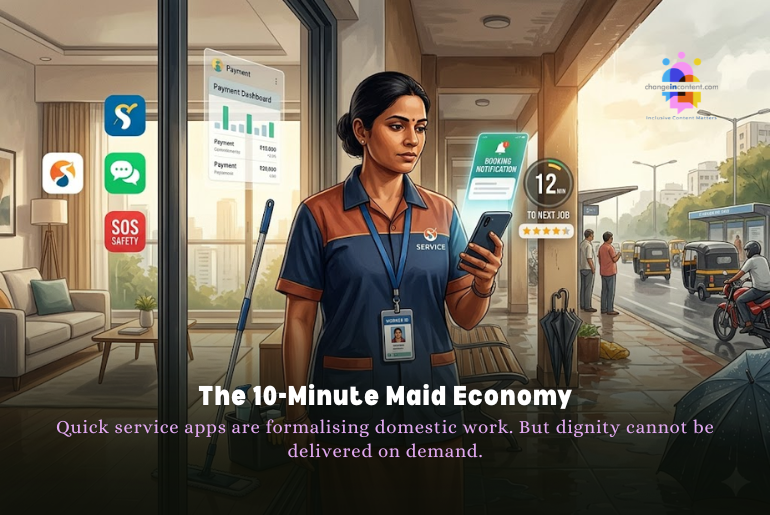
At 8.45 in the morning, a woman in a bright uniform waits outside a large apartment complex in Bengaluru. She is not the family’s regular domestic worker. No household employs her directly. Her phone decides where she goes next. That is the new world of Quick Services Apps employing women domestic workers in urban India.
One booking asks her to mop a 2BHK flat. Another asks for utensils. A third wants chopping, dusting, and bathroom cleaning. Between homes, she waits near a gate, a bus stop, or a service lane. Sometimes there is shade, while sometimes there is not. Sometimes the customer is polite; at other times, the customer watches her as if suspicion has entered with her.
Companies such as Snabbit, Pronto, and Urban Company’s InstaHelp are building an on-demand domestic work economy, promising quick household help to consumers and more structured work to women who have long operated in the informal sector.
On paper, the idea looks powerful. Domestic work, which has traditionally been undervalued, underpaid, invisible, and negotiated behind closed doors, is finally becoming part of a formal service marketplace. Women workers get uniforms, app-based bookings, training, fixed payouts, and safety features. Customers get convenience. Startups get scale.
But there is a question that we cannot ignore. When domestic work becomes a ten-minute service category, does the worker become more visible, or just more efficiently controlled?
Why Quick Services Apps are attracting women workers
The appeal is not difficult to understand. For many women domestic workers, platform work offers something the informal market often does not: predictable pay, structured shifts, training, and the possibility of earning more.
Quick-service platforms are competing to draw women out of the informal economy with flexible shifts, fixed monthly payouts, and better earning opportunities. These companies offer workers around ₹40,000 for full-time work and around ₹20,000 for part-time work. That amount is significantly higher than their previous earnings.
Pronto, Snabbit, and Urban Company are training thousands of domestic helpers for India’s growing instant home-help market. Urban Company estimated India’s cleaning services market at about $9 billion, spread across 53 million households.
The attraction for domestic women workers
Some workers could potentially earn up to $5,000 a year if they worked eight hours a day. That is higher than India’s per capita income of around $3,000. For a woman who earlier depended on three or four households, each paying irregularly, this model can feel attractive.
- No awkward salary negotiation every month.
- No waiting for a household to “adjust” payment.
- No complete dependence on one employer.
- No need to search for new work through neighbours or building guards.
- No invisibility in the eyes of the market.
For many women, the app creates a first formal-looking work identity. A uniform, a schedule, a training centre, a payment record, and a phone notification that says: your labour has a price.
That matters. For too long, we have been treating domestic work as “help”, not labour. These platforms at least force urban India to see it as a service.
The consumer story: Convenience now has a new labour model
For urban households, the promise is almost irresistible.
- Someone did not come today? Book help.
- Guests coming in an hour? Book help.
- Utensils piled up? Book help.
- Need cleaning after a party? Book help.
- Want one hour of housework without hiring a full-time worker? Book help.
The customer sees speed; the app sees demand; the investor sees a market, and the worker sees income. That is the triangle powering this boom.
That is India’s new consumer craze. Startups are offering house help at around $1 an hour and using discounts to attract urban customers. Such low-cost offerings have few global parallels, with comparable services costing far more in markets such as the United States and China.
That is where the story becomes uncomfortable.
If a service is too cheap for the customer, someone somewhere is absorbing the real cost. It may be the investor for now. Later, it may be the worker. Sometimes, it may be both.
The danger is that domestic work, already historically undervalued, could enter the platform economy through a pricing model that makes convenience look modern while keeping the value of labour low.
Quick Services Apps and Women Workers: The formalisation promise is real
Let us be fair. The rise of quick-service apps is not all bad for women domestic workers. It may solve some long-standing problems in domestic work.
Traditional domestic work in India is deeply informal.
- Work terms are often verbal.
- Leave policies are unclear.
- Wages vary wildly.
- Harassment and humiliation are underreported.
- There is no standardised training.
People often blame domestic workers for unreliability without asking whether they have access to transport, childcare, healthcare, or fair working conditions.
Platformisation can introduce some order.
- It can create worker records.
- It can standardise training.
- It can make payments more regular.
- It can offer safety tools.
- It can create complaint systems.
- It can help women build transaction histories.
- It can make domestic work more visible in the formal economy.
Platforms are trying to offer training and security measures. For example:
- Snabbit reportedly has about 15,000 active workers and says it moved from 100 jobs last year to 40,000 jobs daily
- Pronto has 6,500 professionals onboarded and provides a three-day training programme.
That is not a small shift. It shows that urban domestic work is entering a new phase.
But formalisation cannot be limited to uniforms, app IDs, and customer ratings. True formalisation must include rights, safety, income stability, rest, grievance redressal, health protections, and bargaining power.
Without that, formalisation becomes branding.
The safety question: Domestic work happens behind closed doors
A delivery worker may spend seconds at a doorstep. A domestic worker enters the home.
That difference changes everything.
A woman worker cleaning a kitchen, bathroom, or bedroom is not operating in a public workplace. She is inside a private home, often alone with unknown customers. That makes safety the foundation of this business model, not a side feature.
Pronto trains women workers on SOS signals. Snabbit and Pronto have in-app SOS buttons that alert area supervisors in distress situations. Pronto’s CEO said the company tries to support workers with legal and medical help where needed. Urban Company has previously said it offers a women-only safety helpline and an SOS app feature.
Safety concerns among women gig workers in Bengaluru include the fact that workers sometimes wait outside apartment complexes or at bus stops between bookings. Some InstaHelp workers said they were given pepper sprays, and Urban Company asks male customers to share a selfie for verification if no female family member is present.
These steps matter. But they also reveal the scale of the risk.
An SOS button is useful after danger appears. The harder question is how the platform prevents danger before the worker enters the home.
- Who verifies customers?
- Who checks whether a worker is waiting in unsafe conditions?
- Who responds if a customer is abusive but gives a bad rating?
- Who protects the worker when she refuses a risky booking?
- Who compensates her for the time lost after reporting misconduct?
- Who ensures that safety is not just a feature hidden inside the app?
A worker cannot be told she is empowered and then left to manage danger one booking at a time.
The waiting time nobody wants to count
A middle-class customer sees the 60-minute booking. The worker experiences the whole chain.
- Travel to the location.
- Wait outside the apartment.
- Enter after verification.
- Complete the task.
- Respond to customer instructions.
- Leave the building.
- Wait for the next booking.
- Stand in the heat or rain.
- Check the phone again.
Some of this time may be paid, while some may not. The platform might count some of this time, while some may disappear into the invisible margins of gig work.
While speaking to a worker in Surat (Gujarat), we realised that some of these workers stand near big apartment complexes because most orders come from there. That period of waiting at bus stops becomes difficult in the rain or in strong sunlight.
This detail is small, but it carries the whole story.
A platform can formalise the hours of labour inside the house. However, it leaves the time spent waiting, travelling, resting, eating, and recovering invisible.
That is not a small issue.
For women workers, the working day is not only the paid task. It includes the unpaid time between tasks and the unpaid work waiting at home.
The pressure problem: When speed becomes the boss
Quick service apps are built on speed. That is their promise.
- The customer wants help now.
- The app wants to supply now.
- The worker must be available now.
That creates a new type of pressure. Unlike a traditional domestic worker, who may have fixed households and known routines, a platform worker may move between multiple homes, layouts, expectations, customers’ moods, and app instructions in a single day.
- One customer wants “deep cleaning” in 30 minutes.
- Another expects hotel-like service at discount pricing.
- Another watches every movement.
- Another complains that the worker was “slow”.
- Another gives a poor rating because the app promised more than the worker could deliver.
That is where the platform model can become harsh.
When companies compete to win customers, they may promise speed, low prices, and quality. But the worker’s body carries that promise.
- Faster bookings mean less rest.
- More ratings mean more pressure.
- Discounted services may lower the perceived value of labour.
- Customer acquisition costs may later become worker income cuts.
- Incentive-linked work may push women to accept more bookings than is healthy.
Unfair platform rules, opaque payment terms, and rude customers are making some workers rethink the shift to gig work. While workers often find pay attractive, they also raise concerns about payment transparency and platform control.
That is the contradiction. Women workers may earn more and still feel less secure.
The platform economy’s old pattern may repeat itself
India has seen this film before.
Ride-hailing platforms began with attractive incentives. Food delivery platforms began with promises of flexibility. E-commerce logistics expanded through app-based labour. Over time, many workers reported falling incentives, high pressure, penalties, and algorithmic control.
Domestic work platforms may face the same risk.
An Economic Times report compared the current quick-service boom to the early days of ride-hailing, where high payouts and customer discounts helped build supply and demand. It quoted an industry executive saying the sector may move away from fixed payments once companies focus more on unit economics.
That is a crucial warning.
- If fixed payouts attract women now, what happens when investor-funded growth slows?
- If discounts bring customers now, who pays when prices normalise?
- If platforms reduce incentives later, will workers still have bargaining power?
- If the app becomes the main source of income, can workers refuse poor terms?
Formalisation must not become a trap where women leave informal employers only to become dependent on opaque algorithms.
Why this matters especially for women
Domestic work is not just work. It sits at the intersection of gender, caste, class, migration, poverty, care, and urban inequality.
Many women workers enter domestic work because other forms of employment are closed, unsafe, poorly paid, or incompatible with household responsibilities. Domestic work allows them to earn while still managing family duties, but it also exposes them to deep vulnerability.
They work inside private homes.
- Their labour is treated as “natural” because women are expected to clean and care anyway.
- Their skill is underestimated.
- Their bargaining power is weak.
- Their social security is limited.
- Their safety depends heavily on employer behaviour.
- Their work is emotionally and physically demanding.
That is why Changeincontent has consistently argued to understand gig work through a gender lens. In our earlier piece on Women and Gig Work in India, we examined how platform work can create income opportunities while also reproducing instability and unequal risk.
Domestic gig work sharpens this concern because the workplace is someone else’s home.
Quick Services Apps and Women Workers: The legal gap has not disappeared
India has not yet enacted a comprehensive central law exclusively protecting domestic workers. A Ministry of Labour and Employment reply has stated that a National Policy on Domestic Workers was under consideration and in draft stage, with proposed features including registration as unorganised workers and inclusion in existing legislation.
At the same time, the Code on Social Security, 2020, formally recognises gig workers and platform workers. It brings them into the social security conversation. The government has described this as the first formal recognition of gig and platform workers under social security and legal protection.
But recognition and protection are not the same thing.
The law may recognise a worker but still not guarantee minimum wages, paid leave, occupational safety, grievance redressal, maternity support, accident compensation, fair deactivation rules, or protection from customer abuse.
That is why domestic platform work needs a double lens. These women are domestic workers and platform workers. Hence, they need protections that address both realities.
Changeincontent has previously written about the urgent need for legal protection for domestic workers in India. That debate now becomes even more important because platform companies are rapidly reorganising the sector before regulation catches up.
What companies must do if they really want to formalise domestic work
Quick services apps cannot define formalisation only as onboarding workers to an app. If these companies want to claim they are improving domestic work, they must build a worker-first model, not only a customer-first one.
- First, customer verification must be as serious as worker verification. If workers are entering private homes, platforms must know more about customers than a phone number and payment method.
- Second, waiting time and travel time must be counted. An app cannot reduce a worker’s economic day to only task time.
- Third, platforms must create safe waiting points. If women workers have to wait near apartment clusters, there should be shaded, secure, accessible rest areas with toilets, drinking water, and emergency contacts.
- Fourth, payment terms must be transparent. Workers should know exactly how earnings, incentives, deductions, penalties, cancellations, and ratings affect their pay.
- Fifth, safety escalation must involve humans, not only buttons. A named supervisor, rapid response team, and post-incident support system should be mandatory.
- Sixth, the apps must not punish workers for refusing unsafe bookings. Safety has no meaning if refusal affects ratings, incentives, or future allocation.
- Seventh, health protection must be real. Cleaning work involves repetitive movement, chemical exposure, fatigue, and physical strain. Health check-ups, protective gear, rest breaks, and insurance should not be optional branding points.
- Eighth, grievance redressal must be independent. If the platform controls the complaint system entirely, workers may fear retaliation.
- Ninth, workers need representation. A platform that organises thousands of domestic workers should create structured worker councils or consultation mechanisms.
- Tenth, pricing must respect labour. A race to the cheapest home-help service may win customers, but it risks devaluing the very workers the companies claim to uplift.
What consumers must understand
This story is not only about companies. Customers also have a responsibility.
The woman who arrives through the app is not a “quick help unit”. She is a worker. She has a body that gets tired, a commute, a family, safety concerns, and a right to dignity.
Customers must stop treating low-cost convenience as an entitlement.
- Do not add tasks beyond the booking.
- Do not delay payment or dispute unfairly.
- Do not rate workers harshly for app-level promises.
- Do not leave workers alone with unsafe individuals.
- Do not humiliate, monitor, or suspect them by default.
- Do not expect deep cleaning at the price of a snack.
If we want to formalise domestic work, we must also formalise our behaviour as consumers. The home is a workplace when a worker enters it. That simple sentence changes everything.
Quick Service Apps and Women Workers: What regulation must address
India needs a framework that recognises domestic platform work as a serious labour category.
That framework should define minimum standards for pay, working hours, rest, travel time, compensation for cancellations, safety, customer verification, grievance redressal, insurance, accident support, maternity benefits, and protection against arbitrary deactivation.
Regulators must also ask how ratings affect workers. A customer rating system can become a hidden disciplinary tool if workers lose work because of biased or unfair feedback.
There must also be clarity on whether platforms are merely intermediaries or, in substance, employers. If a platform trains workers, fixes prices, assigns bookings, monitors performance, controls payments, and disciplines workers, then the worker’s dependence on the platform is not casual.
The law must catch up with the reality of control.
Changeincontent Perspective: Domestic work cannot become formal only for the customer
Quick services apps and women workers may become one of the most important labour stories of urban India.
- Done well, this model can bring domestic workers better pay, formal identity, safety systems, training, digital records, and social mobility.
- Done badly, it can turn women’s labour into another algorithm-driven race where the customer gets convenience, the investor gets growth, and the worker gets pressure.
At Changeincontent, we believe domestic work deserves modernisation. But modernisation must not mean speed without dignity.
The real test is not whether an app can send someone to clean a home in ten minutes. The real test is whether the woman who enters that home is safer, better paid, better protected, less exploited, and more respected than before.
If the platform economy wants to formalise domestic work, it must formalise rights, not just bookings, because we cannot build a clean home on an invisible worker’s exhaustion.
Methodology and editorial note
This article takes inspiration from the reporting by various experts on quick-service domestic work platforms, including Snabbit, Pronto, and Urban Company’s InstaHelp. It also draws on publicly available government information on domestic worker policy and gig worker recognition under the Code on Social Security.
The opening scene and some examples in this article are representative of reported working conditions and common patterns in platform domestic work. We use them to explain the issue in human terms and do not present them as direct accounts of any named worker.
Sources Used
- The Economic Times Report on quick-service apps and women workers.
- Reuters report on instant home-help services and safety risks.
- Scroll report on domestic gig workers’ concerns.
- PIB note on the proposed National Policy for Domestic Workers.
- PIB note on gig and platform worker recognition under the Code on Social Security.
