
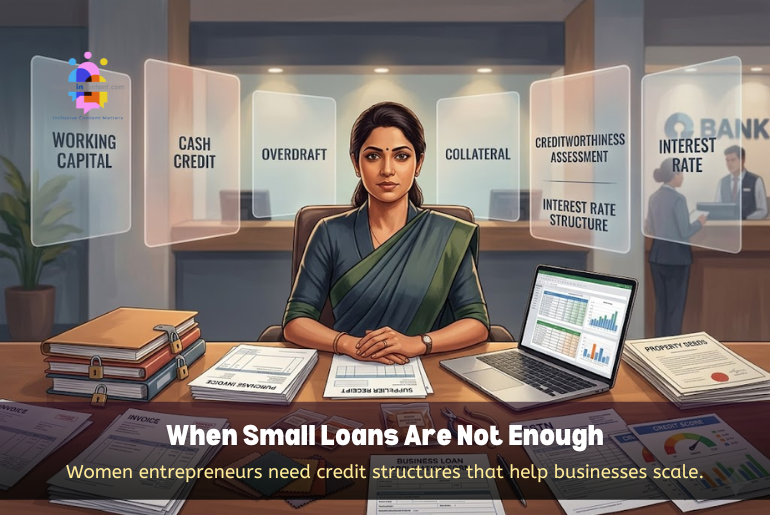
Complex business loans for women entrepreneurs in India are not only about borrowing more money. They are about accessing the kind of finance that helps a business scale, hire, stock inventory, manage receivables, buy machinery, expand into new markets, and survive seasonal cash-flow pressures.
That is where India’s credit story becomes complicated. Women are borrowing more than before. NITI Aayog’s 2026 report, From Borrowers to Builders, says women now account for 26% of total system credit. The credit outstanding to women has increased from ₹16 lakh crore in 2017 to ₹76 lakh crore in 2025. Credit penetration among women also increased from 19% to 36% during this period.
That sounds like progress, and it is. But there is a lack of depth in this progress. According to NITI Aayog data, only 4.3% of women-owned enterprises access cash credit or overdraft facilities. These are the very products that many growing businesses need for working capital and scale.
In simple terms, women are entering the credit system. But too many are still locked out of the credit structures that help businesses grow beyond survival.
Why are complex business loans harder for women entrepreneurs?
Complex business loans are harder for many women entrepreneurs because traditional lending systems often rely on collateral, formal business records, GST trails, audited financials, stock statements, banking history, and predictable cash flows. Many women-led businesses, especially micro, home-based, informal, service-led, or first-generation enterprises, do not always have these documents in the format lenders prefer.
The problem is not that women entrepreneurs lack business sense. The problem is that the lending system often recognises only certain kinds of business proof.
A woman may run a strong home-based food business with repeat customers and steady orders. But if most transactions are informal, if the business is not GST-registered, if the shop is not in her name, if she does not own land, and if her banking history is mixed with household transactions, a bank may not see the same creditworthiness that her customers already see.
That is why experts describe the issue as one of credit structure, not only credit access. Larger business credit products, such as cash credit and overdraft facilities, are underwritten based on a continuous view of business performance and often require audited financials, GST trails, banking records, and collateral.
So the real question is not whether institutions are offering loans to women entrepreneurs in India. The question is whether they are being offered the right loans for the stage their businesses have reached.
The difference between small credit and growth credit
Small credit helps a business begin. Growth credit helps it expand.
This distinction matters because many women entrepreneurs can access microfinance, self-help group credit, MUDRA loans, small working capital loans, or digital lending products. These can be useful for starting, restocking, or managing basic cash needs.
But bigger businesses need different financial tools. For example:
- A garment unit may need a cash credit line to buy raw material before payments arrive.
- A food-processing business may need machinery financing.
- A retailer may need overdraft access during seasonal demand.
- A B2B supplier may need invoice-backed working capital.
- A manufacturer may need term loans, bank guarantees, and flexible repayment structures.
- A growing services firm may need unsecured business credit linked to receivables.
These are not luxury products. They are growth products.
When women are limited to smaller, short-tenure, high-monitoring, or consumption-adjacent loans, their businesses may remain financially visible but economically constrained. That is why this article closely aligns with Changeincontent’s earlier analysis of credit borrowing by women in India, in which we examined how women’s borrowing is rising. However, the depth and quality of that credit still matter. You can read it here: Credit Borrowing by Women in India.
Complex business loans for women entrepreneurs in India: The collateral problem is still real
Collateral remains one of the strongest barriers to women’s access to larger business credit.
Many women entrepreneurs do not own land, shops, commercial property, machinery, or family assets in their own name. Even when they run the business, the asset may be registered in the name of a father, husband, brother, or other family member. That becomes a serious disadvantage in collateral-backed lending.
Banks often rely on collateral and GST turnover as proxies for creditworthiness, which can disadvantage women who lease assets, run home-based businesses, or reinvest informally.
That is not just a banking issue. It reflects a deeper gap in property and asset ownership.
- When women do not own assets, they cannot pledge them.
- When they cannot pledge assets, lenders treat them as higher risk.
- When lenders treat them as higher risk, they receive smaller loans or stricter terms.
- When they receive smaller loans, the business grows slowly.
- When the business grows slowly, the formal proof remains weak.
That loop is difficult to break without a design change.
Informality makes women’s businesses invisible.
India has millions of women-led enterprises, but many remain informal, home-based, unregistered, or partly documented. According to the NITI Aayog, an estimated 95.6% of women-owned enterprises operate outside the formal system, without Udyam registration, GST filings, or consistent banking records.
Informality does not mean the business is unserious. It often means the business grew around household responsibilities, limited mobility, limited networks, low compliance awareness, or fear of paperwork.
But lenders lend to what they can verify.
- If sales are mostly in cash, there is no clear banking trail.
- If business and household money are mixed, cash flow becomes difficult to assess.
- If the unit is not registered, scheme eligibility reduces.
- If invoices are not maintained, receivables cannot support working capital.
- If taxes and filings are absent, lenders cannot estimate turnover confidently.
That is where many women entrepreneurs get trapped. They may be running real businesses, but the financial system sees incomplete evidence.
Why women are often stuck in the “missing middle”
The missing middle is the space between microcredit and mainstream business finance.
- A woman entrepreneur may be too big for a ₹50,000 or ₹2 lakh loan, but not formal enough for a ₹50 lakh working-capital line.
- She may have customers, demand, and repayment discipline, but not enough collateral or audited data.
- She may need flexible finance, but lenders may offer only standardised products.
It is a major reason women-led businesses struggle to scale.
The progress that India has made
India has made strong progress in first-time access to credit.
PM Mudra Yojana, for example, has sanctioned more than 57 crore loans worth over ₹40.07 lakh crore since launch. About 60% of loan accounts in FY 2024–25 were held by women.
The scheme also offers collateral-free loans up to ₹20 lakh across Shishu, Kishor, Tarun, and Tarun Plus categories.
That is important. But a growing enterprise may need more than a Mudra-sized loan. It may need longer tenure, structured working capital, trade finance, receivables financing, equipment finance, or credit backed by real-time cash flows.
That is where the gap remains.
Why digital trails help, but cannot solve everything alone
Digital payments, GST data, bank statements, e-commerce sales, UPI receipts, QR payments, account aggregator frameworks, and digital bookkeeping can help lenders better understand business cash flows.
That is a positive shift.
Lenders are increasingly using bank statements, GST filings, and UPI transaction data to assess self-employed borrowers. Experts also noted that women entrepreneurs with consistent digital commerce and payment histories may already demonstrate creditworthiness. However, these data points are not yet systematically integrated into mainstream underwriting.
That last point matters. Digital evidence exists. But lenders must trust it, standardise it, and use it at scale.
A woman selling through Instagram, WhatsApp, ONDC, Amazon, Meesho, a local store, or a cooperative may generate strong business signals. But if those signals are scattered across platforms and not recognised by lenders, her financial profile remains weaker than her business reality.
Digital lending can help with small-ticket credit. But larger, complex credit still needs better risk models, guarantees, product design, and formalisation support.
Government schemes exist. The problem is navigation and fit.
India does have several schemes and credit structures for women entrepreneurs. The issue is not always absence. It is awareness, eligibility, paperwork, product fit, and last-mile navigation.
- PM Mudra Yojana supports micro and small businesses with collateral-free loans up to ₹20 lakh.
- Stand-Up India supports women entrepreneurs and SC/ST entrepreneurs for greenfield enterprises with loans from ₹10 lakh to ₹1 crore.
- CGTMSE provides credit guarantee cover for eligible micro and small enterprises, with the guarantee ceiling increased to ₹10 crore.
CGTMSE also provides special benefits for women entrepreneurs. Its official scheme information states that women entrepreneurs can receive guaranteed coverage of 90%, compared with standard coverage slabs for other categories.
These structures are useful, but many women entrepreneurs still struggle to understand which scheme fits their stage.
- A first-time entrepreneur may need Mudra.
- A woman setting up a new manufacturing or services unit may explore Stand-Up India.
- A growing small enterprise may need CGTMSE-backed collateral-free credit.
- A digital business may need cash-flow-based working capital.
- An exporter may need trade finance and guarantees.
- A business with receivables may need invoice discounting.
That is why women do not only need schemes. They need credit counselling, documentation support, business planning, and lender-facing preparation.
What financial institutions must do differently?
Financial institutions need to stop treating women entrepreneurs as a high-risk social segment and start treating them as an under-recognised growth market.
First, banks and NBFCs must move towards cash-flow-based underwriting.
Collateral still has a role, but it cannot remain the dominant proof of credibility. They should use business bank statements, digital transactions, GST filings, invoices, platform sales, POS data, and repayment behaviour more intelligently.
Second, lenders must design products around the realities of women-led businesses.
Many women run businesses with seasonal cash flows, mixed channels, home-based operations, part-time staff, family labour, or service-led revenue. Standard industrial loan templates may not fit them.
Credit guarantee coverage
Third, institutions must use the credit guarantee coverage more actively for working-capital products, not only term loans. If the risk is partly guaranteed, lenders should have fewer excuses for rejecting viable women-led businesses.
Fourth, banks should offer pre-loan documentation support.
Many women receive rejection not because the business is weak, but because documents are incomplete. Help desks, digital checklists, local language support, and assisted applications can change approval outcomes.
Publish the data
Fifth, lenders should publish gender-disaggregated data.
- How many women apply?
- How many are approved?
- What ticket sizes are sanctioned?
- What products are they receiving?
- How many get working capital, overdraft, or secured commercial credit?
Transparency creates accountability.
Sixth, banks must train branch-level teams.
Many women entrepreneurs still face discouragement, dismissive attitudes, or informal gatekeeping at the first point of contact. Product reform will fail if the branch experience remains biased.
Build partnerships
Seventh, financial institutions should build partnerships with women entrepreneur networks, chambers, self-help group federations, digital marketplaces, and incubators. Credit access improves when lenders understand business ecosystems, not only balance sheets.
What can policymakers do to improve access?
Policy must now move beyond “more loans for women” to “better credit architecture for women-led growth”.
Formalisation support should be the priority.
Policymakers should embed Udyam registration, GST guidance, digital bookkeeping, invoice discipline, separate business bank accounts, and credit bureau education into women entrepreneurship programmes.
Guarantee-backed working capital
The second priority should be expanding guarantee-backed working capital. If only 4.3% of women-owned enterprises access cash credit or overdraft facilities, then the policy must specifically target this gap.
The third priority should be scheme convergence.
A woman entrepreneur should not have to separately decode Mudra, Stand-Up India, CGTMSE, state schemes, bank products, and digital lending options. Platforms such as JanSamarth can help, but assisted access is still needed for many entrepreneurs. Experts note that women can use JanSamarth to check eligibility across multiple government-backed schemes.
The fourth priority should be outcome tracking.
Do not measure credit success only by disbursal. Measure it by business survival, turnover growth, job creation, formalisation, repeat borrowing, and movement into larger credit products.
The fifth priority should be legal and property-linked reform.
Women’s access to credit will remain limited if women’s ownership of assets remains limited. Property rights, awareness of inheritance, co-ownership, and documentation of business assets are part of the credit conversation.
What women entrepreneurs can do before applying for larger business loans
The system must change. But women entrepreneurs can also strengthen their credit readiness.
- The first step is to separate business and household money: A dedicated business bank account helps create a clean banking trail. Lenders need to see revenue, expenses, deposits, supplier payments, and customer receipts.
- The second step is to register the business: Udyam registration can provide access to MSME benefits, government schemes, priority-sector lending, and formal credit channels.
- The third step is to digitise transactions: UPI, QR payments, POS machines, invoices, e-commerce platforms, and accounting apps help create a transparent cash flow record.
- The fourth step is to maintain basic books: Even simple monthly records of sales, expenses, stock, receivables, and profit can make a major difference. A lender cannot fund growth it cannot understand.
- The fifth step is to build a credit history early: A small loan repaid well can support a larger loan later. Credit discipline matters.
- The sixth step is to prepare a loan story: Women entrepreneurs should be able to explain why they need money, how they will use it, how it will increase revenue, and how they will repay it.
- The seventh step is to understand the product: A term loan, overdraft, cash credit, machinery loan, invoice discounting facility, and Mudra loan are not the same. Choosing the wrong product can create repayment stress.
- The eighth step is to ask for more than just money: Good credit should come with advisory support, repayment planning, clear documentation, and growth guidance.
What this means for women-led growth in India
Women entrepreneurs are already contributing to India’s economic growth. Changeincontent recently highlighted 10 women entrepreneurs driving India’s growth story, from biotech and beauty to fintech, finance, health education, and rural enterprise. You can read that feature here: Women Entrepreneurs Driving India’s Economic Growth.
But inspiration alone cannot fund expansion.
A woman can have a strong idea, loyal customers, repayment discipline, and growth ambition. Yet, if she cannot access working capital, overdraft, machinery finance, or secured business credit, the business remains smaller than it should be.
India’s next challenge is not only to bring women into borrowing. It is to help women move from borrowing to building.
Changeincontent Perspective: Credit must recognise the business women actually build
At changeincontent, we do not see complex business loans for women entrepreneurs as a niche financial issue. We see them as something central to India’s growth story.
We believe the conversation must now move from access to depth. Giving women small loans is important. But if women cannot access working capital, cash credit, overdrafts, equipment finance, trade credit, and growth capital, we are not truly building women-led enterprise. We are only funding survival.
The financial system must stop asking women entrepreneurs to look like traditional male-owned businesses before recognising them as creditworthy.
Women’s businesses may begin at home. They may grow through digital sales and use informal networks. Sometimes, they may be built around care, food, crafts, services, retail, health, education, or local demand. That does not make them less serious. It means credit design must become more intelligent.
India cannot celebrate women entrepreneurs on one page and deny them growth capital on the next. If women are to build businesses that hire, scale, export, innovate, and formalise, they need more than encouragement. They need fit-for-purpose finance.
Methodology and editorial note
This article is an analysis of findings from various reports on women entrepreneurs and complex business loans, including NITI Aayog’s 2026 report From Borrowers to Builders, official information on PM Mudra Yojana, CGTMSE, and publicly available policy resources on women’s business loans in India.
The article is an explanatory Knowledge Hub piece. It does not provide financial advice or recommend any specific lender. Women entrepreneurs should compare loan products, interest rates, processing fees, repayment conditions, collateral requirements, and eligibility terms before applying.
Sources Used
- Business Standard report on women entrepreneurs and complex business loans.
- NITI Aayog report, From Borrowers to Builders.
- PIB release on NITI Aayog’s From Borrowers to Builders report.
- PIB release on 11 years of Pradhan Mantri Mudra Yojana.
- CGTMSE official website.
