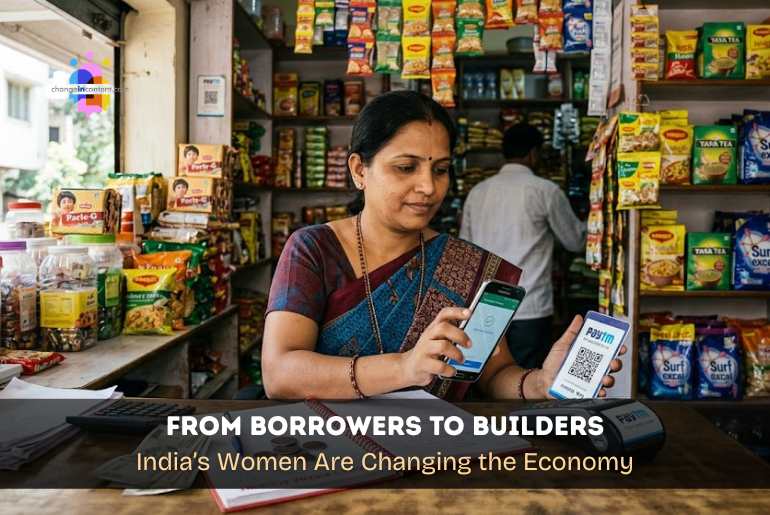
Credit borrowing by women in India is no longer a story about access. It is a story about agency. According to a recent NITI Aayog report titled From Borrowers to Builders: Women and India’s Evolving Credit Market, women now account for over ₹76 lakh crore in outstanding credit. There are more than 16 crore active women borrowers across the country. These are not marginal numbers. They represent a structural shift in how women engage with money, risk, and opportunity.
But the real story lies beneath the headline. This is not just about borrowing more. It is about borrowing differently. Women are not simply taking loans. They are building enterprises, stabilising households, and creating economic momentum in spaces where formal systems once struggled to reach. The shift from borrower to builder is not symbolic. It is measurable and redefining the narrative of financial inclusion in India.
Credit borrowing by women: The numbers that define the shift
The NITI Aayog report provides one of the most comprehensive snapshots of women’s participation in India’s credit ecosystem.
- ₹76 lakh crore in total outstanding credit held by women
- 16 crore+ active women borrowers
- Rapid growth in self-help group (SHG)-linked lending and microfinance participation
- Increasing presence in retail, agriculture, and MSME-linked credit segments
What stands out is not just the scale, but the distribution. A significant portion of this credit is concentrated in semi-urban and rural India, where women are using loans for livelihood creation, small businesses, agriculture, and service-based enterprises.
That is where the narrative begins to shift. Credit is no longer a consumption tool. It is becoming a production tool.
From borrowers to builders: What is actually changing
The report makes a critical distinction that deserves attention. Earlier, women’s participation in credit markets was often linked to necessity, such as household consumption, emergency expenses, or informal borrowing cycles.
That is changing. Women are now increasingly using credit for:
- Enterprise creation in small retail, services, and agriculture
- Income diversification, reducing dependence on a single earning source
- Asset building, including livestock, equipment, and small infrastructure
- Financial planning, including insurance and savings-linked products
This shift is subtle but powerful. It reflects a move from reactive borrowing to strategic borrowing.
And that is where the term “builder” becomes meaningful.
Why women are repaying better, and what that means
One of the most consistent findings across financial studies in India is that women borrowers tend to have higher repayment rates than their male counterparts. That is particularly the case in microfinance and SHG-linked lending.
The NITI Aayog report reinforces this pattern. Women are more likely to:
- Borrow within their repayment capacity
- Use funds for productive purposes
- Maintain consistent repayment cycles
- Build long-term relationships with financial institutions
This has implications beyond finance. It challenges a long-standing bias in credit systems. The data do not support the assumption that women are riskier borrowers. In fact, the opposite is often true.
For financial institutions, this should translate into more targeted lending, better-designed products, and stronger support systems for women borrowers.
The role of SHGs, Digital Access, and Policy Push
The rise in credit borrowing by women is not accidental. It is the result of layered interventions across policy, infrastructure, and community systems.
Self-Help Groups (SHGs) as financial gateways
India’s SHG network, with over 9 crore women mobilised nationally, has acted as the primary entry point into formal credit systems. These groups provide not just access to loans, but also peer support, accountability, and financial literacy.
Digital financial infrastructure
The expansion of Jan Dhan accounts, Aadhaar linkage, and mobile banking has reduced barriers to entry. Women can now access credit, track transactions, and engage with formal systems without intermediaries.
Government and institutional push
Schemes linked to livelihood missions, agriculture, and MSME development have increasingly prioritised women beneficiaries. That creates a pipeline from financial access to economic participation.
Together, these layers have created an ecosystem where women are not just included. They are enabled.
The gaps that still need attention
Despite the progress, the report does not paint a perfect picture.
There are structural gaps that continue to limit the full potential of women borrowers:
- Limited access to larger-ticket loans that restrict business scale
- Continued dependence on microcredit rather than enterprise financing
- Lower participation in formal business credit systems
- Social constraints that limit mobility, decision-making, and risk-taking
There is also a persistent urban-rural divide in access to sophisticated financial products.
These gaps matter because they define the ceiling of growth. If women are to move from micro-entrepreneurs to enterprise builders, the credit ecosystem must evolve with them.
Increasing credit borrowing by women and the risk of exploitation
While formal credit systems are expanding, the risk of exploitation has not disappeared.
In many regions, women still navigate a mix of formal and informal lending systems, sometimes leading to cycles of debt stress. We have previously examined how gaps in awareness and access can expose women to exploitative financial practices.
The lesson here is clear.
Access without awareness can still be dangerous. That is why financial literacy, transparency, and support systems must grow alongside credit expansion.
What organisations and leaders must learn from this shift
It would be wrong to think of this story as just a policy story. It is a leadership lesson.
When women get access to capital, they do not just participate in the economy. They stabilise and expand it.
For organisations, this translates into three clear insights:
- Women are not a “segment” to be included. They are a growth engine.
- Support systems matter as much as access.
- Long-term trust drives better outcomes than short-term extraction.
Whether it is financial institutions, corporates, or startups, the question is no longer whether women should be included in economic systems.
The question is how systems must be redesigned to unlock their full potential.
The Changeincontent perspective
At Changeincontent, we view the rise in credit borrowing by women as one of the clearest indicators of structural change in India’s economic landscape. But we also recognise the risk of oversimplification.
Celebrating numbers without understanding context can be misleading. ₹76 lakh crore in credit is not just a success story. It is a responsibility. It demands better systems, better safeguards, and better opportunities.
The real shift will not come from more borrowing alone. It will come from enabling women to move up the value chain from microcredit to enterprise capital, from survival to scale, from participation to leadership.
That is the journey we must pay attention to.
The rise in credit borrowing by women is no longer a statistic. It is a signal.
The numbers tell one story. The implications tell another.
Women’s borrowing is not just about expanding financial access. It is reshaping economic behaviour, challenging institutional biases, and creating new pathways for growth.
But the most important takeaway is this: When women gain access to capital, they do not just build businesses. They build stability, resilience, and future-ready economies.
The shift from borrower to builder is already underway. The only question is whether our systems are ready to keep up.
Disclaimer: The views expressed in this article are based on the writer’s insights, supported by data and resources available both online and offline, as applicable. Changeincontent.com is committed to promoting inclusivity across all forms of content. We broadly define inclusivity in terms of media, policies, law, and history. It encompasses all elements that influence the lives of women and marginalised individuals. Our goal is to promote understanding and advocate for comprehensive inclusivity.