
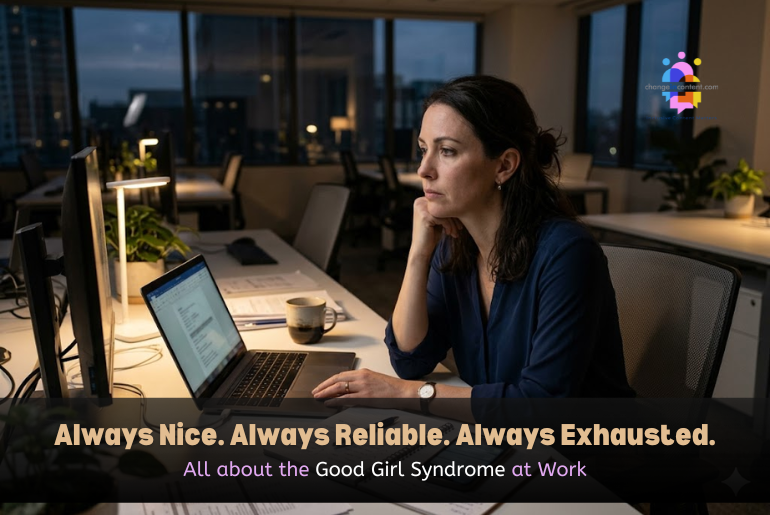
The ‘Good Girl Syndrome’ at work is not about being kind, collaborative, or responsible. It is about the pressure to stay likeable at all costs. It is the learned instinct to avoid conflict, over-deliver without complaint, say yes too quickly, suppress frustration, and keep performing with composure even when the body and mind are under strain.
In recent public health discussions, some doctors in India have used the phrase while talking about how chronic stress, emotional suppression, and perfection-driven pressure can affect young women’s health. Even the doctors discussing it acknowledge that “Good Girl Syndrome” is not a formal clinical diagnosis, but a behavioural pattern with real consequences.
This article focuses on what the Good Girl Syndrome looks like in the workplace. It explains where the pattern comes from, how it shows up in professional life, why it can hurt women’s careers and health, what organisations often misunderstand about it, and what women can do without blaming themselves for adapting to systems that were never neutral in the first place.
What does the ‘Good Girl Syndrome’ actually mean at work?
In everyday workplace terms, Good Girl Syndrome describes a pattern in which women feel rewarded for being endlessly accommodating. At the same time, they are quietly penalised for being direct, boundaried, or visibly ambitious. The behaviour often overlaps with people-pleasing, perfectionism, conflict avoidance, over-functioning, and emotional self-silencing.
People-pleasing is going out of one’s way to make others happy at the expense of one’s own well-being. Over time, it can lead to stress, resentment, burnout, sleep disruption, and other signs of strain.
What it means at work
At work, that pattern may look polished.
- The woman who always says yes is called dependable.
- The woman who absorbs extra emotional labour is called mature.
- And the woman who never creates friction is called easy to work with.
But those labels often conceal something else. The same woman may be carrying undervalued work, avoiding conversations that matter to her career, and exhausting herself to remain acceptable.
That is one reason the phrase resonates so strongly. It captures something many women experience long before they have language for it. These women are not merely working. They are managing perception. They are trying to remain competent without seeming difficult, capable without seeming threatening, and committed without admitting that the arrangement is costing them more than it appears to cost everyone else.
Where does the Good Girl Syndrome come from?
No woman invents this pattern in isolation. It usually begins much earlier than employment. People often praise girls for being cooperative, neat, calm, generous, emotionally available, and low-maintenance. Assertiveness, appetite, anger, defiance, or visible self-prioritisation are more likely to be criticised or disciplined.
Psychology Today described “goodgirling” as a shame-based strategy that teaches women to suppress themselves in order to remain acceptable. Cleveland Clinic notes that people-pleasing can become a defence mechanism that starts early and persists into adulthood.
The workplace then professionalises that conditioning. Women quickly learn which behaviours receive social rewards and which receive critical judgment when they come from women rather than men.
- The woman who does extra invisible coordination work is appreciated
- The woman who sets limits undergoes scrutiny
- The woman who smooths conflict receives the tag of emotionally intelligent
- The woman who names a problem bluntly may be called abrasive or overreactive
Over time, many women do not consciously decide to become over-accommodating. They simply learn the cost of not being so.
How Good Girl Syndrome shows up in the workplace
The workplace version of Good Girl Syndrome is often easiest to spot not in dramatic moments, but in small, repeated decisions.
- A woman accepts work she knows will not help her progress because declining it feels rude.
- She edits her messages to sound softer.
- She apologises before asking reasonable questions.
- She avoids negotiating because she does not want to seem demanding.
- She keeps covering for underperforming colleagues because she would rather overwork than create discomfort.
- She keeps proving she is a “team player” until the team begins to depend on her inability to say no.
That is where the pattern becomes professionally expensive.
The Harvard Report
Harvard Business Review shows that women are disproportionately expected to take on non-promotable tasks and are also more likely to volunteer for them. One HBR analysis notes that women are 48% more likely to volunteer for these jobs, even though such work often does not translate into recognition or advancement.
It shows that saying yes is not always neutral. Sometimes it is career leakage. It is time, credibility, and redirecting energy into work that keeps systems running, but does not move the woman forward.
Good Girl Syndrome at work often persists because it is socially rewarded in the short term, even when it entails structural punishment in the long term.
What Good Girl Syndrome can lead to
The consequences are not limited to feeling tired or overlooked. Left unexamined, this pattern can shape career trajectories, mental health, and physical stress responses.
The professional impact
Professionally, it can lead to stalled advancement. That is because women become known as indispensable helpers rather than strategic leaders.
McKinsey and LeanIn’s Women in the Workplace 2025 report states that women still receive less career support and fewer opportunities to advance. Moreover, when women receive the same support as men, the gap in desire to move up disappears. That means what often looks like lower ambition can actually be a response to weaker sponsorship and less visible opportunity.
The psychological impact
Psychologically, the pattern can produce chronic stress. WHO states that poor working environments pose a risk to mental health. A poor working environment includes discrimination, inequality, excessive workloads, low job control, and job insecurity.
The WHO also estimates that depression and anxiety lead to 12 billion lost working days annually worldwide. It also classifies burnout as an occupational phenomenon resulting from chronic workplace stress that has not been successfully managed.
That is why the “good girl” pattern is not trivial. It can keep a woman locked in over-compliance while her body absorbs the cost. Several endocrinologists link the pressure to remain perfect and emotionally controlled with chronic stress and the possibility of hormonal disruption in some young women. So, stress does not remain emotional forever. It becomes physiological.
Why women should not be blamed for it
It would be easy and lazy to frame this as an individual weakness. It is not.
Many women develop these workplace habits because they are responding rationally to social signals. If speaking too plainly gets you labelled difficult, if boundary-setting gets read as disengagement, and if self-advocacy is punished more harshly when it comes from you, then over-accommodation is not irrational. It is adaptive.
A lot of workplace advice to women still sounds like this: speak up more, say no more often, be more confident, set boundaries.
Some of that advice is useful. But if it doesn’t name the penalties women often face for doing those things, it becomes incomplete. Women do not need lectures on confidence nearly as much as they need organisations willing to stop rewarding self-erasure.
What women can do without turning this into self-blame
Here is what women can do to combat this syndrome.
The first useful step is recognition.
Many women have normalised this pattern so deeply that they only notice it after burnout, resentment, or career stagnation begins. Naming it does not solve it immediately, but it breaks the illusion that this is simply “how professionalism works.”
Identify the cost
The second step is to identify where the pattern is costing the most.
- Is it in overwork
- In conflict avoidance
- In not asking for pay or credit
- In over-preparing
- In accepting non-promotable tasks
- In making yourself smaller in rooms where authority matters.
The point is not to change every behaviour at once. It is to identify the most expensive habit and interrupt it first.
The third step is boundary practice.
Boundaries protect time, energy, and emotional well-being. Without them, it becomes easy to overextend yourself and burn out. At work, that may mean:
- Pausing before saying yes
- Asking for clarification on priorities
- Requesting time before accepting extra work
- Refusing to absorb emotional labour that belongs to the whole team automatically
The fourth step is to separate worth from usefulness.
Many women trapped in workplace good-girl conditioning derive a sense of identity from being the one who always fixes, smooths, or rescues. That can feel noble, but it also makes exploitation feel virtuous. The more sustainable question is not “How can I keep proving I am valuable?” but “What kind of contribution actually supports my growth, health, and authority?”
How organisations can reduce Good Girl Syndrome at work
No organisation can claim to care about women’s advancement if it continues to reward compliance more than leadership. The most effective support is not a motivational campaign telling women to be bold. It is structural.
- Managers need to examine how work is distributed. Who is handling office housework, emotional mediation, scheduling friction, or people care without recognition?
- Leadership teams need to examine how women who speak directly are evaluated compared with men who do the same.
- Performance systems need to separate actual collaboration from unpaid caretaking that quietly becomes a gendered expectation.
- Employers also need to treat burnout as a workplace design issue, not a self-management failure.
WHO’s mental health at work guidance is explicit that there are effective actions to prevent risks at work and that poor working environments themselves create mental health risks.
The safety dimension
There is also a safety dimension. Women who are already dealing with abuse, coercion, or surveillance outside work may carry heightened conflict avoidance or self-silencing into professional settings. We explored some of those spillovers in our earlier article on signs of domestic abuse in the workplace, and that context matters here because not all silence begins at work.
If companies want women to show up fully, then they must build cultures where directness is not punished, asking for support is not pathologised, and masculine behavioural defaults do not define leadership.
The Changeincontent perspective
At Changeincontent, we do not see Good Girl Syndrome as a trendy phrase to diagnose women with. We see it as a useful workplace lens. It helps explain why so many capable women remain overburdened, under-recognised, conflict-avoidant, and professionally cautious even when they are talented enough to lead.
The problem is not that women are too nice. The problem is that workplaces still reward women for disappearing into usefulness and then act surprised when they are exhausted, stuck, or disengaged. If organisations are serious about inclusion, they need to stop treating women’s self-suppression as evidence of professionalism.
The deeper goal is not to teach women to become hard, loud, or permanently combative. It is to create workplaces where women do not have to choose between being respected and being liked, between being ambitious and being acceptable, or between preserving their health and preserving their image.
Conclusion: Good Girl Syndrome will keep costing women until workplaces stop rewarding it
Good Girl Syndrome at work is not a woman’s problem in isolation. It is a workplace pattern that survives because it is repeatedly mistaken for commitment, teamwork, and emotional maturity. In reality, it often masks chronic over-functioning, suppressed needs, invisible labour, and stress that spills into both health and career progression.
The answer is not simply to tell women to toughen up. The answer is to make workplaces less dependent on women’s self-erasure. Women deserve environments where they can set boundaries without penalty, ask for what they need without shame, and build careers without being trapped inside a role they were taught to perform long before they ever entered an office.
Disclaimer: The views expressed in this article are based on the writer’s insights, supported by data and resources available both online and offline, as applicable. Changeincontent.com is committed to promoting inclusivity across all forms of content. We broadly define inclusivity in terms of media, policies, law, and history. It encompasses all elements that influence the lives of women and marginalised individuals. Our goal is to promote understanding and advocate for comprehensive inclusivity.
