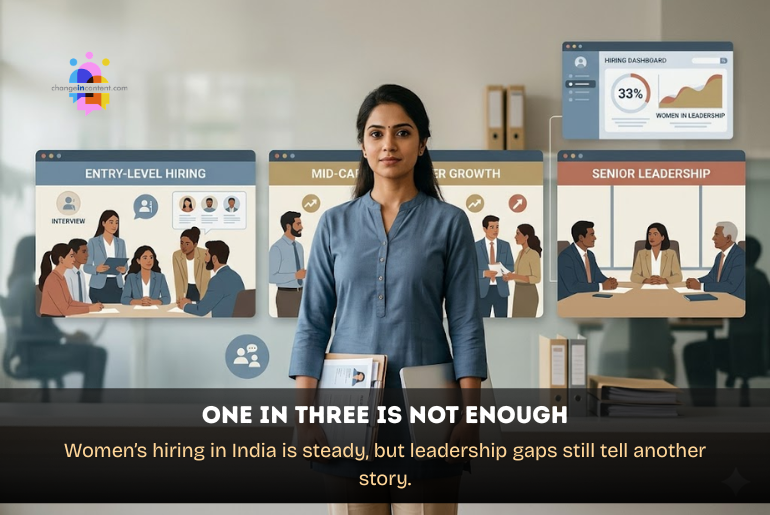
Women’s hiring in India is holding steady, but the word “steady” needs careful reading. It can mean resilience. It can also mean stagnation. A recent CareerNet report says women accounted for 33% of placements in CY2025, with entry-level roles leading at 36% and senior-level hiring standing at only 16%.
That number is not insignificant. One in three placements being women suggests that diversity hiring is no longer a fringe conversation. Sectors such as BFSI Global Capability Centres are showing stronger participation, and mid-career hiring has seen a slight uptick. Yet, the drop at senior levels exposes a familiar pattern. Women are entering the workforce, but too many are still not moving into power.
That is the central question for Indian organisations now. Are we still treating women’s hiring as an entry-level diversity metric, or as a serious leadership pipeline strategy?
What does the CareerNet report say about women’s hiring in India?
CareerNet’s data show that women accounted for nearly one in three placements in CY2025, keeping women’s hiring stable at 33%. Entry-level roles had the strongest share at 36%, while senior roles with more than 12 years of experience fell to 16%, down from 19%.
Women’s hiring in India: Sector-wise data
The sectoral picture is more interesting.
- BFSI GCCs led women’s participation at 40%
- Other GCCs follow the BFSIs at 38%
- Domestic BFSI stands at 31%
- IT services remained stable at 29%
- Domestic enterprises are at 25%
- Product GCCs stand at 22%
Geography also matters.
- Chennai and Bengaluru led women’s placements at 30% and 29%
- Mumbai and Delhi NCR were at 26% and 24%.
- Tier-II and beyond cities remained at 15%
It shows that women’s employment opportunities are still concentrated in major urban hubs.
CareerNet’s Chief Business Officer Neelabh Shukla said targeted interventions are delivering results, especially in BFSI GCC hiring and mid-career roles. However, the decline in senior-level hiring points to the need for stronger leadership pipelines for women.
That is the headline. But the deeper issue is this: if women’s hiring remains stable at 33% while leadership hiring declines, the system may be adding women without changing the structure that determines who rises.
Why 33% is both good news and a warning sign
A 33% share of placements is good news because it indicates that organisations are hiring women at scale. It also suggests that employers, recruiters, and sectors such as GCCs are no longer treating women candidates as exceptional.
But the same number is also a warning sign.
- If one in three placements are women, two in three are still men.
- If entry-level hiring is 36% but senior hiring is 16%, then the career funnel is leaking badly.
- If metro cities are doing better than smaller cities, then opportunity is still geography-dependent.
- If BFSI GCCs are leading while product GCCs and domestic enterprises lag, then inclusive hiring is still uneven across sectors.
India’s labour data
India’s broader labour data adds context. According to the Periodic Labour Force Survey Annual Report 2025, the female labour force participation rate for people aged 15 and above stood at 40.0%, compared with 79.1% for men. The female worker population ratio was 38.8%, compared with 76.6% for men.
That means the hiring gap is not happening in isolation. It sits inside a much larger labour market gap.
The question, therefore, is not whether women want to work. The question is whether the market gives them enough visible, safe, flexible, fairly paid, growth-oriented jobs to stay and advance.
The leadership gap starts much before leadership.
It is tempting to say women are missing at senior levels because fewer women have enough years of experience. That is partly true in some sectors, but it is not the full story.
Leadership gaps begin much earlier.
- The leadership gaps begin when women do not get the same first break.
- They grow when women do not get stretch roles.
- They widen when women are hired but not sponsored.
- They become severe when motherhood, caregiving, relocation limits, safety concerns, workplace bias, and inflexible work design slowly push women out of the pipeline.
McKinsey’s 2025 Women in the Workplace report for India, Nigeria, and Kenya clearly shows the narrowing funnel. In India’s financial services sector, women make up 31% of entry-level roles but only 13% of C-suite roles. In India’s legal sector, women make up 51% at the entry level but only 32% in the C-suite.
Why does it matter?
That matters because it shows that representation at the bottom does not automatically translate into representation at the top.
Women do not disappear from leadership by accident. Systems that reward constant availability, informal networking, relocation readiness, uninterrupted careers, and a narrow definition of leadership presence often filter women out.
What continues to cause the women’s hiring gap in India?
The women’s hiring gap in India does not result from a single factor. It results from many small and large barriers that operate together.
Role design
The first barrier is role design. Many jobs still assume long hours, physical presence, unpredictable schedules, and limited caregiving responsibility. That model silently favours workers who have fewer unpaid responsibilities at home.
Biased screening
The second barrier is biased screening. Recruiters still see career breaks, maternity gaps, non-linear work histories, and flexible work as risks in many hiring processes. They often assess men for potential, while assessing women for continuity.
Confidence gap
The third barrier is the confidence gap that the workplace culture creates. Women may self-select out of roles not because they lack ambition, but because job descriptions read like exclusion tests. If every role demands “aggressive ownership”, “high-pressure availability”, “constant travel”, and “immediate joining”, many capable women may not apply.
Geography
The fourth barrier is geography. CareerNet’s data show a lower share of women’s placements in Tier-II and beyond cities. That points to safety, transport, childcare, local employer ecosystems, and family mobility barriers that job postings alone cannot solve.
Leadership pipeline
The fifth barrier is the broken leadership pipeline. Senior hiring at 16% is not only a hiring issue. It reflects years of uneven retention, promotion, sponsorship, and return-to-work opportunities.
That is why Changeincontent has previously argued that the conversation on India’s workforce cannot ignore the missing women in formal employment. You can read that analysis here: The Missing Women Workforce in India.
Why BFSI GCCs are doing better and what others can learn
BFSI GCCs reporting 40% women’s participation is a useful signal. It suggests that structured hiring, defined roles, professional talent acquisition systems, compliance-led environments, and global diversity expectations may be helping.
But organisations should not copy only the language of diversity. They should study the systems behind better participation.
- Are roles clearly defined?
- Are hiring panels trained?
- Are women being sourced actively?
- Are managers accountable for diverse shortlists?
- Are returners being considered seriously?
- Are flexible roles available without a career penalty?
- Are there enough mid-career pathways?
Good hiring does not happen because companies say they want women. It happens when they redesign the hiring journey so that women are not screened out before the interview stage.
Changeincontent has previously outlined practical steps for employers in 7 Inclusive Hiring Practices for Your Organisation. Those practices matter even more now because women’s hiring will not move from 33% to parity through intention alone.
What organisations must do now?
Organisations need to stop treating women’s hiring as a diversity target and start treating it as a talent strategy.
Audit the hiring funnel.
First, organisations should audit the hiring funnel. Ask simple questions.
- How many women apply?
- How many are shortlisted?
- How many underwent an interview?
- How many receive offers?
- How many accept?
- Where does the drop happen?
Skills and availability bias
Second, organisations should separate skill from availability bias. Recruiters must not confuse a candidate’s ability with her ability to relocate instantly, stay late every night, or have no caregiving responsibilities.
Better job descriptions
In simple terms, organisations must rewrite the job descriptions. Many women do not apply unless they meet a larger share of the listed requirements. Organisations should stop stuffing job posts with unnecessary filters that discourage strong candidates.
Return-to-work
Fourth, returnship and second-career hiring must become mainstream. India has a large pool of experienced women who paused careers for caregiving, relocation, childbirth, elder care, or family reasons. Treating them as “gaps” is a waste of talent.
Sponsorships are vital
Fifth, senior hiring needs deliberate sponsorship. If women are not visible in senior candidate pools, companies must ask whether search mandates are too narrow, networks are too male, or selection criteria are biased towards conventional leadership paths.
Protect flexibility
Sixth, organisations must protect flexibility from stigma. Remote work, hybrid roles, phased returns, part-time leadership tracks, and predictable schedules should not quietly reduce chances of promotion.
Link hiring and retention
Seventh, organisations must link hiring to retention. If women are hired but leave within two years because the culture is unsafe, dismissive, or inflexible, the hiring metric is meaningless.
What women candidates can do without carrying the burden of the system
The responsibility for addressing hiring inequality lies with organisations, not women. Still, women candidates deserve practical ways to strengthen their position in an uneven market.
Women should document outcomes clearly.
Hiring managers respond to proof. Revenue impact, process improvement, cost savings, team management, project delivery, client retention, compliance success, automation, and crisis handling should be visible on résumés and LinkedIn profiles.
Women should also translate career breaks into skill narratives.
A break does not erase competence. Returning candidates should show updated certifications, freelance work, volunteer leadership, consulting assignments, project work, learning, or industry engagement where possible.
Women at the mid-career level should build networks before they need them.
Many roles, especially senior roles, move through referrals and trusted search networks. Visibility matters, not as self-promotion for its own sake, but as access to opportunity.
Negotiate role design early.
Women should discuss flexibility, travel expectations, reporting structure, team size, growth path, and performance metrics before joining. A good offer is not only about salary. It is about whether the role allows growth without hidden penalties.
Women should not internalise structural barriers as personal failure.
A rejection does not always mean a lack of merit. Sometimes it means the system is still too narrow to recognise different career journeys.
Women’s hiring in India: Why this report should matter beyond HR departments
Women’s hiring in India is not only an HR metric. It is a business, economic, and social signal.
- If women are hired only at lower levels, companies lose leadership diversity.
- If women are absent from senior roles, decision-making becomes narrower.
- If women leave mid-career, organisations lose trained talent.
- If smaller cities lag, India’s growth story remains metro-heavy.
- If flexible work carries stigma, many capable women stay outside formal jobs.
Hiring is the front door of inclusion. But the front door means little if the corridors inside are not built for women to move forward.
Changeincontent Perspective: Hiring women is not enough if growth still belongs to men
Women’s hiring in India, holding steady at 33%, is a useful sign. But it is not a victory lap. It is a checkpoint.
At Changeincontent, we believe the real measure of inclusive hiring is not how many women enter the organisation. It is how many stay, grow, lead, return, negotiate, and shape decisions. A company cannot call itself inclusive if women are hired at the entry level but disappear from leadership. It cannot celebrate diversity if women are present in dashboards but absent in decision-making rooms.
The next phase of women’s hiring in India must be less about optics and more about architecture.
- Build the shortlist.
- Fix the job description.
- Train the interviewer.
- Support the returner.
- Sponsor the mid-career woman.
- Redesign flexibility.
- Audit senior hiring.
- Measure who rises.
Because one in three is progress. But two in three still tells us how far we have to go.
Methodology and editorial note
This article is based on CareerNet’s public report summary on women’s hiring in India for CY2025, coverage by ETHRWorld, Government of India PLFS Annual Report 2025 highlights, and McKinsey’s Women in the Workplace 2025 findings for India, Nigeria, and Kenya.
The article is an analytical interpretation by Changeincontent. It does not claim that CareerNet’s placement data represents the entire Indian labour market. Instead, it uses the report as a lens to examine broader issues in hiring, retention, and leadership pipelines affecting women in India.
Sources Used
- CareerNet report summary on women’s hiring in India.
- ETHRWorld coverage of CareerNet’s women hiring report.
- PLFS Annual Report 2025 highlights, Government of India.
- McKinsey Women in the Workplace 2025, India, Nigeria, and Kenya.