
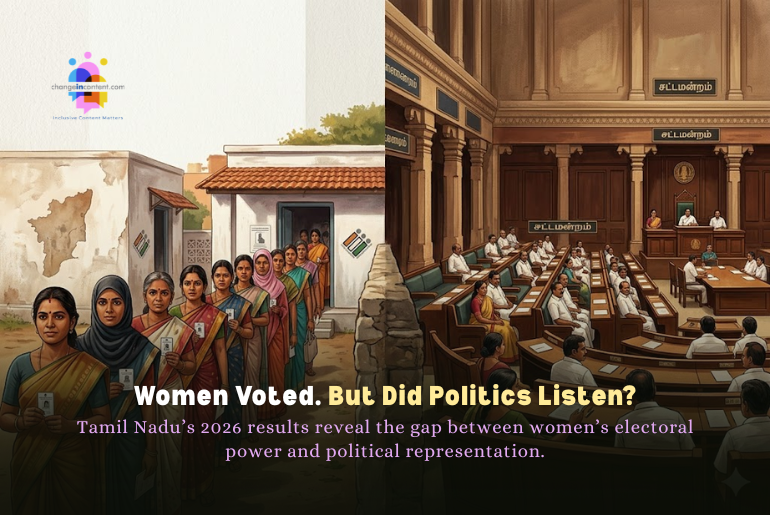
The Tamil Nadu elections have delivered a result that is both encouraging and unsettling for women’s political representation. Encouraging, because the 17th Tamil Nadu Legislative Assembly will have 23 women MLAs. That is a clear rise from the 12 women members in the outgoing House. Unsettling, because women still account for less than 10% of the 234-member Assembly, despite making up 51% of the state’s electorate.
That is the contradiction at the heart of Tamil Nadu’s 2026 mandate. Women turned out to vote in huge numbers. Political parties spoke to them through welfare promises, household-centred schemes, and campaign messaging. But when it came to giving women tickets, the story remained thin.
Out of more than 4,000 candidates who contested the election, only around 443 were women. ADR and Tamil Nadu Election Watch analysed affidavits of 3,992 candidates and recorded 442 women candidates, about 11% of the analysed pool.
So, yes, there is progress. But it is not enough to mistake progress for parity.
What changed after the Tamil Nadu Election results?
The most visible shift is the increase in the number of women legislators. The new Assembly will have 23 women MLAs. That makes it the third-highest number of women representatives in Tamil Nadu’s legislative history. The highest number was in 1991, when 32 women were elected, representing nearly 13% of the House.
The party-wise picture also tells its own story. Tamilaga Vettri Kazhagam, which emerged as the single largest party with 108 seats according to Election Commission results, has 13 women legislators. AIADMK has six women MLAs among its 47 members. Congress, PMK, CPM, and DMDK each have one woman MLA.
The most striking detail is that DMK (despite winning 59 seats and fielding 19 women candidates) has no woman MLAs.
It does not make the conversation about any one party. It makes the conversation about all parties. Because the larger pattern is familiar: women are central to election strategy, but rarely central to candidate strategy.
Women voters are powerful. Women candidates are still treated as risky.
Tamil Nadu has around 5.73 crore voters, of whom 2.93 crore are women. Women make up 51% of the electorate. Of the 4.87 crore votes cast in the election, nearly 2.52 crore were women voters.
These numbers should have changed how parties distribute tickets. They did not.
Political parties know women vote. They also know women influence household-level political discussions, welfare decisions, local priorities, and community sentiment. Yet in candidate selection, women still appear to be exceptions. Parties often want women’s votes, but hesitate to invest in women’s political careers.
That is the sharpest lesson from the 2026 Tamil Nadu elections.
Are women absent from democracy?
Women were not absent from democracy. They were present in queues, booths, campaigns, households, party offices, and political conversations. But presence as voters did not translate into presence as elected representatives.
Changeincontent has earlier explored this broader contradiction in Indian politics in its article on Women and Politics, where we examined why women’s democratic participation still struggles to translate into political power.
The Tamil Nadu election results give that question a fresh urgency.
NTK’s 50% women candidate model made a point, but not a breakthrough
Naam Tamilar Katchi fielded 117 women candidates out of 234, giving women 50% representation on its candidate list. The party has followed a similar model across several elections, including the 2019 Lok Sabha election, the 2021 Tamil Nadu Assembly election, and the 2024 Lok Sabha election.
That consistency matters. In a political culture where parties often discuss women’s participation without reflecting it in their ticket distribution, NTK’s candidate model forced a difficult question: if one party can field women in half the seats, why do others not even come close?
But the 2026 result also shows the limitation of candidate representation without electoral strength. NTK did not win a seat. Its chief Seeman finished fourth in Karaikudi, while none of the party’s 117 women candidates entered the Assembly.
It is politically significant and emotionally complicated.
What does it mean?
On one hand, fielding women matters. It gives women political experience, visibility, campaign exposure, and a claim to public space. On the other hand, if women are fielded from parties or constituencies where victory is structurally difficult, representation remains symbolic rather than transformative.
The question, therefore, is not only how many women are given tickets.
It is also where political parties field them, fund them, back them seriously, and see them as future leaders or just proof of intent.
Why candidate numbers alone do not guarantee power
Tamil Nadu’s 2026 election shows that representation has layers.
- The first layer is participation as voters. Women crossed that bar with force.
- The second layer is candidacy. Here, the number is still weak. Women formed only around 11% of the candidate pool.
- The third layer is winnability. That is where the real gatekeeping begins. Parties decide who receives a viable seat, campaign resources, organisational support, media visibility, and ground-level mobilisation.
- The fourth layer is power after victory. Even elected women can remain marginal if they are excluded from cabinet positions, party decision-making, policy committees, and leadership pipelines.
So, when we say more women must enter politics, we should not mean only more women on posters. We must mean more women in winnable seats, more women with campaign resources, more women in party leadership, more women shaping manifestos, and more women with real legislative influence.
Welfare politics speaks to women. Representation politics must speak through women.
Tamil Nadu has a strong history of welfare politics. During the 2026 campaign, parties made women-centric promises because women are a decisive voting bloc. That is not surprising.
But there is a difference between designing schemes for women and designing politics with women.
- The first sees women as beneficiaries.
- The second sees women as decision-makers.
This distinction matters because one cannot fully represent women’s lives through welfare promises alone. Women also need political agency. They need the power to decide what welfare looks like, how safety is addressed, how labour is valued, how public health is delivered, how care is recognised, and how local governance responds to gendered realities.
When parties speak about women only as voters, mothers, homemakers, beneficiaries, or welfare recipients, they flatten women’s political identity.
Women are not only a vote bank. They are political thinkers, organisers, negotiators, campaigners, public leaders, and future legislators.
What voters must also ask
It is easy to put the entire burden on political parties. Much of the burden belongs there. Parties control tickets, campaign funds, and visibility. They decide who to promote and who to sideline.
But voters also shape incentives.
- If voters reward parties for women-centric schemes but do not ask why so few women were fielded, parties will continue the same pattern.
- If voters do not ask whether women were given winnable seats, parties will continue placing them where defeat is convenient.
- If voters do not demand women in leadership debates, media panels, candidate lists, and constituency conversations, representation will remain a secondary issue.
It is not about voting for a woman only because she is a woman. That would be too simplistic.
It is about refusing to accept a politics in which women are mobilised as voters but are missing as leaders. At the same time, it is about asking every party the same questions.
- How many women did you field?
- Were they placed in winnable seats?
- Did they receive equal campaign support?
- How many women are in your decision-making bodies?
- How many will be given legislative responsibility after victory?
Until voters ask these questions loudly, parties will continue treating women’s representation as optional.
The Women’s Reservation Bill makes this conversation unavoidable
The 2026 Tamil Nadu elections also come at a time when India’s larger debate on women’s reservation remains alive. The Constitution (One Hundred and Sixth Amendment) Act provides for one-third reservation for women in the Lok Sabha and State Legislative Assemblies. However, its implementation depends on delimitation after the next census.
That means the law has created a future promise. But parties still control the present.
The UN Women report on women in politics has already warned that women remain underrepresented in political leadership globally, with many countries still far from parity. Changeincontent previously analysed that warning in its article on Women in Politics: UN Women Report.
Tamil Nadu’s result reflects the same global problem in a state-specific way.
Even when women vote in huge numbers, political systems do not automatically become representative. Representation has to be built deliberately.
Tamil Nadu Elections: What the 23 women MLAs symbolise
It is important to acknowledge the election of 23 women MLAs. At changeincontent, we do that as it’s an increase over the previous Assembly. That is also a reminder that voters can and do elect women when parties field them in viable contests.
But 23 out of 234 is still less than 10%. We must not celebrate that number without discomfort.
- It should inspire more women to contest, but it should also pressure parties to do better.
- It should encourage voters to notice women candidates, but it should also make them question why so few were available to choose from.
- It should show that women can win, but it should not hide the fact that the system still gives them too few doors.
The question is not whether Tamil Nadu has moved forward. It has. The question is why the movement remains so slow.
Methodology and editorial note
This article is based on publicly available election result updates, Election Commission of India data as reported by national and regional media, ADR and Tamil Nadu Election Watch candidate analysis, and post-result reports on women’s representation in the 17th Tamil Nadu Legislative Assembly.
The article does not endorse or criticise any party from an electoral standpoint. It examines women’s political representation as a democratic issue. The numbers cited may be updated by official post-election documentation and Form 20-level constituency data where applicable. The analysis here reflects data available at the time of writing.
Changeincontent Perspective: Women cannot remain democracy’s majority and politics’ minority
The Tamil Nadu elections reveal a truth that extends far beyond one state. Women are not missing from democracy. They are showing up. They are voting, campaigning, debating, mobilising, and shaping outcomes. What they still do not get is equal access to the route from participation to power.
At Changeincontent, we believe the question must now move beyond whether women are interested in politics. The evidence is clear. Women are politically engaged. The real question is whether parties are interested in women as leaders.
Tamil Nadu’s 2026 Assembly has more women than the previous one. That is welcome. But when women make up 51% of the electorate and less than 10% of the Assembly, democracy still reflects only part of the people.
Political representation cannot depend on occasional generosity. It has to become a habit of party structure, voter expectation, and electoral accountability.
Women have already proved that they will vote. Now, politics must prove that it will make room for them to lead.
Sources Used
- Election Commission of India results for Tamil Nadu Assembly Election 2026.
- Indian Express report on Tamil Nadu Assembly Election 2026 results.
- DT Next report on women’s representation in the 17th Tamil Nadu Assembly.
- Association for Democratic Reforms and Tamil Nadu Election Watch candidate analysis.
- The Times of India Report on women candidates in the Tamil Nadu election.
