
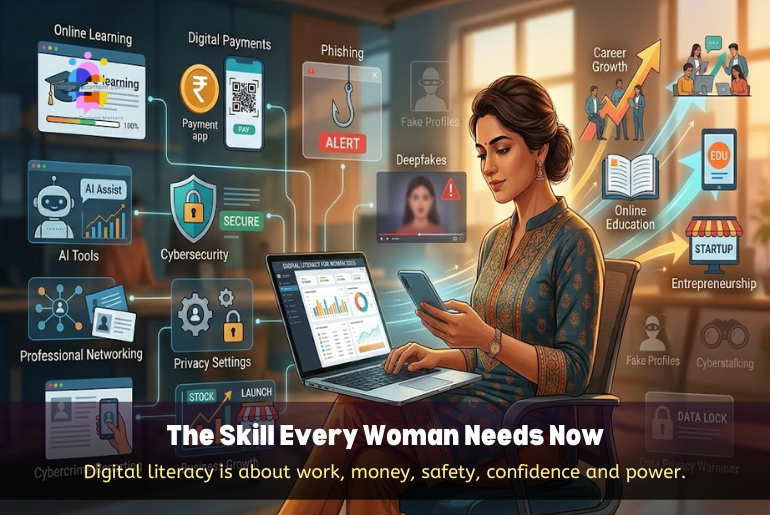
Digital literacy for women has become one of the most important skills of modern life. It determines who has access to jobs, financial services, education, healthcare, government schemes, public information, business opportunities, and professional networks. It also decides who can recognise a scam, protect personal data, report abuse, question misinformation, and stay visible without feeling unsafe.
For many women, the digital world is both a bridge and a battleground. It opens doors to remote work, digital payments, online learning, entrepreneurship, content creation, artificial intelligence tools, telemedicine and financial independence. But it also exposes women to cyber fraud, stalking, image-based abuse, deepfakes, privacy violations, workplace surveillance, misinformation and online harassment.
That is why we cannot teach digital literacy as a purely technical subject. It must be taught as a life skill.
Key Takeaways
- Digital literacy for women in 2026 must include five layers: access, skills, safety, professional growth and accountability.
- Women need more than internet access. They need confidence, critical thinking, privacy awareness, cyber safety, financial caution, and literacy in artificial intelligence.
- Women also need the ability to use digital tools to support income and career growth.
- Organisations also have a responsibility. They must train women employees, protect them from digital abuse, ensure safe reporting systems, prevent workplace surveillance misuse, and create digital cultures that do not punish women for speaking or participating online.
What does digital literacy for women mean in 2026?
Digital literacy for women means the ability to use digital tools safely, confidently and meaningfully. It includes:
- Using devices and apps
- Searching for reliable information
- Communicating professionally
- Protecting passwords and privacy
- Using digital payments
- Understanding artificial intelligence tools
- Identifying fraud and reporting online abuse
- Using technology for work, learning and enterprise
Why does it matter?
Digital literacy for women is important because the internet is now part of almost every system. A woman may need digital skills to apply for a job, attend an interview, use a banking app, file a complaint, promote a business, access health information, learn a skill, manage children’s education, or build a professional identity.
The Global and Indian gender gap
Globally, the gender digital divide remains serious. UNESCO has noted that 244 million fewer women than men use the internet. That restricts women’s access to education, employment and essential services.
India has its own gap. A Government of India response citing NFHS-5 data stated that only 33.3% of women aged 15 to 49 in India had used the internet. At the same time, 51.8% in urban areas and 24.6% in rural areas use the internet.
That is why digital literacy for women is not a “nice to have”. It is a development issue, a safety issue, a workplace issue and an equality issue.
Why digital literacy matters for women’s professional success
Work has become digital even when the job is not in technology.
- A teacher uses online learning platforms.
- A nurse handles digital health records.
- A small entrepreneur uses UPI, WhatsApp, Instagram, ONDC or e-commerce marketplaces.
- A corporate employee uses collaboration tools, dashboards and artificial intelligence.
- A freelancer builds visibility through LinkedIn, portfolios and digital payments.
- Even domestic workers and gig workers increasingly depend on apps for bookings, ratings and payments.
The World Economic Forum’s Future of Jobs Report 2025 says job disruption could affect 22% of jobs by 2030. It says there will be 170 million new roles created and 92 million displaced. That will lead to a net increase of 78 million jobs. Technology is one of the major forces behind this change.
What does it mean for women?
For women, it means digital skills are no longer optional for career survival.
A woman who understands digital tools can apply for more jobs, build a stronger profile, learn remotely, track industry changes, negotiate better terms, run a side business, use productivity tools, and participate in new work opportunities.
A woman without these skills risks exclusion even before the interview begins.
The 1st layer: Access and confidence
The first barrier is still access.
Many women lack personal devices, stable internet access, privacy at home, control over digital payments, or the freedom to use technology without being watched.
- Some share phones with family members.
- Some have phones but limited data.
- Some use the internet only for basic messaging.
- Some are discouraged from being visible online because families fear harassment, reputation damage or “too much independence”.
That is why digital literacy cannot begin with advanced tools. It must begin with confidence.
Women must know how to use a smartphone independently. They should know how to update apps, manage storage, change settings, use email, save documents, scan files, join online meetings, use maps, create passwords, manage digital payments and identify official websites.
These may sound basic. But these are the foundations of digital independence.
Changeincontent has previously explored this gap in its article on the gendered digital divide in mobile ownership and internet use. It examines how access to devices and the internet continues to shape women’s participation.
The 2nd layer: Information literacy
Before diving deep, let us be clear about some facts:
- Not everything online is true.
- Not everything forwarded on WhatsApp is harmless.
- Not every “expert” is credible.
- Not every viral video is real.
Information literacy means knowing how to check what you read, watch and share. Women must learn to ask simple questions before trusting information.
- Who published the content?
- Is it from an official source?
- Is the headline exaggerated?
- Is the image old or manipulated?
- Is the message trying to create fear or urgency?
- Is it asking for money, documents, OTPs or personal details?
- Can the same claim be verified from another reliable source?
That matters because misinformation affects health, politics, finance, safety and social trust.
- A false health claim can delay treatment.
- A fake job post can lead to fraud.
- A misleading loan advertisement can trap a woman in debt.
- A manipulated image can destroy a reputation.
In 2026, digital literacy must include the ability to pause before forwarding. That pause is power.
The 3rd layer: Financial digital literacy
Digital money has changed women’s financial lives. UPI, banking apps, wallets, online lending, mutual fund apps, e-commerce payments and digital gold platforms have made financial services easier to access.
But convenience has also increased risk.
Women must know how to use digital finance safely. That includes checking account details before sending money, never sharing OTPs, understanding QR code scams, avoiding screen-sharing with strangers, verifying loan apps, reading repayment terms, checking interest rates, using secure banking apps and reporting fraud quickly.
India’s National Cyber Crime Reporting Portal lists 1930 as the cybercrime helpline. It also provides a section for reporting crimes against women and children.
The most important rule is simple: no bank, police officer, government official, courier company, employer or platform should ask for your OTP, PIN, CVV, full card details or remote access to your phone.
Women also need to understand digital debt.
Instant loan apps, buy-now-pay-later products, informal digital lending, and social media-based credit offers can seem easy, but can become stressful if the terms are unclear.
Financial literacy is not only about saving money. It is about recognising digital traps before they become debt.
The 4th layer: Cyber safety and privacy
The base for teaching cyber safety must be its practicality, not the fear.
Every woman should know the basics.
Some core insights that every woman should be aware of are:
- How to create strong passwords
- Use two-factor authentication
- Lock apps
- Update devices
- Avoid suspicious links
- Check privacy settings
- Control who can see posts
- Block abusive accounts
- Preserve evidence
- Report impersonation
- Remove location data from public content.
That matters because digital abuse is becoming more complex.
UN Women describes technology-facilitated violence against women and girls as a growing form of violence. There are emerging risks linked to online harassment, abuse, platform accountability failures and the need for survivor support systems.
What all does digital violence include?
Digital violence can include cyberstalking, doxxing, image-based abuse, deepfakes, threats, impersonation, sexual harassment, account hacking, non-consensual sharing of images, intimate partner surveillance and coordinated trolling.
Changeincontent has earlier written about digital violence against women and how online abuse affects women’s real lives, work, public presence and mental health.
The key lesson is: Let us not tell women to disappear from the internet to stay safe. The burden must not fall only on women. Platforms, police systems, employers, schools, families and governments must also act.
The 5th layer: Artificial intelligence literacy
Artificial intelligence is now part of writing, search, hiring, design, customer service, coding, marketing, education and workplace productivity. Women need to understand it, not fear it.
AI literacy means knowing what AI tools can and cannot do, and how to use them responsibly.
Women professionals should know how to use AI for drafting emails, research summaries, presentations, learning plans, interview preparation, data analysis, content planning, business ideas, coding support, language translation and productivity.
But they must also know the risks.
AI also brings its own risks, and the growing number of cases is proof of the same. Women must know the risks:
- AI can produce wrong information.
- AI can reflect gender bias.
- AI-generated images can be misused.
- Deepfakes can harm women’s reputations.
- Hiring tools can reproduce discrimination.
- Workplace monitoring tools can become intrusive.
- Confidential data should not be pasted into public AI tools.
The Financial Times recently reported that women in administrative roles may be especially exposed to AI-related job disruption. Experts warn that women are less likely than men to receive AI training. That makes AI literacy a gender issue.
Let us not place women only on the receiving end of automation. We must train them to use, question, audit and benefit from AI tools.
Digital literacy for women entrepreneurs
For women entrepreneurs, digital literacy can directly influence income. A woman who knows how to use digital tools can:
- Register her business
- Create a Google Business Profile
- Use UPI QR codes
- Maintain invoices
- Track inventory
- Build social media pages
- Run WhatsApp catalogues
- Sell on marketplaces
- Manage customer reviews
- Use digital ads
- Analyse customer behaviour
- File taxes
- Apply for loans
- Protect herself from fraud.
It is especially important for home-based, rural, micro and first-generation women entrepreneurs. Many women-led businesses are real but under-documented. Digital records can help create business credibility.
How can digital literacy help women entrepreneurs?
Digital literacy can help women entrepreneurs build:
- A separate business bank account
- Digital payment history
- Invoices and receipts
- GST or Udyam documentation, where applicable
- Customer databases
- Social media visibility
- Online reputation
- Marketplace access
- Credit readiness
But this must not become another burden placed only on women. Banks, government departments, platforms and business networks must simplify documentation, offer local-language support and create assisted digital pathways.
Digital literacy and online professional identity
Women also need to know how to build a professional digital identity. Here is what it includes:
- Using LinkedIn well
- Writing a clear bio
- Uploading work samples
- Maintaining a portfolio
- Creating a professional email address
- Using video calls confidently
- Applying through reliable job portals
- Avoiding fake recruiters
- Checking the company’s legitimacy before sharing documents.
That matters because many women are not missing out on opportunities due to a lack of capability. They are missing because they are not visible in the right digital spaces.
A strong digital identity can help women return after career breaks, find freelance work, access remote jobs, build thought leadership, connect with mentors, and enter professional networks.
The risk that comes with digital visibility
Visibility also comes with risk. That is why we must teach women how to balance visibility with privacy.
- Do not publicly share phone numbers unless necessary.
- Use a professional email address for work.
- Separate personal and public profiles where needed.
- Control who can see family photos.
- Avoid sharing your live location publicly.
- Keep identity documents private.
- Be cautious about strangers offering “urgent” job or investment opportunities.
Digital confidence is not recklessness. It is informed participation.
Digital literacy at the workplace
Organisations must stop assuming that all employees are digitally equal.
The need for digital literacy in the workplace
- A woman returning after a career break may need help with new collaboration tools.
- A factory worker may need training on app-based attendance or digital payroll.
- A sales employee may need cyber safety training.
- A manager may need AI literacy.
- A remote worker may need guidance on data protection, phishing and secure communication.
What does digital literacy include?
Digital literacy at work should include:
- Email and communication etiquette
- Cybersecurity basics
- Password management
- Data privacy
- Safe use of AI tools
- Digital collaboration
- Online meeting confidence
- File management
- Digital payments and reimbursements
- Awareness of workplace surveillance
- Reporting of online harassment
- Protection from technology-facilitated abuse
The accountability point is crucial.
If a woman employee faces any form of harassment on a work chat, stalked through workplace systems, pressured to share personal contact details, targeted through deepfake content, or abused after appearing in company campaigns, the organisation cannot say it is a personal issue.
Digital safety is workplace safety.
What organisations must do?
Organisations must make digital literacy part of employee development, not a one-time IT session.
Digital skills training
Organisations should offer practical digital skills training for women at every level, from basic tools to AI use. It should include women in frontline, administrative, factory, sales, remote, gig and managerial roles.
Teach cybersecurity
Organisations must teach cyber safety in simple language. Employees should know how phishing works, how to protect passwords, how to report fraud, and how to respond if accounts are hacked.
Inclusive AI training
AI training must be inclusive. If only senior or technical teams receive AI training, women in support, administrative, HR, content, operations and customer-facing roles may be left behind.
Reporting channels
Companies must create clear reporting channels for digital harassment. The organisation must take abuse via Slack, Teams, WhatsApp, email, LinkedIn, Instagram, or work devices seriously.
No surveillance without consent
Workplace technology must not become surveillance without consent. Monitoring productivity, screenshots, keystrokes, webcam time, or location data can be especially harmful to women if used without transparency.
Protection
Organisations must protect women who are visible online. Women founders, journalists, executives, creators, recruiters, lawyers, activists, DEI professionals and public-facing employees often face targeted abuse. Companies must not benefit from their visibility and abandon them during attacks.
Inclusive digital accessibility
Digital accessibility must be inclusive. Training should be available in local languages, in flexible formats, in low-bandwidth versions, and in accessible formats for women with disabilities.
What families and communities must understand
Many women’s digital exclusion begins at home.
- A girl may be told not to use social media.
- A daughter-in-law may be watched when she uses her phone.
- A wife may not control the family’s banking app.
- A mother may depend on children for basic digital tasks.
- A woman may avoid online learning because the family sees it as unnecessary.
That is why digital literacy for women must include a social conversation.
What families must understand
Families must understand that a woman using the internet is not becoming any less safe. She is becoming informed.
- A woman learning online is not wasting time.
- A woman using digital payments is not being reckless.
- A woman building a LinkedIn profile is not showing off.
- A woman running an Instagram business is not “just scrolling”.
- A woman protecting her passwords is not hiding something.
Families must ensure that they do not treat digital independence with suspicion.
What can women start doing today?
Digital literacy can feel overwhelming, but it can begin with small steps.
- Create a strong password for your email and banking apps.
- Turn on two-factor authentication.
- Update your phone and apps regularly.
- Keep a separate work email.
- Learn how to scan and save documents.
- Use UPI carefully and verify names before paying.
- Never share OTPs, PINs or passwords.
- Check privacy settings on social media.
- Learn how to block and report abuse.
- Save evidence before deleting threatening messages.
- Use official websites for complaints and government services.
- Take one online course every few months.
- Learn one AI tool for your work.
- Build a basic LinkedIn profile or digital portfolio.
- Teach another woman what you learn.
Digital literacy grows through practice, not perfection.
How to respond to cyber fraud or digital abuse?
If money is lost to cyber fraud, immediate action is essential. Report quickly through the National Cyber Crime Reporting Portal or call the cybercrime helpline 1930.
If the issue involves online abuse, image-based harassment, cyberstalking, impersonation or threats, preserve evidence first.
- Take screenshots.
- Save URLs.
- Note usernames, phone numbers and timestamps.
- Do not engage with the abuser repeatedly.
- Report the account.
- Inform trusted people.
- File a complaint through official cybercrime channels.
- If there is immediate physical danger, contact local police or emergency services.
Women should not feel ashamed for being targeted. The shame belongs to the offender.
Accountability cannot stop at telling women to be careful
That is the most important point.
Digital literacy for women should never become another way of saying women must protect themselves from unsafe systems.
- Women need skills, yes. But platforms need responsibility.
- Employers need policies.
- Police systems need capacity.
- Schools need digital safety education.
- Families need trust.
- Governments need stronger enforcement.
- Technology companies need safety-by-design.
UN Women’s work on technology-facilitated violence stresses the need for prevention, response mechanisms, platform accountability, reporting systems and safety-by-design approaches.
So the goal is not to train women to shrink online. The goal is to build a digital world where women can participate without being punished for being visible.
Changeincontent Perspective: Digital literacy for women is freedom with a safety net
Digital literacy for women is not about turning every woman into a coder, influencer or technology expert. It is about giving women the confidence to use digital systems without fear, shame or dependence.
At Changeincontent, we believe the digital future cannot be called inclusive if women are expected to participate without protection. Access matters. Skills matter. But accountability matters just as much.
Women need to know how to use the internet for jobs, money, learning, business, safety and public voice. But platforms must stop rewarding abuse. Organisations must stop ignoring digital harassment. Families must stop controlling women’s access. Policymakers must stop treating online harm as secondary harm.
The internet can help women earn, learn, speak and lead. But only when digital literacy is matched with digital dignity.
Methodology and editorial note
This article draws on recent public sources from UNESCO, GSMA, UN Women, the World Economic Forum, the National Cyber Crime Reporting Portal, Government of India material citing NFHS-5 data, and Changeincontent’s previous coverage of digital violence and the gender digital divide.
The article is a Knowledge Hub guide. It is meant for awareness and education, not legal, financial or cybersecurity advice. Readers facing cybercrime, digital abuse, financial fraud, stalking or threats should use official reporting channels and seek professional support where needed.
Sources used
- UNESCO on the global gender gap in internet use.
- Government of India response citing NFHS-5 data on women’s internet use.
- World Economic Forum, Future of Jobs Report 2025.
- UN Women on technology-facilitated violence against women and girls.
- National Cyber Crime Reporting Portal.
