
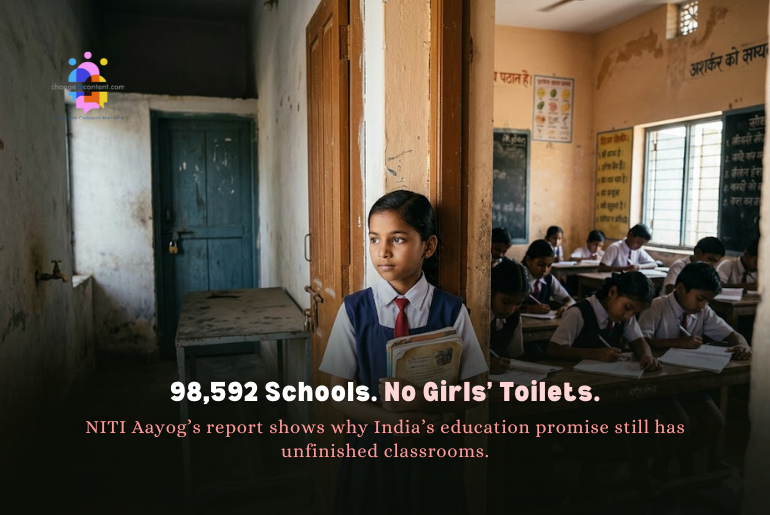
We often discuss the school education system in India through enrolment drives, policy reforms, and ambitious national goals. But a recent NITI Aayog report forces us to look at a harder truth. Thousands of schools still lack basic facilities that determine whether children can learn with dignity, safety, and consistency.
The report, titled School Education System in India: Temporal Analysis and Policy Roadmap for Quality Enhancement, was released by NITI Aayog in May 2026. It analyses a decade of data across access, enrolment, infrastructure, equity, inclusion, digital integration, and learning outcomes.
The report draws on UDISE+ 2024-25, PARAKH Rashtriya Sarvekshan 2024, NAS 2017 and 2021, ASER 2024, and stakeholder consultations. India’s school system now spans 14.71 lakh schools and serves more than 24.69 crore students. That makes it the largest school education system in the world.
What does this story mean?
NITI Aayog’s report shows that India has made visible progress in school access and infrastructure, but major gaps remain.
- As per UDISE+ 2024-25 data cited in the report, 98,592 schools still lack functional girls’ toilets.
- It also shows that 61,540 schools have no usable toilets
- 1.19 lakh schools lack functional electricity
- 14,505 schools in India lack drinking water facilities
- 59,829 schools lack handwashing facilities.
- Nearly half of government secondary schools still lack functional science laboratories.
It means the conversation around the school education system in India cannot stop at enrolment. The real question is whether schools are physically, digitally, socially, and academically ready to support every child.
98,592 schools without girls’ toilets: The hidden crisis in the school education system in India
India has improved access to girls’ sanitation facilities in schools over the past decade. However, the numbers show that major gaps continue. The share of schools with functional girls’ toilets rose from 85.17% in 2014-15 to 94% in 2024-25. That is progress, and it deserves acknowledgement.
Yet progress in percentages often hides the scale of what remains unfinished.
- Even today, 98,592 schools across India lack functional girls’ toilets.
- 61,540 schools report no usable toilet facilities at all.
The NITI Aayog report states that inadequate menstrual hygiene facilities, including toilets, disposal units, private changing areas, and access to sanitary products, can lead to absenteeism and dropout among girls at the secondary level.
That is where school infrastructure becomes a gender issue
A missing toilet is not just a missing facility. For many girls, it means discomfort, fear, embarrassment, missed classes, and sometimes a quiet exit from school.
Changeincontent has previously explored the broader question of dignity and access in our article on gender-neutral toilets in the workplace. The setting may be different, but the larger truth remains the same. Toilets are not minor facilities. They are part of dignity, safety, inclusion, and participation.
Water, handwashing, and the everyday hygiene gap
The report shows that the share of schools with drinking water facilities rose from 96.5% in 2014 to 99% in 2025. Again, this is a strong improvement. But the unfinished gap is still large in human terms.
As per UDISE+ 2024-25 data cited by NITI Aayog, 14,505 schools still lack functional water sources. At the same time, nearly 59,829 schools lack handwashing facilities.
These numbers matter because hygiene is not separate from learning. A child who spends the school day without access to safe drinking water or handwashing is not getting a healthy learning environment. Poor sanitation affects attendance, concentration, health, and classroom continuity. After the COVID-19 pandemic, the idea of a school without basic hygiene facilities should disturb us even more.
1.19 lakh schools without power: Can digital learning reach everyone?
Electricity access in Indian schools has improved significantly over the last decade.
The share of schools with electricity rose from 55.96% in 2014 to 91.9% in 2024-25. That opens the door for better classroom infrastructure, digital tools, computers, smart classrooms, and technology-enabled learning. However, 1.19 lakh schools still lack access to functional electricity. That means the digital education conversation cannot assume that all children are standing at the same starting line.
If a school cannot reliably switch on a light or a device, then smart classrooms, online learning platforms, digital assessments, and AI-enabled education remain distant promises for its students.
We cannot treat the last 8% as a footnote.
Regional inequalities make this gap even more visible. The draft data points to particularly low levels of electricity access across various states.
- Only 28.1% of schools report electricity access in Meghalaya
- Arunachal Pradesh follows Meghalaya with a 62.3%
- Manipur is at 63.3%
- Nagaland is at at 78.2%
- Ladakh is at 76.4%
- Jammu and Kashmir stands at 87.2%.
It is not just an infrastructure issue, but a fairness issue. If classrooms increasingly rely on digital tools, then children in schools without electricity are not merely missing technology. We are pushing these girls further away from the future of learning.
NEP’s STEM vision meets the science lab gap
The National Education Policy 2020 places strong emphasis on scientific thinking, inquiry-led learning, practical exposure, and stronger participation in STEM fields. But the NITI Aayog report shows that only 51.7% of government secondary schools have functional science laboratories. That leaves nearly half without dedicated lab access.
Students cannot fully understand subjects such as Physics, Chemistry, and Biology through textbooks alone. Experiments, observation, testing, failure, and problem-solving are central to science learning. When we teach science to students without laboratories, they may learn definitions but miss the chance to build curiosity, confidence, and applied understanding.
It also affects the future talent pipeline. India wants more students, especially girls and students from disadvantaged communities, to participate in STEM. But aspiration cannot survive on slogans alone. It needs classrooms where students can touch, test, question and experience science.
The learning gap is also a social equity gap.
Students from Socio-Economically Disadvantaged Groups, including Scheduled Castes, Scheduled Tribes, Other Backward Classes, girls, children with special needs, and migrant communities, continue to face multiple barriers. These barriers affect not just enrolment, but retention, transition, and classroom learning.
Poverty, low parental education, weak early learning support, and unequal access to academic resources continue to widen these gaps as students move through the school system.
At the middle school stage, only 33% of SC students and 33% of ST students demonstrated proficiency in mathematics. That is in comparison with 48% among students from the General category. Among OBC students, the figure stood at 39%.
Language outcomes also showed differences. SC students scored 48%, ST students 49%, and OBC students 59%, while students in the General category reached 60%.
Why access alone does not equal learning
Access alone does not guarantee equal learning. When students enter classrooms with unequal academic support, those gaps often widen with each stage of schooling.
Both the National Education Policy 2020 and the National Curriculum Framework for School Education 2023 call for bilingual teaching, locally relevant learning materials, and teaching methods that address diverse learning needs.
Without stronger support in the early years, many students from disadvantaged communities continue to reach secondary school already several steps behind their peers.
Changeincontent has previously examined this broader issue in our article on gender disparities in education in India, where we examined how social norms, infrastructure, affordability, and opportunity shape educational outcomes for girls.
A teacher for every classroom is still not guaranteed.
The NITI Aayog report also flags the continued presence of single-teacher schools.
As per UDISE+ 2024-25, India has 1,04,125 single-teacher schools. More than 33.76 lakh students are a part of such schools. The report notes that in these schools, one teacher often handles multiple grades, administrative work, record keeping, mid-day meal coordination, parent communication, and classroom instruction at the same time.
That is not a small operational problem. A child in a single-teacher school may not receive the grade-specific attention, subject support, or classroom engagement that learning requires. We cannot expect a teacher carrying every responsibility in the building to deliver the same learning experience as a well-staffed school.
Zero enrolment schools
The report also records 7,993 zero-enrolment schools across India. These schools appear in administrative records, but do not serve any student population. NITI Aayog notes that such schools may continue to receive resources due to outdated records. That exposes a gap between planning data and ground reality.
Gaps in the school education system in India: The Changeincontent perspective
The school education system in India does not need another round of polite concern. It needs a serious public conversation about what we are willing to accept as normal.
- A school without a girls’ toilet is not ready for girls.
- A school without electricity is not ready for digital learning.
- A school without a science lab is not ready for STEM ambition.
- A school with one teacher for many grades is not ready for equitable learning.
- A school that exists on paper but has no students is not a school. It is an administrative fiction.
That is not to deny progress. India has expanded access, improved several infrastructure indicators, and built one of the largest education systems in the world. But scale cannot become an excuse for unfinished dignity. The hardest gaps now are not only about opening schools. They are about making schools worthy of the children who enter them.
The solution must be practical and measurable.
- Toilets must be functional, not just built.
- Menstrual hygiene facilities must be part of school planning, not an afterthought.
- Schools must treat electricity, water, handwashing, laboratories, libraries, ramps, and teachers as learning infrastructure.
- States must be supported, but also held accountable.
- Data must be updated honestly.
- School Management Committees must have real power.
- District-level reviews must track whether facilities are working, not whether they once existed.
The closing thoughts
India cannot speak of Viksit Bharat while children study in classrooms without power, labs, hygiene, or enough teachers. The future does not begin in a policy document. It begins in a school where a child can sit safely, ask questions freely, drink clean water, use a toilet with dignity, learn from a teacher, and imagine a life bigger than survival.
Editorial Note, Methodology Note, and Disclaimer
This article is part of Changeincontent’s policy stories, where we examine social issues that shape public life, equality, dignity, and opportunity. The article is based on NITI Aayog’s policy report, School Education System in India: Temporal Analysis and Policy Roadmap for Quality Enhancement, released in May 2026. The article uses publicly available data cited in the report, including UDISE+ 2024-25, PARAKH Rashtriya Sarvekshan 2024, NAS 2017 and 2021, ASER 2024, and related public reporting.
Changeincontent has used the findings for editorial analysis and public-interest discussion. The article does not intend to dismiss progress made by governments, schools, teachers, or communities. It highlights remaining gaps so that readers, institutions, and policymakers can engage with the issue more seriously.
Sources Used
- NITI Aayog Policy Report: School Education System in India: Temporal Analysis and Policy Roadmap for Quality Enhancement
- Press Information Bureau: NITI Aayog releases an announcement on the report and its scope.
- NDTV: Public reporting on schools lacking power, girls’ toilets, and single-teacher schools.
- NewsGram: Public reporting on the May 2026 NITI Aayog school education report and infrastructure gaps.
- The Tribune: Public reporting on zero-enrolment schools and girls’ toilet gaps.
