
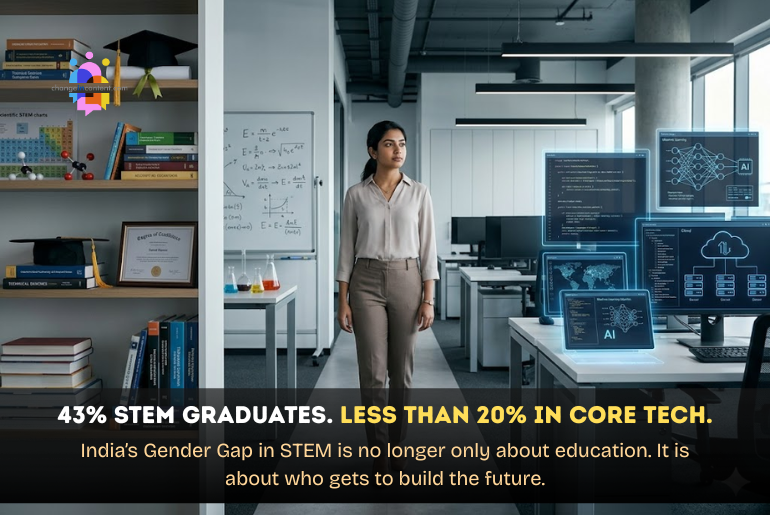
The gender gap in STEM is no longer only about whether girls are entering science and technology classrooms. In India, women now make up around 43% of STEM graduates. However, their presence drops sharply in core engineering fields and niche technology roles. That means the real question has moved beyond enrolment. It is now about training, employability, access, retention, and career progression.
A new report by TeamLease Degree Apprenticeship and GAN Global highlights this gap between participation and progression. Women account for 35–38% of India’s overall IT workforce, yet they make up only 14–16% of niche technical roles such as artificial intelligence, cybersecurity, cloud computing, and programming. The report also points to a 20–25% job-readiness gap for specialised technical roles, at a time when India’s technology sector could face a talent shortfall of more than 1.8 million by 2027.
What this story means: India does not have a shortage of women studying STEM. The concern is that too many women are getting filtered out before they reach the roles that carry technical power, better pay, innovation influence, and leadership potential. The numbers are improving at the entry point, but the outcomes still reveal a system that does not carry enough women forward.
The ‘Leaky Pipeline’ behind the gender gap in STEM
The report by TeamLease Degree Apprenticeship and GAN Global found that women account for 35–38% of India’s IT workforce. Still, there is a 20–25% gap in job readiness for specialised technical roles. It means many women are entering the sector, but fewer are getting access to the technical training, hands-on exposure, or industry preparation required for roles in advanced technologies.
The report also warned that India’s technology sector could face a talent shortfall of more than 1.8 million by 2027. That is because the demand for skilled professionals continues to outpace supply.
Education to employment gap
The study also tracked a clear drop in women’s participation from education to employment.
Women make up around 43% of STEM graduates, but their representation falls to 30% in engineering programmes. Moreover, it drops below 20% in core engineering fields such as mechanical, electrical, and civil engineering.
In the workforce, women account for only 14–16% of niche technical roles, including artificial intelligence, cybersecurity, cloud computing, and programming. Their employability in these areas remains at around 22%.
What these numbers indicate
We cannot fully understand the gender gap in STEM by examining university enrolment alone. India may be producing more women STEM graduates, but the transition from degree to high-skill career remains uneven. Changeincontent has previously examined how this gap begins much earlier, including in school choices, access to coaching, IIT pathways, and family expectations around “safe” careers for girls.
Read more: Gender Gap in STEM Learning: IITs Admit More Women, Yet the Divide Grows.
Hyderabad reports 42% women apprentices as companies look for skilled talent.
The report also found that skill gaps remain significant in emerging technologies, particularly in advanced coding, AI, and cybersecurity. Similar gaps are evident in sectors such as manufacturing automation and electric mobility, where employers increasingly seek practical experience alongside academic qualifications.
To address this, the study identified apprenticeships as one route into technical roles, especially for women from Tier 2 and Tier 3 cities who may have fewer industry connections or training opportunities. By combining classroom learning with paid workplace experience, apprenticeships can help improve employability, confidence, and job readiness before full-time hiring.
Nipun Sharma, CEO of TeamLease Degree Apprenticeship, said some cities are already seeing encouraging participation. For example, Hyderabad reports 42% of apprentices being women. He said stronger coordination between companies, colleges, and government institutions can help create more entry points for women in technical and digital jobs.
That matters because India is not starting from zero. As Changeincontent has previously reported, India has made visible progress in female STEM enrolment when compared with many global benchmarks. The challenge is to make sure that enrolment does not remain the most celebrated number in the story.
Also read: Global Female STEM Enrolment: India Tops the World, But Gaps Remain.
Why retention remains a challenge for women in tech
More women entering technology jobs is only one part of the story. The bigger question is how many stay in those roles long enough to build technical depth, lead teams, or move into decision-making positions. Many women enter the sector at the entry level, but the numbers often begin to fall a few years into their careers.
One reason is career breaks, which may result from caregiving responsibilities, motherhood, or family expectations. In fast-moving sectors like technology, even a short break can make it difficult to return because AI tools, programming languages, and industry demands change quickly.
The upskilling gap that slows women’s tech careers
Another issue is access to upskilling. Employees who earn certifications, complete advanced training, or gain exposure to new technologies often advance more quickly into better roles. When women are not equally nominated for or mentored in these opportunities, it can slow their career growth over time.
The challenge is whether workplaces are creating conditions in which women can stay, grow, and move into high-skill technology roles. Hiring women into entry-level positions is not enough if the system does not support them through technical projects, mentorship, promotions, returnship pathways, and leadership tracks.
Changeincontent perspective on the gender gap in STEP
The gender gap in STEM is not a motivation problem. It is not about telling more girls to dream bigger. Many already are. The harder question is whether India’s education, skilling, and workplace systems are built to carry those ambitions forward.
The numbers tell a story that should make policymakers, colleges, and employers uncomfortable. Women are visible in STEM classrooms, but they thin out in core engineering fields, advanced technology roles, and leadership pipelines. That is not because women lack interest. That is because access to practical training, industry exposure, mentorship, mobility, safety, career continuity, and upskilling is still uneven.
The solution cannot be one-dimensional.
- Schools must build science confidence early.
- Colleges must connect STEM education with real industry exposure.
- Companies must stop treating women’s participation as a hiring statistic and start measuring retention, technical growth, leadership movement, and return-to-work outcomes.
Apprenticeships, if designed well, can serve as a bridge. But they must lead to dignified, paid, high-growth opportunities, not another layer of low-value participation.
India does not have a shortage of women studying science and technology. It lacks systems that help women translate STEM education into STEM power. Until that changes, the question will remain uncomfortable: who gets to study the future, and who gets to build it?
Editorial Note
This article is part of Changeincontent’s DEI Insights coverage, where we examine gender, workplace inclusion, education, policy, and economic participation through a data-led and equity-focused lens. The article uses publicly available information from credible reports and news sources, along with Changeincontent’s editorial analysis, to examine the Gender Gap in STEM in India.
Methodology
This article is based on reported findings from the TeamLease Degree Apprenticeship and GAN Global report on women’s participation in apprenticeships and high-skill technology roles. The analysis also draws from verified media reports, previously published Changeincontent articles on STEM enrolment and learning gaps, and broader workforce participation patterns. Data points have been used to explain the education-to-employment pipeline, not to reduce the issue to numbers alone.
