The Quick Read
- India showcased Women-led Panchayati Raj as a Global Model at the BRICS Women Ministerial Meeting in Kochi, Kerala, during India’s BRICS Chairship 2026. The discussion was part of a panel on “Advancing Women’s Leadership at the Grassroots”.
- The Ministry of Panchayati Raj said women-led Panchayati Raj Institutions are becoming important drivers of inclusive and participatory local governance.
- Of the 42 Gram Panchayats recognised under the National Panchayat Awards last year, 25 were led by women.
- The Sashakt Panchayat Netri Abhiyan, launched in March 2025, has trained around 1.5 lakh elected women representatives.
- With UNFPA support, 744 Gram Panchayats are being developed as Model Women-Friendly Gram Panchayats across districts, focusing on health, nutrition, education, skilling, safety, and public service delivery.
- The larger message is that when women lead at the village level, governance can become more responsive to everyday needs.
Women-led Panchayati Raj as a global model gets a BRICS platform
India has taken its grassroots women’s leadership story to a global forum.
At the BRICS Women Ministerial Meeting held in Kochi, Kerala, the Ministry of Panchayati Raj showcased Women-led Panchayati Raj as a Global Model for inclusive grassroots governance.
The presentation took place during India’s BRICS Chairship 2026, as part of a panel discussion on “Advancing Women’s Leadership at the Grassroots”. The panel was chaired by Vivek Bharadwaj, Secretary, Ministry of Panchayati Raj. (PIB)
The meeting brought together ministers and heads of delegation from BRICS member countries to discuss women’s empowerment, cooperation and inclusive development. For India, the Panchayati Raj experience became a way to show how democratic decentralisation can create leadership opportunities for women at the local level. (PIB)
This is a policy story. It is also a people story.
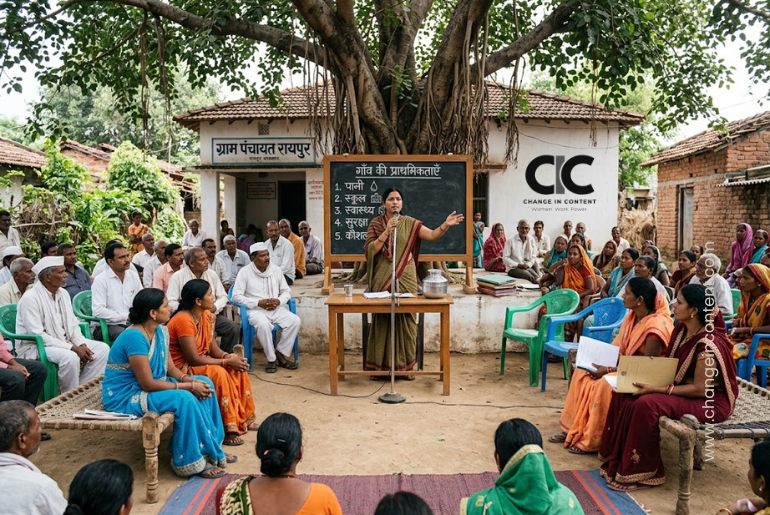
A woman sarpanch does not govern in abstraction. She deals with drinking water, health centres, nutrition, school access, sanitation, local roads, safety, skills, welfare schemes and everyday disputes. Her work sits close to people’s lives.
That closeness is what makes Panchayati Raj powerful.
What is Women-led Panchayati Raj?
Women-led Panchayati Raj refers to women’s leadership and participation in Panchayati Raj Institutions (PRIs), which constitute India’s elected local self-government system in rural areas.
These institutions work at different levels, including Gram Panchayats at the village level. They are responsible for local development priorities and public service delivery. In practice, this means decisions around basic needs: water, roads, sanitation, health, schools, local infrastructure, welfare delivery and community development.
For women, local governance opens a major political route. It brings public decision-making closer to women who may not easily enter state or national politics.
A previous Change in Content article on women in Panchayat governance examined both the promise and the challenges of women’s representation in local government. The BRICS presentation now places that story in an international frame.
India’s message is that elected women at the grassroots can help create more inclusive, people-centred governance.
Why India is calling Women-led Panchayati Raj a global model
The Ministry highlighted several examples to support the case.
First, women are increasingly emerging as local agents of change. According to the Ministry, 25 of the 42 Gram Panchayats recognised for exemplary performance under the National Panchayat Awards last year were led by women. (PIB) That number is important because it goes beyond representation. It points towards performance.
Second, the Ministry highlighted the Sashakt Panchayat Netri Abhiyan, a capacity-building initiative for elected women representatives. Launched in March 2025, it has trained around 1.5 lakh elected women representatives. The programme is designed to help women leaders build the knowledge, skills and confidence required to lead local governments and drive community development. (PIB)
That is where the policy becomes practical. Winning an election is one stage. Governing well needs training, information, administrative confidence, public speaking, budget understanding and the ability to deal with officials and local power structures.
Third, India is developing 744 Model Women-Friendly Gram Panchayats with support from UNFPA. These Gram Panchayats are being shaped as models of gender-responsive local governance, with attention to health, nutrition, education, skilling, safety and inclusive public service delivery. (PIB)
These areas matter deeply for women and girls. A village that improves safety, health, education, and access to skills changes how women live, move, study, work, and participate.
How does women-led Panchayati Raj work on the ground?
The best way to understand Panchayati Raj is to look at daily governance.
A Gram Panchayat identifies local needs. It works with communities, government schemes and district-level systems. It may support work on roads, drinking water, sanitation, schools, welfare delivery, local assets and social development.
When women lead these institutions, the agenda can shift.
A woman leader may bring more attention to drinking water because women often carry the burden of water collection. She may take sanitation more seriously because women and girls feel the effects of the absence of safe toilets firsthand. She may notice school access, nutrition, health services and local safety because these issues shape women’s daily lives.
It does not mean every woman leader will govern the same way. Women are not a single political category. But their lived experiences can broaden the list of what local governance considers urgent.
Change in Content has earlier written about women and politics and the struggle to move from symbolic representation to real influence. Panchayati Raj is where that shift can be tested most directly.
A woman representative must not only have a seat. She must have voice, access, support and authority.
The proxy leadership challenge cannot be ignored
Women’s local leadership also faces a well-known challenge: proxy representation.
In many places, elected women representatives have faced pressure from male relatives who informally control their roles. The phrase “sarpanch pati” became common because husbands of elected women sometimes exercised power on their behalf.
The Ministry acknowledged this concern at the BRICS panel, underscoring its commitment to addressing proxy representation through institutional measures. (PIB)
It is crucial. If a woman is elected but someone else decides, the democratic promise weakens. The solution is not to doubt women’s leadership. The solution is to strengthen it.
Training helps. Public recognition helps. Administrative support helps. Digital tools help. Peer networks help. Clear rules help. Communities must also learn to see women representatives as the actual office-holders.
A woman leader should not have to prove that she is more than a name on a ballot.
Why capacity building is central to the model
Representation opens the door. Capacity building helps women use the room.
The Sashakt Panchayat Netri Abhiyan is important because many elected women representatives may be first-time leaders. Some may come from communities where public speaking, administrative work and political negotiation were not easily accessible to women.
Training can help them understand budgets, schemes, planning, local data, grievance systems, meeting procedures and development priorities. It can also build confidence. Confidence matters in governance.
A woman leader may know the village’s problems. But she also needs to speak in meetings, question officials, manage opposition, handle public pressure and make decisions.
The Ministry’s statement that nearly 1.5 lakh elected women representatives have already been trained gives the initiative scale. (PIB)
The next test will be how this training improves outcomes on the ground.
What are Model Women-Friendly Gram Panchayats?
The Model Women-Friendly Gram Panchayat initiative aims to create local governance models that respond better to the needs of women and girls.
According to the Ministry, 744 Gram Panchayats are being developed as models with active support from UNFPA. Their focus areas include health, nutrition, education, skilling, safety and inclusive public service delivery. (PIB)
This approach is valuable because women’s empowerment cannot be reduced to one scheme.
- A girl’s education is linked to safety, transport, toilets, nutrition, family income and community norms.
- A woman’s ability to work is linked to care work, mobility, skilling, access to local jobs, and health.
- A pregnant woman’s well-being is linked to access to health services, nutrition, awareness, and timely support.
A women-friendly Gram Panchayat can bring these pieces together. Good local governance connects the dots.
How does this benefit society as a whole?
Women-led Panchayati Raj is not only useful for women. It benefits entire communities.
When local governance focuses on water, health, nutrition, safety, education and skilling, everyone gains. Children gain. Families gain. Older people gain. Local economies gain.
Women leaders often bring attention to issues that are treated as private household matters, even when they are public governance concerns.
- Water access is not a “women’s issue”. It is infrastructure.
- Nutrition is not a “mother’s issue”. It is public health.
- Safety is not a “girls’ issue”. It is freedom and citizenship.
That is why grassroots women’s leadership can improve the quality of development.
A Change in Content article on women’s leadership in global institutions examined women’s entry into major international leadership roles. The Panchayati Raj story sits at the other end of the power map. It reminds us that leadership is not only global. Sometimes it begins in a village meeting.
Why this matters for BRICS and the wider world
India’s presentation at the BRICS Women Ministerial Meeting gives the Panchayati Raj model international visibility.
Many countries are trying to make development more local, inclusive and responsive. India’s experience shows how constitutional decentralisation, women’s participation, capacity building and data-led governance can work together.
The Ministry also highlighted the localisation of the Sustainable Development Goals into nine citizen-centric themes and the Panchayat Advancement Index, which has nearly 150 measurable indicators. These tools help Gram Panchayats assess progress, identify priorities and move towards inclusive and sustainable development. (PIB)
It matters because global goals often feel distant at the village level. Localisation makes them usable.
If a Gram Panchayat can connect SDGs to nutrition, schooling, safety, livelihoods, public services and infrastructure, the global agenda becomes less abstract.
That is where India’s model may interest other countries.
What should come next?
The next phase must focus on depth.
Women must not only be elected. They must be able to lead without interference. Training must continue. Data must track outcomes. Model Gram Panchayats must become learning sites. Good practices must move from one district to another.
The proxy leadership challenge needs firm attention. Women representatives also need peer networks, legal awareness, digital access, administrative support and public legitimacy.
Villages need to see women leaders doing the work. Officials need to treat them as decision-makers. Families need to stop managing their authority from behind the scenes. If this happens, Panchayati Raj can become one of India’s strongest leadership schools for women.
It can create women who understand governance, budgets, communities, negotiation and development. Some may stay in local governance, while some may move to state politics. At the same time, some may shape civil society, cooperatives, local enterprise and public institutions.
That is how grassroots leadership builds a wider pipeline.
The Change in Content View
India’s Women-led Panchayati Raj as a global model deserves attention because it brings power closer to women’s everyday lives.
The model has promise, and the numbers are encouraging. Women-led Gram Panchayats are being recognised. Elected women representatives are being trained. Women-friendly Gram Panchayats are being developed. Data tools are being used to track progress.
The work ahead is just as important.
Representation must become authority. Training must become confidence. Local governance must become more responsive. Communities must learn to trust women as leaders, not symbolic placeholders.
If India gets this right, women-led Panchayati Raj can do more than strengthen villages. It can reshape how leadership is understood.
FAQs
Q: What is Women-led Panchayati Raj as a Global Model?
A: Women-led Panchayati Raj as a Global Model refers to India’s use of elected women’s leadership in Panchayati Raj Institutions to strengthen inclusive, participatory and gender-responsive grassroots governance.
Q: Where did India showcase Women-led Panchayati Raj as a Global Model?
A: India showcased the model at the BRICS Women Ministerial Meeting in Kochi, Kerala, under India’s BRICS Chairship 2026. The presentation was made during a panel on “Advancing Women’s Leadership at the Grassroots”. (PIB)
Q: What is the Sashakt Panchayat Netri Abhiyan?
A: The Sashakt Panchayat Netri Abhiyan is a capacity-building initiative for elected women representatives. It was launched in March 2025 and has trained around 1.5 lakh elected women representatives. (PIB)
Q: What are Model Women-Friendly Gram Panchayats?
A: Model Women-Friendly Gram Panchayats are local governance models focused on gender-responsive public service delivery. With UNFPA support, 744 Gram Panchayats are being developed with a focus on health, nutrition, education, skilling, safety, and inclusive services. (PIB)
Q: Why is women’s leadership in Panchayati Raj important?
A: Women’s leadership in Panchayati Raj brings governance closer to issues that shape everyday life, including water, sanitation, health, nutrition, education, safety and livelihoods. It also creates a political leadership pipeline for women at the grassroots.
Editorial Note and Sources
This article is based on the official Press Information Bureau release by the Ministry of Panchayati Raj on India’s presentation at the BRICS Women Ministerial Meeting in Kochi. It explains the policy context and public significance of women-led Panchayati Raj for a wider readership. The article is intended for editorial and informational purposes only and should not be read as legal, political, administrative or policy advice.
Source used: Press Information Bureau, Ministry of Panchayati Raj: India Showcases Women-led Panchayati Raj as a Global Model for Inclusive Grassroots Governance at BRICS Women Ministerial Meeting